
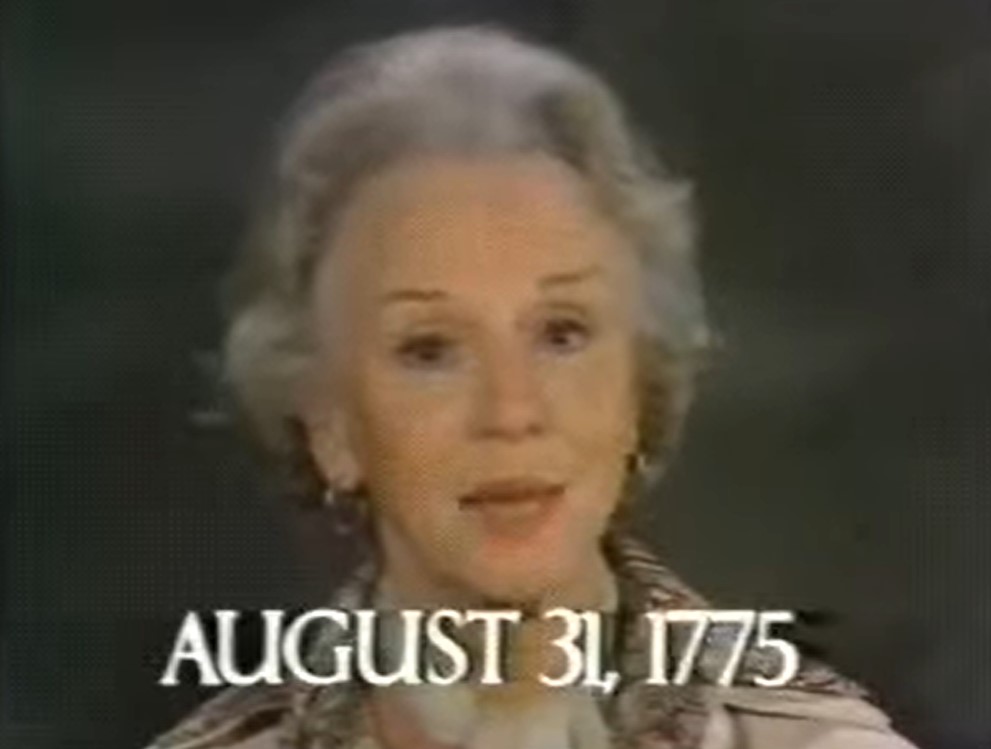
BOOTLEG FILES 942: “Bicentennial Minutes” (1974-76 daily series of one-minute educational shorts).
LAST SEEN: Some episodes are on YouTube.
AMERICAN HOME VIDEO: None.
REASON FOR BOOTLEG STATUS: No perceived reissue value.
CHANCES OF SEEING A COMMERCIAL DVD RELEASE: None.
Have you noticed there is a considerable lack of enthusiasm for the current America 250 celebrations? I can recall a very different environment when the nation was celebrating its 200th birthday. Fifty years ago, there was an unusual but jolly series of one-minute episodes broadcast daily in prime time on CBS that recalled the incidents, issues, and personalities that shaped the American push for independence.
The series was officially titled “Bicentennial Minutes,” although that name did not appear in the episodes. Instead, each episode opened with a title card reading “200 Years Ago Today.”
Every episode opened with a different narrator – usually someone from show business or politics, but occasionally a prominent figure from sports, literature, science or religion. This person would be positioned in a setting that suggested historic importance. After the narrator self-identified, they would intone “200 years ago today” and launch into recalling what happened on that day two centuries earlier.
Not every date cited in these episodes was marked by a historic happening, but the seemingly mundane aspects of colonial social and economic life was interesting – there was even an episode on corn-shucking by colonial farmers. Artwork would be flashed on the screen to visualize what was being described while dramatic music laced its way across the soundtrack.
Each episode closed with the narrator repeating his or her name while adding, “And that’s the way it was” – that end line was a riff on Walter Cronkite’s trademark sign-off “And that’s the way it is.”
As a denouement, there would be a quick marketing flash from the corporate sponsor. Shell Oil Corporation paid for the series from its launch through July 1976 and the folks at Raid bug spray came in to finance the final months.
The beauty of “Bicentennial Minutes” was the consistency – each episode aired at either 8:27 p.m. Eastern or 8:57 p.m. Eastern, seven days a week. The narration was always delivered with a sense of solemnity of the importance of what transpired – there was no jokey shtick, even among the comic actors who appeared on camera.
“Bicentennial Minutes” kicked off on July 4, 1974, which Charlton Heston as the first guest narrator. The original plan was to end the series on July 4, 1976, but “Bicentennial Minutes” was so popular that it ran until New Year’s Eve of that year, with President Gerald Ford as the last narrator. (First Lady Betty Ford was given the honor of the Independence Day episode, while Vice President Nelson Rockefeller was on camera the day before her appearance).
“Bicentennial Minutes” did not dwell on the sociopolitical shortcomings of the colonists – there was no meditation on slavery, the encroachment on indigenous territory or the second-class citizenship of women. Lest we forget, in the mid-1970s America was still reeling from the failure of the Vietnam War and the political paralysis from Watergate. “Bicentennial Minutes” offered a daily vitamin shot of patriotism to remind viewers that Americans had a history of overcoming unenviable challenges with gusto.
As for the narrators, it seemed like a surplus number were actors who starred on CBS programs were recruited for this endeavor, along with some personalities that you don’t expect to see giving American history lessons (including Paul Lynde, Zsa Zsa Gabor, and Kukla, Fran and Ollie). Still, there was plenty of Hollywood royalty willing to volunteer to narrate each episode – Lucille Ball, Bing Crosby, Glenn Ford, Benny Goodman, Olivia de Havilland, Peter Finch, Henry Fonda, Alfred Hitchcock, George Jessel, Deborah Kerr, Paul Newman, Merle Oberon, Christopher Plummer, Otto Preminger, Gena Rowlands, Rosalind Russell, Raquel Welch, Joanne Woodward, and Michael York were among the luminaries who appeared on camera.
Other prominent figures in the “Bicentennial Minutes” spotlight included such diverse figures as Kareem Abdul-Jabar, Edward Albee, Marian Anderson, Isaac Asimov, General Omar Bradley, Jimmy Breslin, James Clavell, Billy Graham, Martha Mitchell, Louise Nevelson, Arnold Palmer, Linus Pauling, Norman Vincent Peale, Sugar Ray Robinson, Vidal Sassoon, Arthur M. Schlesinger Jr., Willie Shoemaker, Mickey Spillane, Gloria Steinem, Gore Vidal, Tennessee Williams, and Capitol Hill leaders such as Representatives Bella Abzug and Shirely Chisholm and Senators Joe Biden, Strom Thurmond, and Walter Mondale.
“Bicentennial Minutes” had its detractors – New York Times television critic John J. O’Connor viewed the early episodes as being “so insubstantial as to be almost meaningless” while the series was lampooned on comedy programs including “The Carol Burnett Show” and “Saturday Night Live.” Even the CBS executives were initially skeptical about devoting time, money and energy into this offbeat idea. But the series also won an Emmy Award in 1976, and people of a certain age who were watching television in the mid-1970s still remember it fondly.
Sadly, only a handful of episodes are available for easy online viewing – the series was never compiled for home entertainment release. CBS still possesses the videos, and earlier this week two episodes featuring Kitty Carlisle and Bert Convy were shared online.
However, most episodes online were preserved by TV viewers who recorded these offerings via the Betamax and VCR machines. Perhaps the best of this surviving bunch can be seen below – it has Jessica Tandy recalling how British soldiers chopped down the Liberty Tree, an arboreal Boston landmark. But Tandy slyly recalls how the tree had its revenge. “One redcoat, hacking away at a high branch, slipped and fell to his death,” she observed. “The Liberty Tree died, but not without a struggle.”
Happy Birthday, America!
IMPORTANT NOTICE: While this weekly column acknowledges the presence of rare film and television productions through the so-called collector-to-collector market, this should not be seen as encouraging or condoning the unauthorized duplication and distribution of copyright-protected material, either through DVDs or Blu-ray discs or through postings on Internet video sites.
Listen to Phil Hall’s award-winning podcast “The Online Movie Show with Phil Hall” on SoundCloud and his radio show “Nutmeg Chatter” on WAPJ-FM in Torrington, Connecticut, with a new episode every Sunday. You can also follow his book reviews at The Epoch Times.
I should mention that Marvel Comics did a three page parody of the series in their satire magazine Crazy #15, January 1976.