
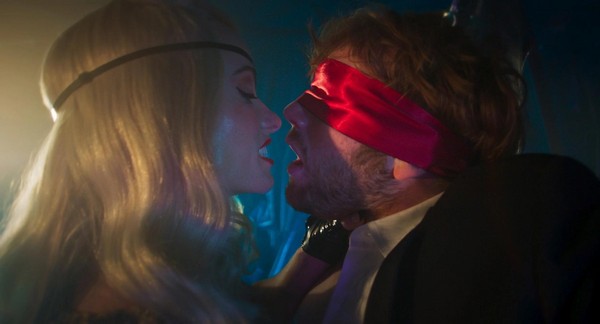
 An anxious young man takes a job for an edgy artist, leading him into a new world of sex and openness in Gregg Araki’s hilarious I Want Your Sex.
Greg Araki is a filmmaker who consistently brings interesting films to the table. How they are received largely depends on viewers’ acceptance of uncomfortable subjects, odd performances, and ways of working with frankness others don’t. With Doom Generation, Splendor, Nowhere, and others, I Want Your Sex may be the most mainstream film; Olivia Wilde and Cooper Hoffman’s incredible performances are leading it up, after all. But that doesn’t mean he’s working any less to push the boundaries of his audience. In I Want Your Sex, Gregg Araki, along with co-writer Karley Sciortino, updates a mixture of Sunset Blvd and 9 ½ Weeks in a discussion of modern sensitivities, hang-ups and generational differences on sexual providication (and more). I Want Your Sex, which played at this year’s SIFF and is now in wide release (I saw it then but had to sit on this review until now), is an incredibly funny film with plenty to say along the way, led by fantastic performances and strong writing.
I Want Your Sex finds a young schlubby man, Elliot Bell, played by Cooper Hoffman, telling his story to a pair of detectives played by a game Johnny Knoxville and Margaret Cho. His employee, a fading provocative artist, an irresistible Olivia Wilde as Erika Tracy, is dead in a swimming pool (reversing Sunset Blvd, but the influence across the film is noted). He’s asked to recall the previous 9 ½ weeks (heh) of working with, being secluded by, and breaking out of his sexual shell with her; getting more and more involved with her world and herself as her life also crumbles. I Want Your Sex is a sex comedy, finding humor in the ribald humor, frank discussion, sexcapades, and almost random and absurd set-ups for the central pair and all around. But it’s not an empty 80s farce for sex jokes’ sake but a cumming-of-age of a different sort.
That life is a wild ride for Elliot, pushed out of his comfort zone. Cooper Hoffman is an incredible young actor. He may have a famous father (Phillip Seymour), but he’s a powerful talent all his own from Licorice Pizza (I didn’t like the movie, but he’s great), to last year’s The Long Walk (with a small role in Saturday Night), and now, he’s getting better and better. He may be the son of Phillip Seymour, but he gives a Tom Hanks everyman pushed into a different place. He stammers, gets caught up in himself, bubbles until he needs to explode with a chaotic energy agains tthe slightly out of phase world around. His Elliot is one of anxious uncertainty, questioning his motions and movements, and what other people want from him and what he wants from himself. He seems to love the control, finding a freedom in domination; and the balance of Elliot and Tracy is a fantastic power shift as the film goes on.
 Opposite to him is Olivia Wilde, continuing her astounding year. I noted in the review for The Invite, which she starred in and directed, that these two performances come very close in time but are very different in performance. Wilde is clearly enjoying playing the wild card as Hooper’s parter and instigator. What’s best in the film is watching her sly smile as she pushes him just a little more. But she’s more than a catalyst or a foil; there’s a fullness to her character even outside of his blind eyes. She might be edging him, but she’s on the edge as her world is shaky. Their relationship is the center of the film in how we treat one another. Who is using who, the blinders we might wear in how it gets ripped off. For Elliot, that big moment that shifts the life is sexual liberation and abuse from his boss Erica Tracy is big, pushy, and particular. Her methods of work and sex, and the mixture, is a delight of a character, but one that has a hidden hurt and worry.
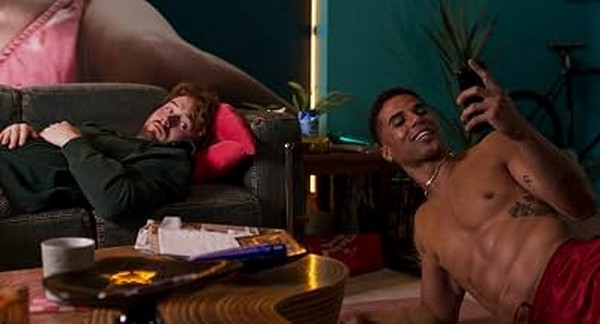
But Hoffman and Wilde aren’t alone in Araki’s BDSM sandbox. It’s the sort of film where every character and the actor behind them makes the movie their own, no matter how large or small their parts are. Memorable bits all around, due to keyed-in choices and strong play-like back-and-forth beats. Charlie XCX’s sardonic and dry marks another notable role for her this year (after Faces of Death, The Moment, and the music of Wuthering Heights) in a scene-stealing bit. Daveed Diggs is delicious as Tracy’s right-hand man, sarcastic and above Bell and his anxiety. Fellow charisma monster Mason Gooding gets the best lines with so many natural asides, so much on the nature of “what is art?” as fellow new hire and work bestie. And let’s not forget Chase Sui Wonders as Apple, Elliot’s roommate. She has a handful of banger scenes. I keep almost saying “steals the film” for each of these folks. And an earned assessment. Unfortunately, some of these characters leave the narrative without feeling like they’re done, leaving a few notes hanging.
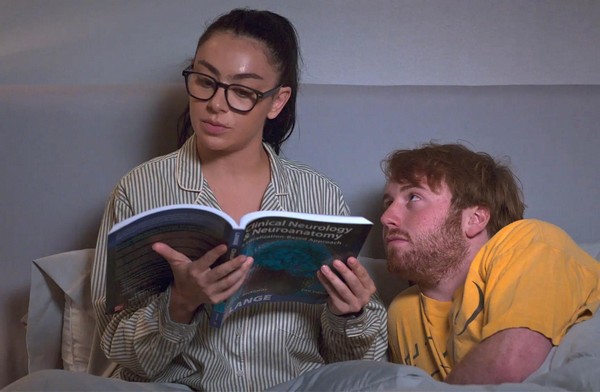
Much of the talk around I Want Your Sex is the push of sexuality within the film, and it is a film filled with sex, getting great humor not only in Hoffman’s reactions and the acts themselves. Weirdly, with so much out there, some of the sharpness of breaking taboos is dulled. This would hit harder in Araki’s prime. Perhaps most shocking is playing in multiplexes, where Terrifier 3 also makes a splash; something unconventional like Obsession and Backrooms have legs. Who would see I Want Your Sex are those who aren’t shocked by it. This ain’t Pink Flamingos.
Despite how enjoyable the majority of the film is, I Want Your Sex fumbles at the end. It comes off too pat, too neat for our leads while leaving a few sideplot threads hanging, just tied up in a very awkward exposition climax, and an atrocious epilogue. However, the final fifteen minutes, as bad a note it ends on, along with the unclosed character moments, the journey to that climax (heh) is more than enough to draw in. Greg Araki’s I Want Your Sex is a hilarious personal journey of sexual and personal liberation with a never-ending parade of great sex and personal jokes and side characters. You want I Want Your Sex.