
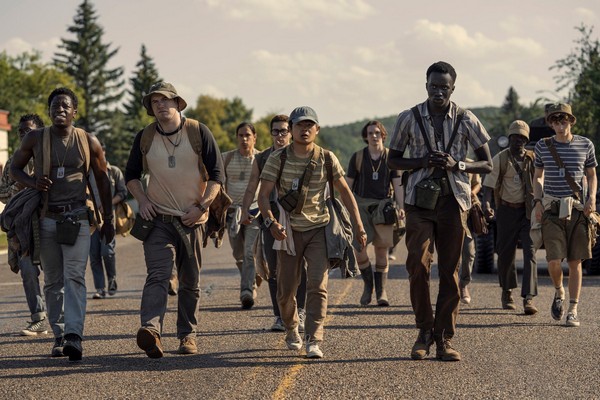
 In a desolate America, a set of boys walk until only one survives in the intense and emotionally devastating The Long Walk, directed by Francis Lawrence, adapted from Stephen King’s novel.
Stephen King’s The Long Walk title matches its journey to the screen. First published under the pseudonym Richard Bachman in 1979, although it was the first novel he wrote, it’s long been thought unfilmable. How can the story only featuring a few dozen teenagers endlessly walking, tailed by the military, and shot if they slow down, sustain tension and story drive for what is essentially a single location (even if it is a few hundred miles long)? Frank Darabont, of several amazing King adaptations, had tried for too many years, picking up from King’s friend and collaborator, George A. Romero. Finally, it’s Francis Lawrence, who helmed the similarly themed Hunger Games series, working from a script by JT Mollner, who finishes the marathon production. The Long Walk is worth the wait. Francis Lawrence’s film is tense and terrifying, but sad and heartbreaking, with amazing character and world-building, an intense exercise.
Lawrence is a fantastic choice to direct. He’s been at the helm of all the Hunger Games movies after the initial installment, balancing the character and world building with the action and tension that comes from fights to the death and characters in hellish situations. It’s especially true in Catching Fire, a film filled with fire and anger, soaking the film with desperation, fight, and righteous indignation. It’s that energy Lawrence brings to The Long Walk, with the help of Strange Darling’s JT Mollner’s script.
It’s a future America, 16 years after a war tore it apart, setting up a fascist regime where free thought, reading, and sharing ideas are forbidden. To push production, every year, a boy is chosen from each state to set out on a trek. They walk and walk and walk. If they go under 3 miles an hour enough times (get some warnings), they are shot. They trudge until one survives. All for the cameras.
 Lawrence gives a beautifully stripped-down film. There is no flash and pizzazz. That’s a good thing. It allows us to focus on the characters and their situation. It’s a telling of strong filmmaking to make a film whose whole visual nature is watching boys walk and keep interesting without being showy. The story and those who populate it are the show. The simplicity creates intensity. And it is an intense and powerful film. The suspense of knowing only one could make it out (per the rules, but rules can break right) hangs, and the harrowing situations and hiccups in the body as it fights back (yes, all your questions about bodily needs are answered) from the never-ending walk make hearts beat loud. The whole is tense, but there are moments of such intensity, I realized I gripped my arm with my hand so hard it went to sleep. It lands that hard. Lawrence keeps it tight, only cutting away from the road twice (the world around the road is empty and desolate, akin to one post The Stand), but it never feels drawn out, keeping the focus.
Strong writing drives the film. King, in his novels, and JT Mollner carrying forward in adaptation, has always been able to draw characters with easy brevity, giving something to hang onto. Even the briefest moment resonates. The majority of the 49, even those only glimpsed for moments, have their time in the sun before the bullet. It’s a tense, terrible situation, and how they react is natural. They make friends, they fight, they squabble, they team up, they help, they hinder, they share their lives, and hold their secrets; they share a dark humor in the fatalism. Not a single one is a carbon copy of the other.
The thing that seeps through the film, elevating the material, is the intense sadness of it all. It’s heartbreaking. The boys’ desperation oozes through the film. Their hurt, their circumstances. We grow to love them and understand them, even the more antagonistic, aren’t hated. We get their anger at the others and why. We understand. We know the true enmity is society. It’s a world where external violence is internalized, represented through this selection of young men; how the world bends the needy in favor of the powerful. It’s a lot to chew on. It’s all emotionally devastating. Powerful.
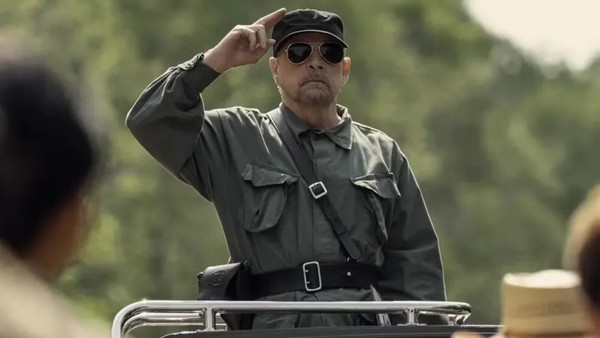
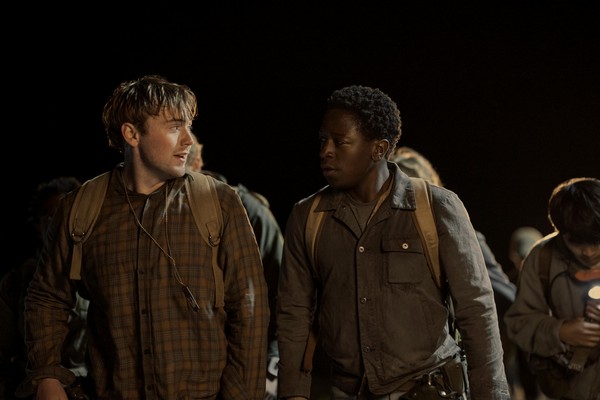 The strong writing is followed by incredibly strong performances. Cooper Hoffman, looking more and more like his Hunger Games star father, leads. He was fine in Licorice Pizza, but here has a true charismatic relatability. But this does give him much more to chew on. The big standout is David Jonsson. Last year, he brought a soul to synthetic Andy in Alien: Romulus, with a commanding name-making performance. He does the same here, carrying so much pain and heart. He and Kaufman are truly amazing together. The remaining boys are all strong, with a standout in Charlie Plummer. They all have incredible chemistry. Mark Hamill, in his second King this year after the very different and just as great Life of Chuck, is terrifying as the face of the military, The Major. Always love to see Judy Greer, if even for only a few minutes.
I’m interested in seeing the response to the heavy social commentary. It’s not subtle or shying away, the boys clearly state in the dialogue and speeches what this all is about, what it needs to say, and how to relate to our world (without ever feeling on-the-nose). Originally an allegory for Vietnam, it’s mutable to current troubles. But people watched The Hunger Games series without letting it sink in, so we’ll see. Interesting to have The Long Walk released very close to Edgar Wright’s The Running Man, another Bachman book filled with social commentary via way of a contest. If anything, it’s a double dose of direct desperation, of people in dire straits trying to survive a world set out to kill them.
The Long Walk is a simple premise delivered flawlessly. It’s lean and tight, an example of character building backed by strong actors. It’s tense, terrifying, heartbreaking, and emotionally devastating. One of the strongest Stephen King adaptations. Francis Lawrence and JT Mollner have pulled a wonder in adapting The Long Walk to the screen.