
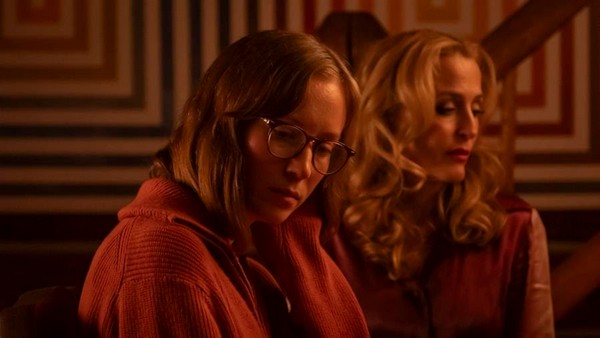
 An up-and-coming queer film director rebooting a problematic camp slasher series meets the final girl from the first film at the filming location, and they embark on a journey of self-discovery. Like I Saw the TV Glow, Jane Schoenbrun’s mind-blowingly fantastic TEENAGE SEX AND DEATH AT CAMP MIASMA is far bigger than the basic description can grasp.
Teenage Sex and Death at Camp Miasma is a hard film to review. Not because it’s middling and difficult to push to a complete length; far from it. No, Camp Miasma (to shorten for sanity) is such a complex film, discussing and debating while invigorating, entertaining, and educating the viewer. It’s a film ready for those debates and discussions of themes and ideas, complex feelings, memories of media, and our connection to it. And I’m here to review it, not slide back to getting my Film and ELA degrees and write an academic article breaking it down in the way writer-director Jane Schoenbrun is absolutely inviting audiences to do. And to review succinctly and wholly is a challenge.
The short version: Teenage Sex and Death and Camp Miasma is an inescapably eccentric and immensely engaging oddity, held up by two astounding performances, guiding the audience through a complex maze of concepts and ideas from an increasingly confident writer-directorin Jane Schoenbrun.
Camp Miasma is an intersection of sex, death (title!), reality, fiction, ourselves, character, art, gender, memory, creation, destruction, and rebirth. No, that’s too much to merely intersect. It collides; a manifesto of a thousand thoughts on anything and everything involving the slasher genre, its conventions, its issues in transphobia and misogyny, the studio system and more. It might sound like a maze to get lost in, but Schoenburn deftly guides the viewer through, refusing to allow anyone to get lost, through the story of an introspective queer film director meeting the eccentric star of the first film in a dead, problematic slasher IP at the abandoned summer camp where the film was shot. Their connection, conversations, and everything that occurs are profoundly accessible even amid all the discussion of the discipline.
 Camp Miasma is in conversation with the subgenre in ways that differ from those of the touchstones Scream, New Nightmare, and fellow camp slasher satire The Final Girls. Those look at the genre by exploring and riffing on tropes and expansions of people aware of such. In Camp Miasma, the characters, specifically Hannah Einhinder’s Kris, are also aware, but from a different angle for this recontextualization. Often more academic, more gendered, and from a wider lens. Schoenbrun approaches the satire in the manner of a panel discussion, an article, or a debate: Men, Women and Chainsaws in visual form. At least until Gillian Anderson’s Billy calls her out of it after a fascinating speech on older, more troublesome intellectual properties and how they can be debated and discussed, and yes, remade and/or sequelized in the modern “woke” era. But all done with a sheer love of the genre, reflective and reflexive (as is horror as a genre, one of the reasons I’m drawn to it) and respectful. There’s no cynicism or sneering here, but celebration of genre, while also conversing with the big picture. These connections of sex and cinema, awakenings, discussions of penetrations and the perversions of genre, and the melding of art, media and life (there’s a specific moment where the camera pulls back just enough, a 4th wall break that is not only brilliantly done but hones in on the statement within) combine with a feverish intent.
It’s a discussion often had in horror circles, at conventions, or in talks at special screenings. At the recent Sleepaway Camp roadshow, the hosts spoke to reclaiming transphobic or the wider LGBTQ-troubled films, as so many were of the era as part of Queer cinema instead of rejecting. Sleepaway Camp and Nightmare on Elm Street Part 2: Freddy’s Revenge are films now embraced and transformed by the community; Psycho continues to be discussed: externally in culture and internally in Camp Miasma. How do we engage with the media, how we discuss and own it, and how perception can shift over time? And what personal connections does one make with such art?
Camp Miasma serves as a spiritual follow-up to I Saw the TV Glow; not a sequel per se, but a continuation of the ideas there: alienation and art, finding missing real connections within media, and the transitions of both gender and life. But it’s not sad in its incompleteness, like Owen’s lack of transition; Camp Miasma is a celebration of the shift in terms. Accepting and positive amongst all the death and tearing down. It’s far more hopeful and open, and actually very funny, not a downer at all. The sexuality, its growth, and understanding within (in many ways, Camp Miasma is a rom-com) center the film and are the heart of Kris’s (and Schoenbrun’s) journey. Across their trilogy of We’re All Going to the World’s Fair, I Saw the TV Glow, and now Camp Miasma is fascinating. The “trilogy” is one of a filmmaker’s growth and the revision and refreshing of the themes that carry through as Schoenbrun grows as a person and comes to understand themselves better. These are all highly personal films.
Jane Schoenbrun takes this wild collection of ideas and brings it to life in front of the camera. I adore the production design. There’s a purposeful artificiality to the Camp setting, with beautiful matte paintings and obvious models. It’s fitting for the film itself, matching mental states and playing into where the film goes. It sets a mood and incredible atmosphere. Production designers Matt Hyland and Brandon Tonner-Connolly build a brilliant, immersive world. This continues into the film-within-a-film and the culture around it. The clips from the fictional Camp Miasma movies endear to the slasher lover in us (although far more directly violent than any Friday the 13th, but gives a truly amazing kill sequence set to a very unexpected song) with wonderful references and throwbacks to F13, Sleepaway Camp, The Burning, and so many others both overtly and subtly, but perhaps best to enter the world is the sheer merchandising perfectly replicated. Such detail and love.
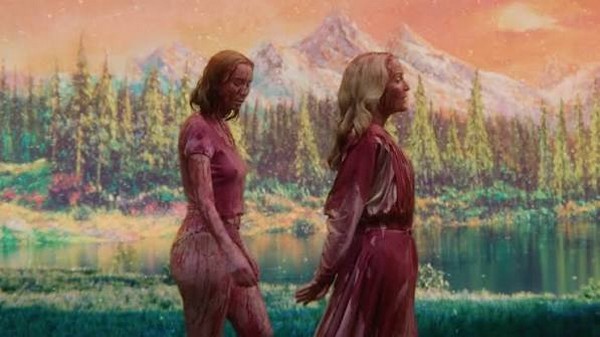 At the center of what is basically a two-hander are Hack’s Hannah Einbinder and The X-Files’s Gillian Anderson. Both are truly astounding, with fully realized, felt characters. Kris’s uncertainty in herself, but disappearing into the work, losing where the line is, and reflecting a feeling of being unable to truly find a self without that last push is encompassing (to catch back to earlier, aspects continue: Owen from TV Glow in the emptiness inside the disconnect in sex and more). Opposite her is Anderson’s Billy, clearly relishing in a role written for her as she’s an actor who was the sexual awakening for a whole generation. As a kinda-Norma Desmond, wherein this aspect is referenced, but also ran with, there’s a delicious, purposely designed campiness, her mesmerizing and unhinged go, ushering the film into the deliriously insane third act. The pair have a perfect chemistry, playing off one another in a beautifully sapphic connection.
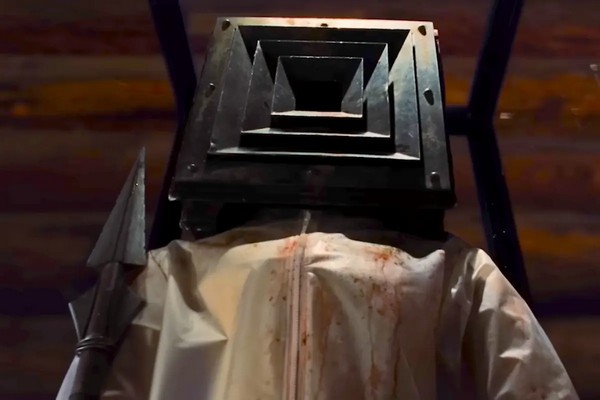
Side characters, often played by a slew of “oh that guy,” make marks for short bits of a scene or two. Eva Victor, who shadowed Schoeburn while they were filming I Saw the TV Glow and used that to make their own indie banger in 2025’s Sorry, Baby, gets big laughs as the requisite punk member of the original film cast. Scream cast are even pulled in, with Kris’s girlfriend played by the new Scream trilogy’s Mindy, Jasmin Savor Brown. Lucky Dylan Baker gets to his bit over Zoom. Always awesome to see Kids in the Hall’s Kevin McDonald, stealing scenes across the film. No spoiler spoiler: stay through the credits for a nice gag with him and Mulholland Drive’s Patrick Fischler, who plays a great Crazy Ralph Harbinger. Always enjoy seeing Sarah Sherman and Zach Cherry. Finally, Jack Haven, previously seen as Maddy in TV Glow, performs the vent-headed (two big things with ceiling vents this summer) Little Death, the centerpiece of the film series and Kris’s obsession. Loved the recursion in the vent design (which also looks like a camera…hmmm), along with, let’s not forget, Little Death is a translation of le petit mort, a French euphemism for orgasm. That is absolutely on purpose.
Each film by writer-director Jane Schoenbrun is a greater accomplishment by a confident filmmaker who tackles complex concepts in interesting ways without getting lost in the mazes of her films. These incredibly personal films resonate with the viewer in both recognizing Schoenbrun’s life and teh audience’s. Teenage Sex and Death at Camp Miasma is a masterpiece of rich complexity, an exploration of self, sex, and death with perfectly designed cultural mishmash.