
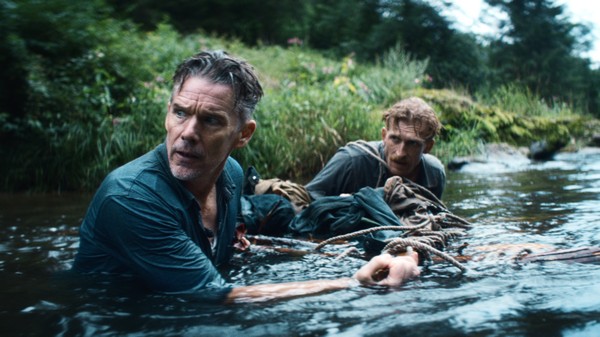
 During the 1930s, a group of prisoners, led by Ethan Hawke, is tasked with a perilous journey across Oregon in the sublimely powerful The Weight, directed by Padaic McKinley.
During the Great Depression of the 1930s, life and livelihood were always on edge; even those with jobs and set-ups were precarious, quickly falling into urgent need and snowballing further. Such is the case for Ethan Hawke’s Samuel Murphy. A mechanic raising his daughter on his own, everything falls apart when he’s evicted from his apartment and, in the search for a new one, ends up in the wrong place at the wrong time. This ends up with him at a prison work camp in the woods and her in a foster home. He forms a kinship, albeit with a lopsided power dynamic, with his work warden, played by Russell Crowe, who enlists him and others on a dangerous mission: move a lot of gold from their camp to another before the federal government takes it all. Maybe a little risky legally and a whole lot of direct risk as they make the journey. In his debut feature film, after an established career in editing and some TV directing, Padaic McKinley shows amazing skill and grace, balancing strong set pieces and character.
The Weight, written by Matthew Booi, Shelby Gaines, and Matthew Chapman, feels its title, both directly, in character, and in audience. The terrible weight of the heavy gold literally weighs upon the people carrying it. But the weight of life may be too much to bear: all the pain and longing they carry in their souls. And McKinley’s film embodies that with a heavy atmosphere of sadness and power within the deep Pacific Northwest woods. True stakes are present and felt, with exhilarating sequences of danger and a depth of true character as the team made up of Hawke, a few hand-chosen convicts, two armed company men, and an indigenous woman escaping from a bad situation makes their way through the danger.
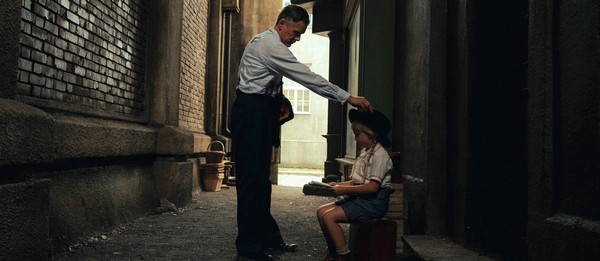 I can’t help but describe The Weight as a combination of William Friedkin’s Wages of Fear remake Sorcerer and last year’s Train Dreams. For the latter, maybe it’s the quiet, deep wood setting, a strange calming under the uncertainty in the lives presented. Of people living out what they need with a deep-rooted sadness and depth: the weight. But also the peril of transporting precious goods over a forbidding and dangerous landscape, filled with natural dangers and people with less internal depth and more “ooh, gold. Me want.” Not to mention the strife and betrayal just a step away in the group itself. Desperate people can have desperate needs. The external and internal meld with a certain something that drives the film’s power.
In the Blue Moon review from last year, I lauded Ethan Hawke’s career renaissance of the last decade, and he continues with a powerfully understated lead performance. Each line on his face reads deep loss and trouble, and his eyes carry a glance that reaches the soul. His Sam Murphy is instantly likable in his world-weariness, and he has amazing chemistry with relative newcomer Avy Berry (only two previous roles, including Quiet Place: Day One) as his daughter. It’s wonderful to find kid actors who can sell it all, and she does with amazing ease. Russell Crowe, who has either shrugged through performances or gone over the top (Pope’s Exorcist!), delivers the grounded work that got him noticed and to fame. Rounding out the team are the lived-in performances of Julia Jones, Austin Amelio, Avi Nash, Lucas Lynggaard Tønnesen, Sam Hazeldine and George Burgess. Excelling in casting across the board.
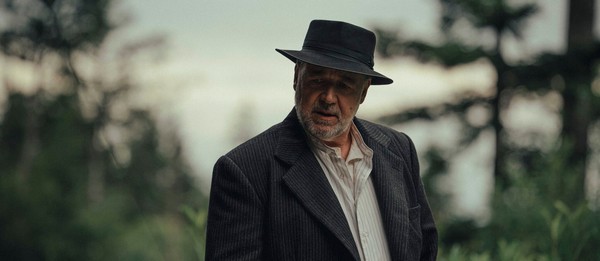 The cinematography makes the journey a character, too. Like Train Dreams, McKinley and cinematographer Matteo Cocco use the Pacific Northwest as the backdrop, though here it’s the forests of Bavaria, Germany. The deep, lush forests are a sight to behold. As the six-day trek continues, landscape wonders such as the pertrifying canyon with the rickety bridge, the raging rivers, and more immerse the viewer. The deep woods, the gorgeous landscape, and the natural features lend a sense of realism; every sound of the woods, every leaf, is beauty and danger; shades of John Boorman’s Deliverance reflect in the picture. Beyond the cinematography, the costuming and overall look add detail and depth. It’s a deeply textured film.
The Weight is the sort of film that may simmer under the radar, but those who do find it (and share it with others) will find a moving, powerful film about pushing through adversity, with strong characters, gorgeous cinematography, and resonating emotional depth. The Weight is the sort of film you don’t often see now. There’s an aspect of old Hollywood- the era, the atmosphere, and the pure filmmaking and adventure of African Queen or Treasure of the Sierra Madre (so John Huston-esque?), but also the 1970s cinematic grit.
The Weight, directed by Patriac McKinley, is a beautiful underdog of a film. The expanse of Oregon, as played by Germany, is a locale of depth and danger, with Ethan Hawke leading a fantastic cat. McKinley puts together a powerfully beautiful film that harkens back to earlier eras of cinema and is plain thrilling. Carry the Weight.