
 A courtesan in Edo Japan tries to break the bonds imposed on her life in the extraordinarily colorful, in look and performance, Sakuran. The 2007 film is on Blu-Ray via 88 Films.
Set in Edo-era Japan, Sakuran, directed by Mika Ninagawa, a long-time photographer in her first feature, follows an oiran (a high-end courtesan), as she tries to make the best she can of the life forced upon her and find her own agency within and without. Based on the manga by Moyoco Anno and adapted by Yuki Tanada, 2007’s Sakuran is a fascinating but flawed film with a commanding lead and a remarkable production value.
Kiyoha (she’s known by various names as she goes up in the ranks, but for continuity, we’ll stick to this one) is born into a life out of her control. Shoved into the employ of a brothel at a young age, first as a young house worker, trained up to the intentions of the home, she’s quite a character to follow. She’s a firebrand, out to be her own person; she won’t put up with it, pushing back and trying in every way to get out. However, her forceful, punk-rock personality and refusal to play along fully end up making her more popular. It’s an odd plurality: finding her own way to take it but still stuck under the thumb of society (but not the extreme lengths of this week’s also release of Cruel Tale of Bushido, but it’s interesting to see both of these films back-to-back) makes her better at it. Sakuran presents quite a lot to explore and debate society within the ins and outs, hypocrites and expectations, how women are treated, and the class structure. One can’t help, at least as one in the English film world, but connect to 2005’s Memoirs of a Geisha, directed by Rob Marshall, a White Western man adapting a novel from a White Western man. Just two years later, Sakuran can feel like an answer to that: the heartwarming tale is soap opera fiction. Of course, a geisha and Oisin are different, but some overlap is present in both worlds
The thing most people will take away from Sakuran, what bleeds through any other thoughts and will remain in the memory: Sakuran is insanely gorgeous. There’s no doubt the director was a photographer in a previous life. The compositions are breathtaking. For the mentions of Memoirs of Geisha above, Sakuran also takes a few notes from Moulin Rouge with the design. It would be easy to use a muted color palette to reflect the endless turmoil and inescapable situations of the women involved, but Ninagawa says “nah, I’m not doing that,” outside of a few moments for effect. In fact, she goes completely in the other direction. The production design is resplendent. Incredibly bright colors, bursting from every single inch of the frame: whether it be the intricately designed sets or the wide outdoors (the flowers and mountains of the final sequences, wow).. All the colors, especially the red, rush from the screen, commanding constant attention and astonishment. Add in the complicated and detailed costuming, and it’s impressive just to look at Sakuran, dampening the compelling story underneath the visuals. Also, similar to Moulin Rouge, a few moments of anachronistic music pop in at key points to make a note.
Anna Tsuchya is the lead as Kiyoha, who we follow as she moves up the ranks within, working within the station of life, bettering her life as best she can, crashing against the walls in an attempt to escape and grab her own agency. She’s astounding, commanding the screen with a punk-rock energy, fitting as she was a rock star herself. Her agency is the push; how can one find the agency in this situation? There’s an astounding life in her performance. I’m not one to lean on looks in review, but she has a sort of otherworldly beauty. Of course, she’s meant to stand out, take the attention, be a bigger figure than the women around her. She does, and how.
However, Sakuran, while interesting with a great lead and look, doesn’t fully come together. Parts are very repetitive as there’s only so much fight we can watch in bouncing against the walls of society. It’s important to keep it up, but as a film viewer its a little tiring, treading water for a bit with nearly two hours of run time. It never escapes its own boundaries. Like the referenced films above, it sometimes becomes style over substance, often wondering what the point of a sequence would be if it looks great. Sakuran does have much to say, but feels like a deeper movie is close. Does the Marie Antoinene like excess soften the message?
A few nitpicks aside, Mika Ninagawa’s Sakuran is an interesting character and period piece (although a bigger-than-life version; we’re not looking for historical accuracy, the story is more important). Based on the manga by Moyocca Anna, it’s a truly gorgeous spectacle of saturation and style, led by a great performance by Anna Tsuchiya.
The Packaging
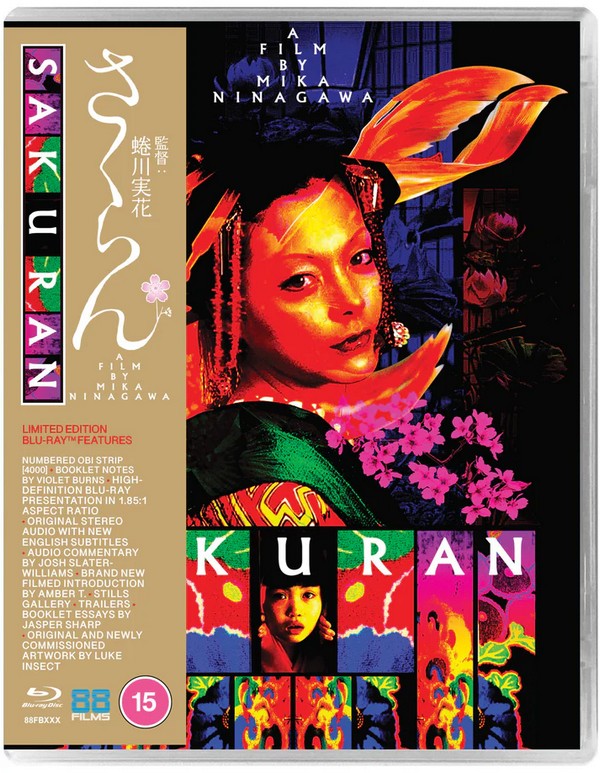
88 Films presses Sakuran in a fitting, colorful package. The single-disc Blu-ray shares the interior with a booklet. The clear Blu-ray case has a two-sided sleeve, each side offering a variety of visual styles, with original art and new art from Luke Insect.
88 Films pulls from Radiance in the style of packaging, including a removable OBI strip containing the film information, keeping the main sleeve clean. The set is limited to 4000 units.
The Presentation
As fitting with the highly designed and color-saturated look of the film, the transfer is utterly gorgeous. It’s one to show off with all the colors bright and popping. With so much red, it’s impressive that there is no bleed or detail loss, as can happen with bright reds. Astonishing. The sound options are Original 5.1 and stereo, both in Japanese with new English subtitles. 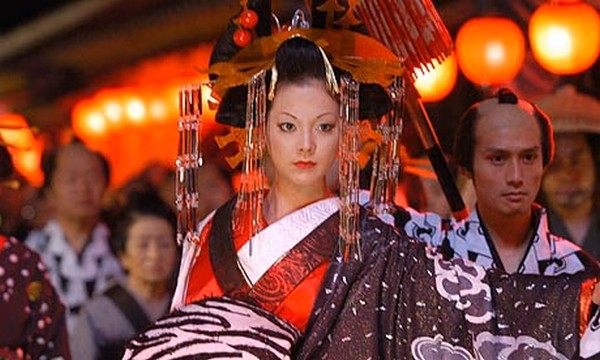
The Features
Commentary
Josh Slater-Williams gives a great, wide-ranging commentary on the history of the manga, the comparisons I also made above, the ins and outs of making the film, and the historical context. Falls off a bit towards the end (as noted, it’s a little longer than it has content for), but good stuff.
Introduction by Amber T.
Not really an introduction, but full out special feature exploring the film in detail. I wouldn’t watch it before the movie. Amber T expands on Slater-Williams in the specifics of the world presented and how it’s adapted, designed and used. (22m)
Stills Gallery
Trailer
Booklet
A 22-page stapled booklet. Disruption in the Floating World: Neo-Japonisme In Mika Ninagawa’s Sakuran” by Jasper Sharp is a wide-ranging essay of the history and art of the world depicted in the film and of Japan, specifically of the Yoshiwara red-light districts.
Final Thoughts
Sakuran, now on Blu-Ray by 88 films is a unique, colorful film. It’s fascinating. The new release is gorgeous, with a small amount but insightful features.