
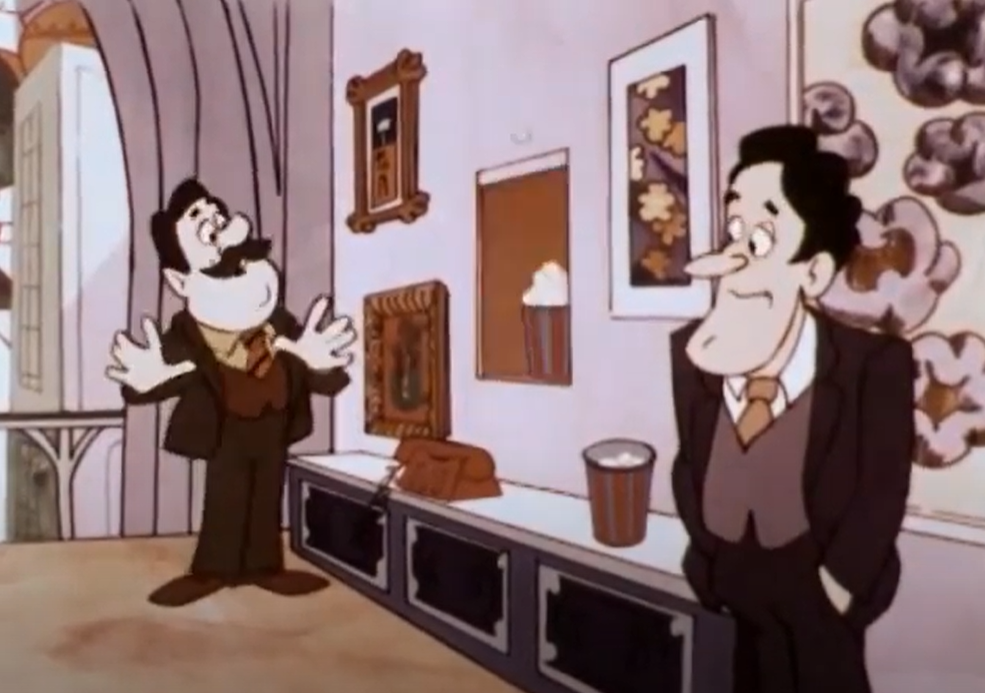
BOOTLEG FILES 764: “Popcorn” (1974 animated short by Hanna-Barbera on behalf of the U.S. Air Force Reserve).
LAST SEEN: On YouTube.
AMERICAN HOME VIDEO: None.
REASON FOR BOOTLEG STATUS: Fell through the proverbial cracks.
CHANCES OF SEEING A COMMERCIAL DVD RELEASE: Not likely.
During the 1960s and 1970s, the Hanna-Barbera animation studio supplemented its television and film production output with contracted work on behalf of government agencies and nonprofits. One of the strangest of these works was “Popcorn,” made in 1974 on behalf of the U.S. Air Force Reserve.
Now, why would a promotional film for the U.S. Air Force reserve be named “Popcorn”? Well, it is because the film takes place in a popcorn factory and the chart-topping instrumental tune “Popcorn” by Hot Butter is part of the soundtrack. Of course, this leads to the next obvious question: where is the connection between popcorn and the U.S. Air Force Reserve? That is where things become a bit sticky.
“Popcorn” opens in the office of Mr. Popper, the chief executive of Popcorn, a manufacturer of (what else?) popcorn. Mr. Popper is meeting with Arthur, a new plant manager. Arthur mentions he is a member of the Air Force Reserve and Mr. Popper exclaims, “The Air Force Reserve? Fantastic! We have quite a few Air Force Reservists working at Popcorn.”
Mr. Popper adds that Joe Mechanic, who is working in Arthur’s division, is one of the top master sergeants in the reserve. He adds Joe is leaving for a few weeks of reservist trading, and offers to take Arthur to meet him.
On their journey to Joe, Mr. Popper mentions that Joe was part of the reservist mission to help the Navajo Indians when their reservation was paralyzed by snow – and he adds that the Indians were the first ones to use corn.
“The Air Force Reserve is always doing things like that,” Mr. Popper continues. “Like building playgrounds. Working with Boys Scouts, the Civil Air Patrol, helping kids keep out of trouble.” Arthur feebly interjects that he is aware of the reserve’s duty because he is a member, but Mr. Popper bulldozes ahead by noting their efforts of giving medical care in poor areas and how the reserve would be the first to defend the U.S. against “some country that’s stupid enough to attack the United States.”
Mr. Popper then recalls when the company’s butter machine overflowed and nearly drowned the facility, but he credits Joe’s Air Force Reserve training for saving the day by fixing the machine and reconfiguring the machine to prevent a repeat of that chaos.
Mr. Popper finally introduces Arthur to Joe, but Joe barely gets a word in except to say thanks to his employer. Mr. Popper then claims his father was one of the first company executives to back the reserve. “My dad always said that what’s good for the Air Force Reserve is good for America. And what’s good for America is good Popcorn.”
Mr. Popper then announces he is leaving for a convention, and says Arthur can use his office during his absence. But he leaves with a caveat, asking Arthur not to open a door in the corner of office. Arthur contemplates the request and decides to see what is behind the door. And … uh, I am not going to spoil the surprise ending.
From a visual standpoint, the weirdness of “Popcorn” is that there is no illustration of anything that the Air Force Reserve does. The entire animated short is a tour of a gigantic popcorn manufacturing operation, with Mr. Popper and Arthur walking through various parts of the facility and pausing to taste the popcorn being produced. There is a brief look at the old-school secretarial pool, which is all-female – but, as a mid-70s cartoon, it is a racially integrated setting.
Despite an amusing voice performance by Keenan Wynn as a boisterous Mr. Popper, “Popcorn” is ultimately bogged down in its verbosity by the endless talk about the Air Force Reserve; one could easily listen to the film without looking at the screen to get the message. Ross Martin is credited as the voice of Arthur, but he barely has anything of value to contribute.
Details on the release of “Popcorn” are hard to pin down. Considering the film focuses on a corporate leader’s eager support for the reservists’ work, one could theorize it was distributed in the non-theatrical market to corporations. This was back in the days before VHS video, so any company that would want this might either rent or buy a 16mm print – and one has to assume the film created a widespread “Huh?” response to whomever watched it.
“Popcorn” was submitted for the Academy Award for Best Animated Short Subject. But even in the decade that good taste forgot, the film wasn’t considered worthy for an Oscar nomination.
How long “Popcorn” was in circulation is anyone’s guess. It has not been made available for home entertainment release – the music clearance rights to the Hot Butter recording of “Popcorn” would probably be an obstacle – but a private collector has a print available on YouTube in an unlisted posting.
Hanna-Barbera completists might be interested in seeing “Popcorn,” but for most viewers the film is a dull and forgettable curio.
IMPORTANT NOTICE: While this weekly column acknowledges the presence of rare film and television productions through the so-called collector-to-collector market, this should not be seen as encouraging or condoning the unauthorized duplication and distribution of copyright-protected material, either through DVDs or Blu-ray discs or through postings on Internet video sites.
Listen to the award-winning podcast “The Online Movie Show with Phil Hall” on SoundCloud, with new episodes every Monday.