
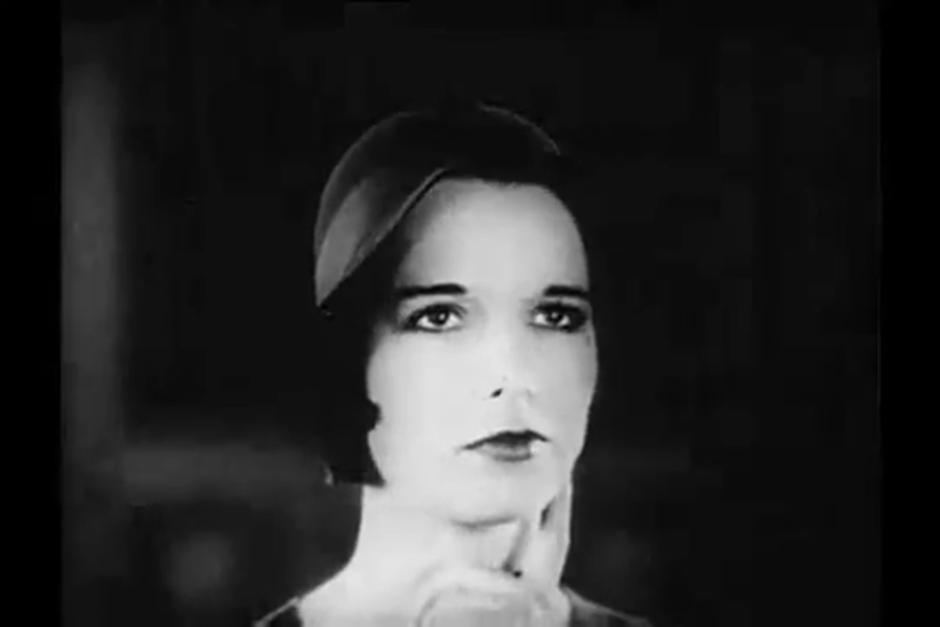
BOOTLEG FILES 820: “Windy Riley Goes Hollywood” (1931 short starring Louise Brooks and directed by Roscoe “Fatty” Arbuckle under a pseudonym).
LAST SEEN: On YouTube.
AMERICAN HOME VIDEO: On public domain labels and as a special feature on a Kino Lorber Blu-ray offering.
REASON FOR BOOTLEG STATUS: A lapsed copyright enables endless dupes.
CHANCES OF SEEING A COMMERCIAL DVD RELEASE: It was already on a commercial label, but the public domain dupes never stopped.
The 1931 Educational Pictures short “Windy Riley Goes Hollywood” is not remembered today for its content – which, quite frankly, is terrible – but as a low point in the creative lives of two iconic talents of the silent screen who came into the talkie era with their respective careers in shambles.
The film’s direction is credited to William Goodrich, which was the pseudonym for Roscoe “Fatty” Arbuckle, the comic actor/director whose life was ruined by one the most horrendous miscarriages of justice of the 20th century. (And if you don’t what I’m referring to, make a note to yourself to read up on the Arbuckle trials after finishing this column – the story is too complex to recall here.) While blacklisted from appearing on camera, the friends of Arbuckle enabled him to continue working behind the camera – but he could not use his name on the screen credits and, thus, was forced to hide behind the William Goodrich moniker.
The other talent who made an unfortunate stop in this dismal little film is Louise Brooks, who was a fast-rising star in the mid-1920s before she abruptly left Hollywood to make films in Europe. By the time she returned to America in 1930, the Hollywood studios had lost interest in her and she could only obtain a few supporting roles in minor films. For someone who had been the toast of Hollywood, Berlin and Paris a few years before, Brooks hit a nadir by showing up in a crummy two-reeler for the low-rent Educational Pictures studio.
Windy Riley was a comic strip character that was semi-popular in the 1920s and early 1930s – he was a cigar chomping fool whose sense of self-importance was out of touch with his intellectual shortcomings. For this screen adaptation, Educational recruited Jack Shutta, a vaudeville comedian who was new to films, to play the character.
The only reason Windy Riles goes to Hollywood is due to a mistake – the character is in a New York to San Francisco auto race but takes a wrong turn in California and winds up in the movie capital. As soon as he arrives in the city, his car is repossessed – but the repo man gets into a fender-bender with the head of a movie studio and quickly blames Windy, even though he wasn’t driving the car at the time. Nonetheless, the studio chief decides to make Windy work for him in order to pay for the damage to his car – and Windy gets assigned to the studio’s publicity department.
The studio has a problem with its leading lady, Betty Grey (played by Louise Brooks), who keeps getting bad publicity. The arrogant but dumb Windy is unaware of this problem and unilaterally hatches a publicity scheme tied to Betty’s new movie, “The Boxcar Mystery” – he kidnaps and ties up the film’s director and hides him in a boxcar in a nearby railroad depot. But when a reporter finds out the director is missing and threatens to implicate Betty in his disappearance, Windy races to retrieve the abducted director.
“Windy Riley Goes Hollywood” is one of the slovenliest paced comedy shorts imaginable. Even by the admittedly stiff filmmaking styles of the early talkies, this film’s lethargy is grueling – there isn’t any reason to laugh at the tired, dull and contrived situations forced on the screen. Louise Brooks would later recall that Roscoe Arbuckle’s heart and soul were nowhere to be found in the film’s creation.
“He made no attempt to direct this picture at all,” Brooks said. “He just sat silently all through the three days of filming in his director’s chair like a dead man.”
Brooks dismissed the short as a “broken down picture,” but she made no effort to invigorate the proceedings. Her performance is flat and stale, and outside of a very brief dance number she seemed bored by her surroundings. Granted, she didn’t have any funny lines and had to play the straight role to Jack Shutta’s obnoxiously overbearing attempts at being funny, but whatever star power she displayed in the silent movies was nowhere to be seen here.
According to the Louise Brooks Society website, “Windy Riley Goes Hollywood” was given a relatively scant theatrical release in 1931, although it had more visibility later when it was offered as 16mm Filmsound rental by the Bell and Howell Company for the home movie market. It also was the first Louise Brooks film shown on television, turning up on November 18, 1948, on WJZ-TV in Asbury Park, New Jersey.
In retrospect, the film was a turning point for Arbuckle, Shutta and Brooks. One year after making this film, Warner Bros. broke the blacklisting of Arbuckle and cast him in a few short films. The popularity of these works encouraged the studio to plan a feature film for him, but tragically he died of a heart attack in 1933 on the day he signed the Warner Bros. contract to make his return to features.
Shutta’s film career continued in supporting parts in a few short films and uncredited bit parts in features – his cinematic output was a classic case of starting with a starring role and then working one’s way down the ladder. Brooks never regained her footing in Hollywood, with a few bit parts and the female lead in the 1938 low-budget John Wayne Western “Overland Stage Raiders.” She left Hollywood and went through a series of jobs, including work as a call girl, and was mostly forgotten until European film scholars rediscovered her work – she spent her latter years writing about her Hollywood experiences and has been belatedly hailed as one of the great stars of the silent era.
As with the bulk of the Educational Pictures releases, “Windy Riley Goes Hollywood” had a lapsed copyright and has been in the public domain for years. The film did have a commercial Blu-ray release via Kino Lorber’s 2015 offering of Brooks’ German-made “Diary of a Lost Girl,” but it was badly placed as a special feature in this presentation of G.W. Pabst’s artistic masterwork – it was startling to see Brooks’ career collapse from Pabst’s stunning master work to the dismal two-reeler made only two years afterwards. Poor copies of the film have popped up on public domain labels – these seem to be sourced from the 16mm prints made for the home movie market – and those awful prints have been the subject of multiple postings on YouTube.
“Windy Riley Goes Hollywood” is a sad little blot that overlapped the body of two great stars. Except for those who have a morbid curiosity on how low someone’s career can fall, there is no reason to seek it out.
IMPORTANT NOTICE: While this weekly column acknowledges the presence of rare film and television productions through the so-called collector-to-collector market, this should not be seen as encouraging or condoning the unauthorized duplication and distribution of copyright-protected material, either through DVDs or Blu-ray discs or through postings on Internet video sites.
Listen to Phil Hall’s award-winning podcast “The Online Movie Show with Phil Hall” on SoundCloud and his radio show “Nutmeg Chatter” on WAPJ-FM in Torrington, Connecticut, every Sunday. His new book “100 Years of Wall Street Crooks” is now in release through Bicep Books.