

A recent widow, along with her two children, is struggling physically, emotionally, and financially. Things get worse when the titular supernatural figure descends upon their home.
Trigger Warning: Depression, suicidality
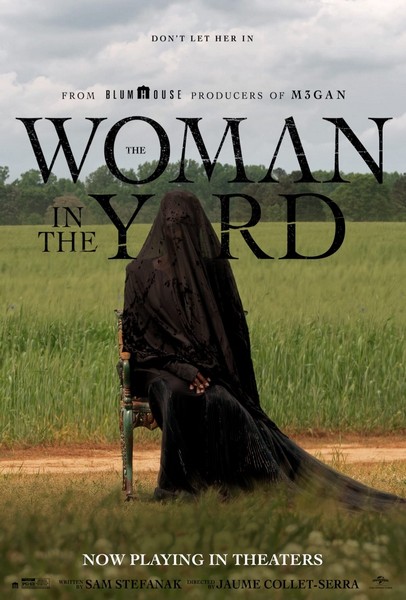
It’s been eight weeks since a car accident widowed Ramona, broke her leg, and sent her into a spiral of depression. Things aren’t great in the half-remodeled, isolated farmhouse she shares with her teenage son Taylor and young daughter Annie; the power is turned off, their phones are dead, their car won’t start, and a mysterious woman in black is sitting in their front yard. She’s a menacing figure, draped in funeral clothes, hands covered in blood, and claiming she’s been asked to come for “today’s the day.”
For most of the run time, The Woman in the Yard is a small, intimate (only 5 characters), often effective piece, one where spirited direction does its best to push past script issues, until it falls apart in the final twenty minutes.
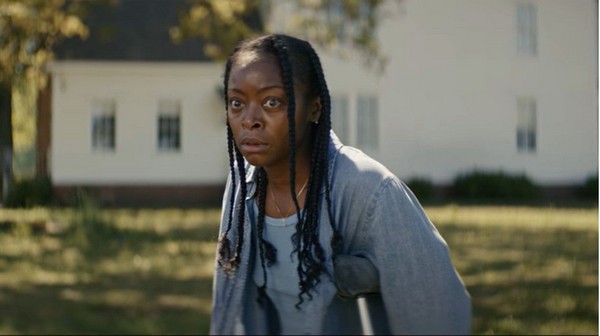
The family’s situation naturally evokes sympathy, and good casting makes them believable, especially when Sam Stefanak’s script slides into silly platitudes, mixed messages, and odd lines. Danielle Deadwyler uses her expressive face to sell everything Ramona is working through. Payton Jackson plays the exasperated, put-upon older child well; one who is used to dealing with his parents’ fights and being the rock for the younger sister. Estella Kahiha isn’t given much to work with as the innocent Annie, more of a pawn in the proceedings of the older character, but she’s also a new actress in her single digits of age; she gets a pass. Okwui Okpokwasili is suitably creepy as the titular woman, exuding unease even if sitting in place, graveling through lines while her unseen eyes glare through her shroud.
Director Jaume Collet-Sera has thrived when working with small casts and locations, creating a sense of tension from limited environments, especially with “Blake Lively vs a Shark” in The Shallows, or the family dynamic of the first Orphan film. Heck, I even really enjoy his remake of Tourist Trap, 2005’s House of Wax. In larger studio films, such as a bunch of the yearly “Liam Neeson Has a Special Set of Skills” movies or Jungle Cruise, he’s made fun thrill rides. I don’t blame him for Black Adam; no one could save that from The Rock’s ego.
Returning to more constrained ventures of a single location, Collet-Sera creates the tension in interesting camera set-ups, movements, and edits. There is a control of the visual narrative, keeping the audience on their toes and invested. This is especially true in the ability to mine a discomfort from a still shot of an unmoving woman in a wide open yard (heightening how isolated the trio is in their farmhouse). There’s a strength as the Woman edges closer, blood spills, and the situation inside the house becomes more fraught emotionally and mentally. There’s a nice shadow use, akin to the recent Nosferatu I loved. All based in the camera and Collet-Sera’s skills.
The issue with The Woman in the Yard stems completely from the script. I get what Stefanak is trying to say. There’s a better movie within as a vehicle for it. It was called the Babadook. Jennifer Kent’s now classic covered almost exactly the same ground with terrifying excellence just over a decade ago (cue someone complaining about the kid here). Of course, multiple films can talk of the same things: depression, held-in negative feelings, and loss, all rendered in a supernatural manner; but when it comes so close, the comparison is apt. But Stefanak’s script is so messy in how it works the message, it begs for another draft or two to work the messages (it’s all a big metaphor) into shape.
For this, it absolutely falls apart in the back portion. While I rarely get into the third act of a film, especially not to give any spoilers (it has happened for good reason), to properly discuss The Woman in the Yard, I need to speak about it. Of course, I won’t go into details.
Similar to January’s The Damned, the good will of the set-up is dissipated with a bad third act. The Damned was a disappointment in the end, but The Woman in the Yard is a terrible mess. After the good enough, but a little light and stretched first two acts, the shift of the final pushes derail it wholly. It starts with a jarring alteration in merely how it’s shot, suddenly jumping into a sequence that feels like a producer’s note come to life, with missing information that made me think I nodded off for a minute. But once past the “wake up the teens” minute, the film hones in on The Message.
And it does so with such a tone-deaf and infuriatingly tactless manner. There’s a fine line to presenting bleak situations and mindsets. A piece of media can present darkness and characters’ wants and choices as the narrative, but also inform the audience to take away the opposite. It’s done in most narratives, the nature of storytelling. But The Woman in the Yard can’t walk that tightrope. For the sake of spoilers, I won’t go any further, but it has to be said. If the places depression can take someone are a trigger for you, this film will make you angry with how it’s presented: ambiguous at best, “they didn’t just say what I think they did” at worst.
The Woman in the Yard has a decent start and awful finish, with director Collet-Serra and game actress trying to elevate an underwhelming script.