
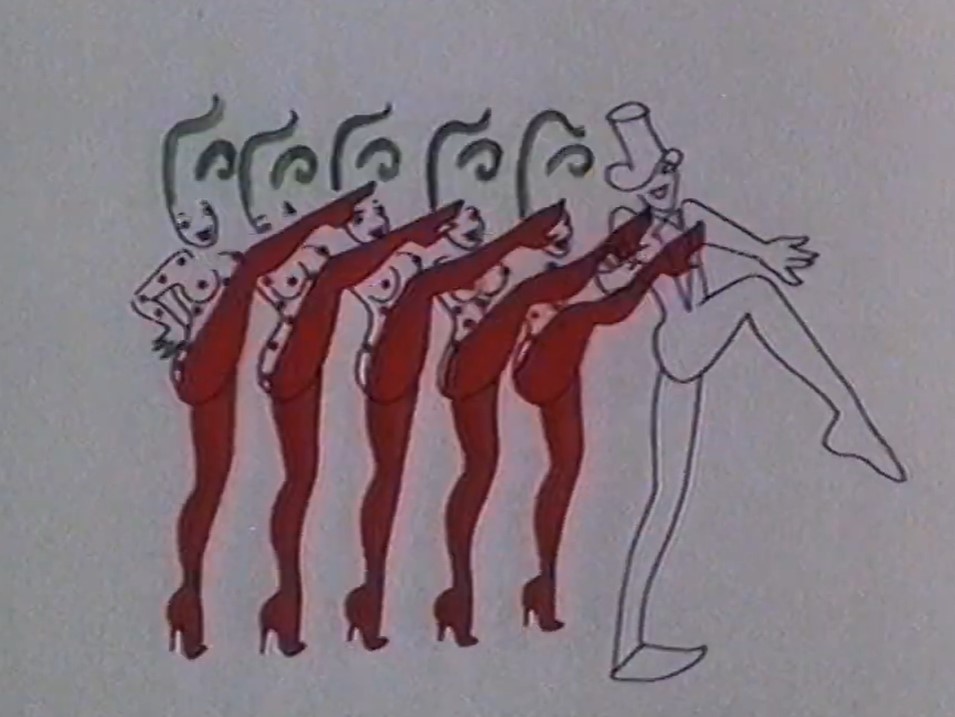
BOOTLEG FILES 939: “Putting on the Ritz” (1974 animated short by Antoinette Starkiewicz).
LAST SEEN: On YouTube.
AMERICAN HOME VIDEO: None.
REASON FOR BOOTLEG STATUS: It fell through the cracks.
CHANCES OF SEEING A COMMERCIAL DVD RELEASE: Perhaps as part of a collection of the filmmaker’s work.
Earlier this week, I did an essay on “International Animation Festival,” a PBS series that aired in the mid-1970s. That series, which was hosted by British actress Jean Marsh, introduced viewers to rarely-seen animated shorts from European, Canadian, and independent American animators.
Sadly, it appears that the series is now lost, KQED, the San Francisco PBS station that produced the episodes, no longer has any copies, and only one episode taped on a Betamax machine by a viewer has surfaced online. Still, many of the shorts made a significant impression on the elementary school version of me who watched the series when it was broadcast, and I can still recall many of the animated shorts even though I’ve not seen them (nor thought about them) for a half-century.
One of the shorts that made a great impression on me was a stylish interpretation of the Irving Berlin tune “Putting on the Ritz.” To my happy surprise, there are several unauthorized uploads of this work on YouTube. And while researching the film’s backstory, I learned about a remarkable filmmaker whose work is mostly unknown in the United States.
Antoinette Starkiewicz was born in Poland in 1949 to a Jewish family that was eager to leave the then-Communist nation. She arrived with her parents and older brother to Australia in 1960, not understanding a word of English. She quickly absorbed the language and by the end of the decade studying fine arts at the National Gallery of Victoria Art School.
Starkiewicz decided to pursue a career in animation. Her first effort, “Secret of Madame X” (1970), was an experimental work funded by the Australian Film Development Corporation. Based on this work, she received an opportunity to study animation at the London Film School. Her first production at the school was “Putting on the Ritz,” which was created in 1974 and screened at the opening night of the 18th London Film Festival.
“Putting on the Ritz” took the 1930 recording of the song by Fred Astaire for its soundtrack. This version, which has the title “Puttin’ on the Ritz,” is known as the Harlem version because of Irving Berlin’s references to Manhattan’s celebrated Black neighborhood. However, this version is less familiar today after Berlin rewrote the original lyrics, which included some derogatory references to Black Americans as clumsy parvenus – “Spangled gowns upon the bevy of high browns / From down the levee, all misfits / Puttin’ on the Ritz.”
While Astaire is given acknowledgement on the credits of Starkiewicz’s film, Berlin is not. It would seem the student filmmaker just “borrowed” the song, unaware of the concept of clearing music rights. Hopefully, today’s London Film School is a lot more thorough in teaching its students about intellectual property and copyright protection.
Starkiewicz creates an avant garde vision of a 1930s nightclub floor show in “Putting on the Ritz,” with fanciful depictions of leggy showgirls, one mischievous chorine in a Minnie Mouse-inspired costume, and a male dancer in top hat and a tuxedo tapping away to the Berlin melody. Starkiewicz uses line drawings that are mostly monochromatic, with wild pops of color created jarring effects. She uses blue in the thick tears cried by a figure in the opening sequence and red for the showgirls’ legs. Also given the crimson treatment are the showgirls’ and bare breasted nipples and the lascivious tongue gestures of the male dancer – yes, this is a grown-up cartoon.
Throughout the cartoon, the line drawings merge, vanish, and reappear to present the nightclub performers going through their playful, seductive and acrobatic feats. The film feels like a notebook full of doodles that magically come to life, looping through abstract formations into artistically striking poses.
“Putting on the Ritz” helped launch Starkiewicz into a long and successful career in animation. Her follow-up film “High Fidelity” (1976) was produced by the British Film Institute and played at the Cannes Film Festival. She returned to Australia to create the 1979 “Pussy Pumps Up,” which won the Australian Film Institute Award for Best Short Animation in 1980 and later screened at the Annecy International Animated Film Festival. She was a pioneer Australia’s digital animation output with “Zipper” (1998) and became a well-loved teacher and lecturer. She passed away on New Year’s Day in 2023.
Outside of animation circles, most Americans are unfamiliar with Starkiewicz’s work. A fine copy of “Putting on the Ritz” taken from a broadcast on Britain’s Channel 4 is the best online posting. If you’ve never seen it, check it out and use it as a launching pad for discovering Starkiewicz’s marvelous creations.
IMPORTANT NOTICE: While this weekly column acknowledges the presence of rare film and television productions through the so-called collector-to-collector market, this should not be seen as encouraging or condoning the unauthorized duplication and distribution of copyright-protected material, either through DVDs or Blu-ray discs or through postings on Internet video sites.
Listen to Phil Hall’s award-winning podcast “The Online Movie Show with Phil Hall” on SoundCloud and his radio show “Nutmeg Chatter” on WAPJ-FM in Torrington, Connecticut, with a new episode every Sunday. You can also follow his book reviews at The Epoch Times.