
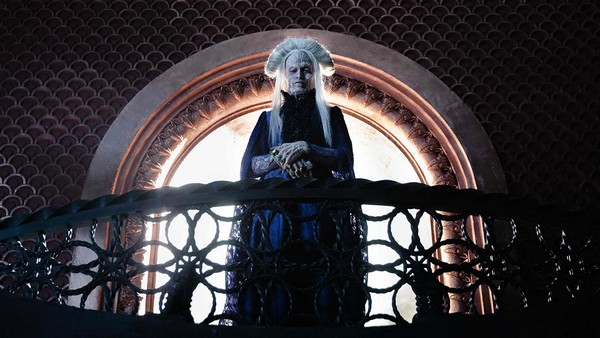
 Dracula searches for his lost love, while a priest seeks to destroy him, in Luc Besson’s romantic take on the Bram Stoker story, Dracula: A Love Tale.
Luc Besson, director of The Fifth Element and Leon: The Professional (and countless others), sinks his teeth into writing and directing a new version of the oft-told Dracula tale. With the subtitle of A Love Tale, Besson shifts Bram Stoker’s narrative into a melancholy romance across time rather than bloodshed and horror, often entrancing with a sense of space and character.
It’s a fine film, but I wish I liked it more. There’s a whole lot to love. The different method of telling the familiar story, the lush and gorgeous set and scenery, and the fantastic but subdued performance by Caleb Landry Jones as the titular vampire. But something comes off flat and disconnected. But I was engaged, liked what I saw overall, and still recommend.
I appreciate Dracula: A Love Story. Besson crafts a thoughtful film, with a slow, beating heart; far more purposely paced than his usually frantic methods, but just as stylish. Of all Draculas that came before, it hews closest to Francis Ford Coppola’s 1992. While I do try to separate adaptations, it’s hard not to connect their shared openings of losing one’s love, renouncing God, and spending hundreds of years looking for her reincarnation. It’s an element not in Bram Stoker’s book, but aspects of it appear across media, but never so much of all the bits lining up as these two versions. The elderly, long-unfed Dracula make-up and hair on Jones is just about the same. Yes, he is an older version of himself in the castle with Harker in the novel, but if you’re going to do that bit of the adaptation, don’t make it look exactly like the other one. But, rest assured, despite these two glaring similarities, which would be weird not to mention, Luc Besson’s Dracula is rather different from Coppola’s.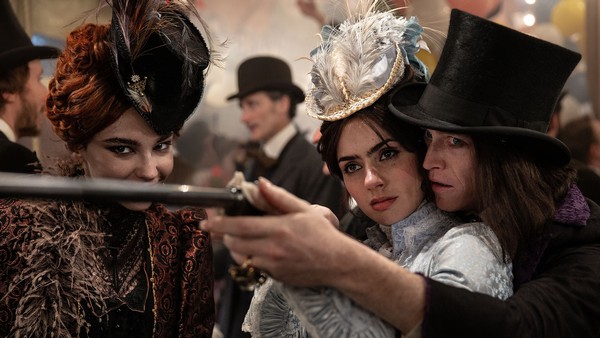
I liked how Besson takes these shifts. Jones’s Dracula is not an evil, vile creature of the night. He’s a man at a loss without his love, angry at his god and the world. Besson flashes back as Dracula travels, looking for his connection, finding his powers, and his vampirism. It’s a shift, with Caleb Landry Jones playing Dracula with a subdued power of sadness and loss; more romantic. I’ve always enjoyed Jones as an actor, including the underappreciated vampire flick Byzantium. He seems like an odd pick for this role, but he matches very well with Besson’s focus on the Count. His obsession and love exude with a look; his readings are wonderfully thoughtful. He’s a great romantic Count Dracula. Rest assured, he does have his wonderful vampire moments. Interest in his power is as often the charm, perfume, and focus. It’s fun watching him getting a turn a convent of Nuns into a scene from Ken Russell’s The Devils. However, when there is more direct vampire action, it’s out of place and odd, particularly in more violent aspects. But he doens’t seem like he enjoys it, giving a different dimension.
With all the extra time spent on Dracula’s backstory, again appreciated and gives a new life to his undeath, the human end is rushed. Thankfully, the fact vampires exist and are known creatures is got out of the way early, with Christoph Waltz, fresh from Frankenstein, now as a Van Helsing-like Priest (unnamed otherwise), immediately recognizing an asylum-captured Maria (this film’s Lucy with some Renfield) as a creature. How Dracula uses her and the other vampires is an interesting change (spoilers if I go further here). Gathering the team, recognizing what’s happening, heading to Transylvania to fight the count and get Mina back is all dashed out quickly in interspersing scenes. It’s almost perfunctory, like Besson knows the story needs the other plot line, but knows we know it already from the countless adaptations over the last 104 years since Nosferatu. He’s far more interested in Dracula and Mina. As played by Zoe Bleu, Mina’s concept for this take is interesting, but sadly, she has little to do but be swept along and look lovingly at Dracula. Though she has a great scene with Maria, played by Matilda De Angelis, as they visit a freakshow, showing a love of the sad and strange, connecting to Dracula. 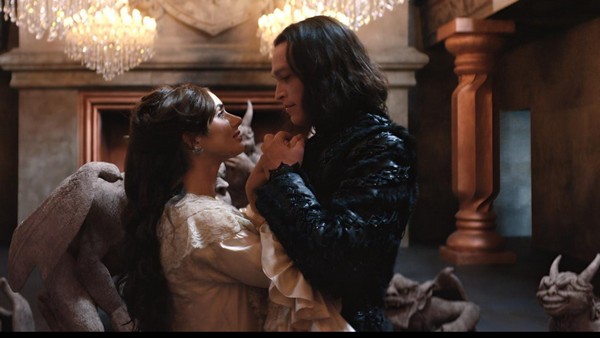
On a technical end, Dracula is gorgeous. Besson and DP Colin Wandersman’s camera work and set-ups are astounding. Sweeping exteriors, with added CGI that, while obviously CG, looks great, and lush, detailed interior sets. I was surprised to learn they were sets, as the incredible churches, castle interiors, and others have an innate beauty of the region’s churches and buildings. I would believe they were in a real castle. Congrats to production designer Hugues Tissandier. But those costumes. Wow. Incredible and intricate, Corinne Bruand’s costuming is exquisite. Especially what Mina/Elizabeth dons throughout. On a final CG note, Dracula has some CG gargoyles as minions; like the exteriors, they are clearly generated, but I loved the look and movement. There was a stone life to them. Though many might find them silly, especially in the strange and out-of-place action-heavy climax. Danny Elfman provides a solid score to connect it all.
With a soulful, romantic performance of the titular character, Caleb Landry Jones makes a great Dracula. Luc Besson’s film is a different, but mostly well-done take, although it stumbles in balancing the story and tone. It has a great look and core. Recommended, even with any issues I had.