
 A princess embarks on an odyssey of revenge for her slain father in Mamoru Hosada’s uneven anime Scarlet.
It’s 1590, Denmark. The child of the King finds their father dead (in this version, they see it happen in a nasty fashion), and their mother remarrying his cruel brother, Claudius This isn’t William Shakespeare’s Hamlet (in the public’s mouths right now thanks to Chloe Zhao’s Hamnet), but Scarlet, the new film from Marai director Mamoru Hosada (also writing), a sweeping animated epic of revenge, albeit one that while gorgeous is a little stagant in story and character.
Despite that similarity in setting and details, Scarlet is no mere Hamlet adaptation. It uses the familiar story and some characters: Claudius, Gertrude, Rosencrantz, and Guildenstern, but leaps into a very different direction. A touchstone, rather than a plot base. However, Scarlet keeps the Shakespeare play’s thoughts of revenge, how it focuses, shifts, and drives us; how we go about it, and the consequences of it.
They say, “When planning vengeance, dig two graves.” Revenge consumes and changes a person, not for the better. But what if you’re already dead? It’s not a spoiler to say Scarlet dies early into the narrative; the film opens with it in media res and follows up on the promise not long later, with Scarlet, voiced by Mana Ashida, promising to avenge her father as she passes into the next life by way of some awesomely animated dead as their hands reach to grab at her. Instead of finding peace in death, Scarlet is now even more determined to take down Claudius. Death won’t be a deterrent. Teaming up with Hijiri, a kindly Japanese medic guy from modern times (this is a land filled with people from across time and the world) she travels across the wasteland to quench her thirst for blood.
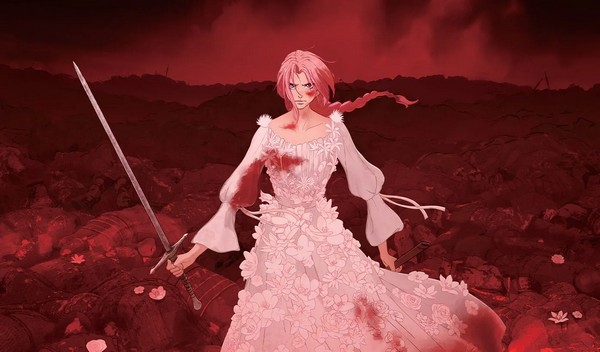 It’s an Otherworld (as called in the film) akin to the void in Loki and Deadpool & Wolverine. Lost souls wandering, making allegiances, fighting, and continuing grudges and angers from their lives. Like they haven’t died at all. Life: the sequel. Oh yes, like Marvel’s otherworld: a giant sky snake shows up occasionally to shock everything and everyone out of their grooves.
Getting caught in those grooves is much of the point of the show. The growth of the characters and their needs is based on loosening the grip of boiling blood and reevaluating our lives, even in death. When we’re focused only outward, whether it be revenge, serving your King’s bloodshed, or just liking a good fight, how does it help you or anyone? Can you find kindness, settling into self-discovery? At just shy of two hours, the odyssey of Scarlet and Hijiri becomes rather repetitive, with never really digging into the surface discussion. In many ways, it’s fluffy and unfocused as they head from group to group, getting closer to Claudius (he’s down here, too) and the army he’s amassed. The various connections of various groups do help bring about her and others’ character arcs, but it is a little tiring to essentially repeat a sequence a few times with a few changing factors.
But even the repetition, Scarlet is a gorgeous tableau to gaze upon. The art and animation by Studio Chizu is astounding, varied, and a visual treat. While often reminiscent of Frank Franzetta’s fantasy art, it shifts based on who we meet and the needs of the story. Never rote, there’s a gorgeous detail in the flowing animation of size and scope. From an unsettling reaching of the dead’s hands at the start of the world, to the massive castle of ruin, it’s impressive again and again. And all different, a grand painted visage in a minute, a rotoscoped dance sequence later. It’s grand and moving, evocative and emotional. I’m curious about the backgrounds: so photorealistic, I’m not sure if they added the art to real photos. I like it. It gives the ethereal, otherworldly feel the right tone.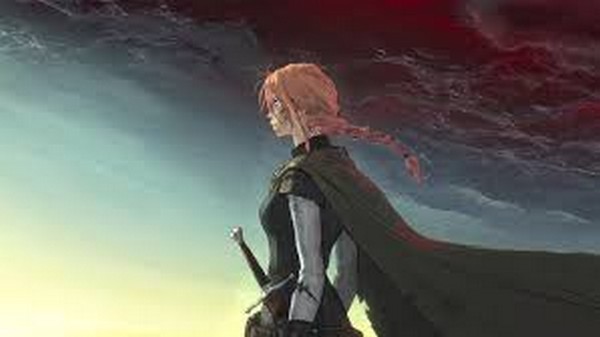 The merging of the story (as it is) and artwork is in sync, baking layers of ambitious narrative and character. The wide range of characters across time brings home ideas of the cycles of violence and vengeance: no matter when or where, revenge and bloodlust drive. Can humanity move forward past these base impulses? The still happening for Hijiri’s time: our own. But, as Hijiri and the film posits, it’s more important to find life and connection. It’s telling the happiest people in the Otherworld are those working as one for the community rather than those holding their grudges. It’s a simple message, one we’ve seen so many times before, and it’s not really explored. Just repeated. The story and gorgeous animation get a little ironed out with this, hobbling Scarlet (the film).
Scarlet, written and directed by Mamoru Hosada, is a vibrant and beautiful revision of Hamlet, albeit one that thinly explores its messages, along with getting caught up in cycles of storytelling. The visuals are worth the big screen adventure. Check out the journey through this underworld.