
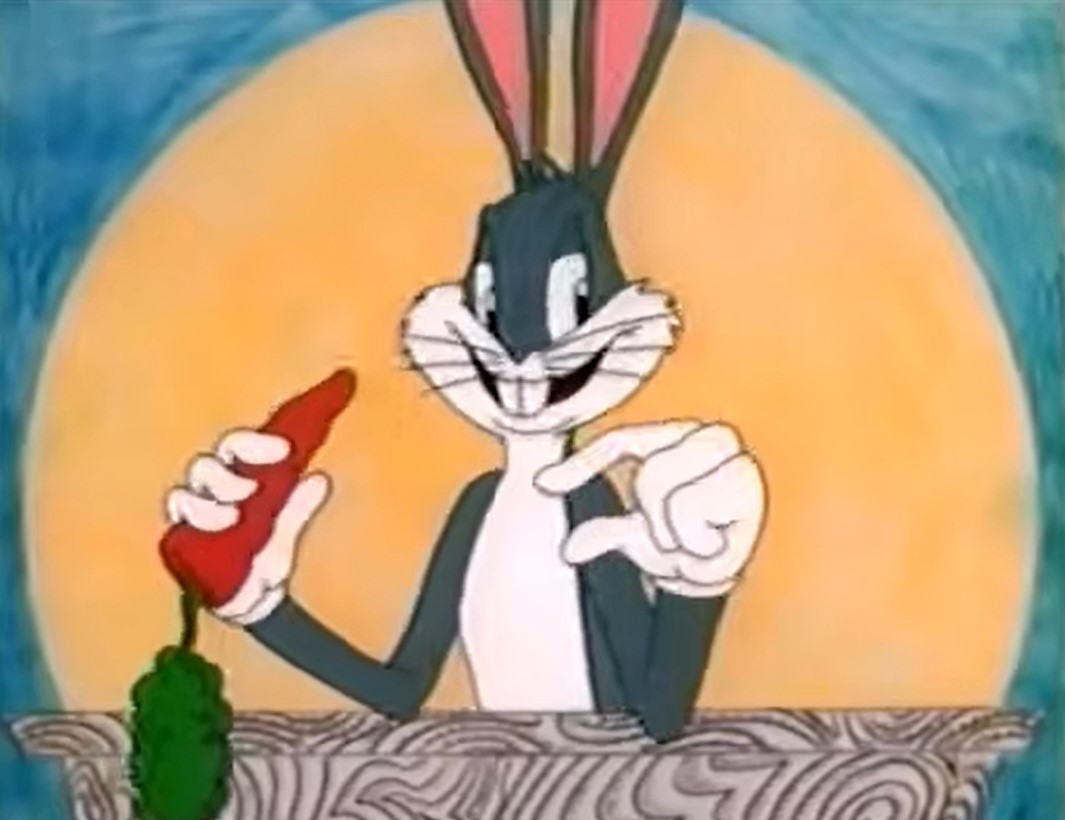
Bugs Bunny’s first theatrical film since “False Hare” in 1964 was “A Political Cartoon,” an independently produced short released in 1974. Filmmakers James K. Morrow and Joe Adamson licensed Bugs Bunny from Warner Bros., while Mark Kausler animated the character to resemble his mid-1940s appearances and Mel Blanc provided his inimitable voice.
“A Political Cartoon” mixes live-action and animation in a tale about two unemployed men – a political consultant and a cartoonist – who meet in a laundromat and hatch a plot to tap into the then-growing public hostility to politicians by having a cartoon character elected to the presidency. Their creation is Peter President, a seemingly non-offensive character who never takes controversial stands. However, when Peter President objects to the actions of the Consolidated Commerce Conglomeration, the company arranges for all India ink to be shipped back to India, thus reducing Peter President to a near-catatonic state.
Although it only runs 22 minutes, “A Political Cartoon” quickly wears out its welcome. It is one joke that gets stretched to the fraying point. However, it had the good fortune to get released in the Watergate period when Americans were actively hating their electing officials. As a result, it was a popular attraction on the film festival circuit for 1974.
As for Bugs Bunny, he’s barely in the film. The character opens “A Political Cartoon” in a pre-credits sequence where he happily tells the audience, “Hi friends, this is Bugs Bunny reminding you that fantasy is everybody’s business.” Bugs then takes on a sad-eyed expression with his ears down while an off-screen voice intones, “Paid for by Suffering Succotash, Washington, D.C.”
Halfway through the film, the film creates a hiccup of a subplot about cartoon characters as an oppressed minority. That cues Bugs to reappear, this time as the subject of a television news segment. He is in a pet store window, with a sign that reads “One Easter Rabbit, 1.98.” An off-screen reporter asks a sleepy Bugs how he feels being put up for sale, and he responds, “How do you feel interviewing a rabbit?”
Between the two brief scenes, Bugs is on screen for less than a minute. Morrow and Adamson originally planned to use Bugs in a spoof of the nursing home scenes with Joseph Cotten’s character in “Citizen Kane,” but Warner Bros. nixed the idea of depicting a geriatric Bugs. Another scene with Bugs painting Easter eggs in a factory setting was rejected by animator Kausler, whose work was later criticized by Chuck Jones and Robert McKimson.
“A Political Cartoon” was not the first time Bugs turned up in a cartoon that was not released by Warner Bros. In 1944, the character had a gag appearance in Paramount’s “Jasper Goes Hunting” and cameos in the Private Snafu cartoons “Gas” and “Three Brothers” that were produced and distributed by the U.S. Army for viewing by the World War II-era troops.