
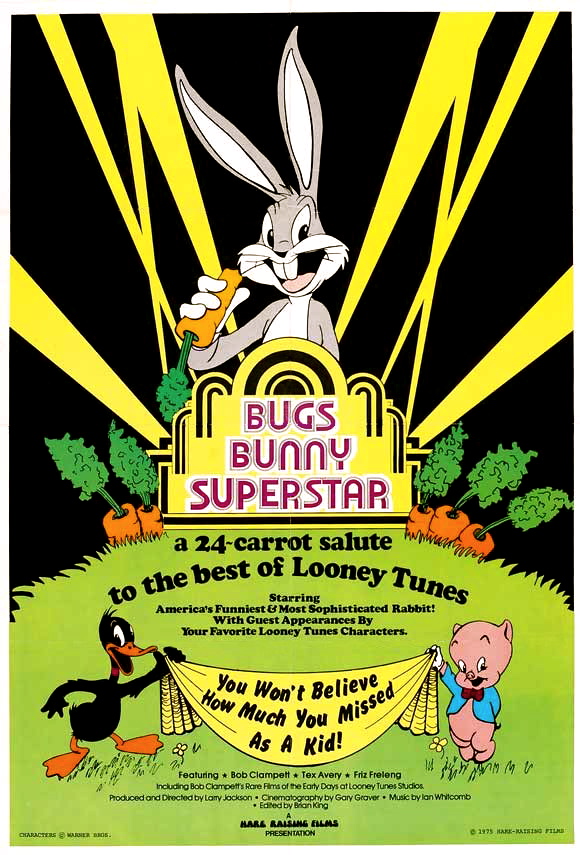
In December 1975, the feature-length documentary “Bugs Bunny Superstar” had its theatrical premiere. The film was conceived as a behind-the-scenes look at the rise of the Warner Bros. animation unit that was informally known as Termite Terrace. But “Bugs Bunny Superstar” was not a Warner Bros. production. Instead, it was independently produced by first-time filmmaker Larry Jackson through his Hare-Raising Films company and released by United Artists.
Jackson was able to license 10 Warner Bros. animated cartoons from United Artists, which controlled the rights to the pre-1948 shorts after the company acquired Associated Artists Productions, a television syndicator that acquired the films from Warner Bros. in 1956. Jackson attempted to license the shorts that were still owned by Warner Bros., but the studio declined to participate in the film.
Several other individuals involved in the Warner Bros. cartoons also declined Jackson’s invitation to be part of “Bugs Bunny Superstar.” Robert McKimson initially agreed to do an on-camera interview, but changed his mind at the last minute. Mel Blanc also turned down Jackson, citing health issues. Chuck Jones eluded Jackson, who finally received an excuse via Jones’ secretary that the animator would be out of town when the interview was supposed to take place.
Jackson managed to secure participation from three animators: Tex Avery, Friz Freleng, and Bob Clampett. However, Jackson felt that Avery and Freleng provided relatively little on-camera insight that could work, but Clampett was unusually charismatic and cogent in recalling the early days of Termite Terrace. As a result, Clampett occupied the lion’s share of the documentary footage, which was roughly one-third of the film’s running time.
Jackson also snagged Orson Welles to narrate the documentary, but his input sounded perfunctory. Gary Graver, who was Welles’ cinematographer in several of his late-career efforts, filmed the new live-action scenes.
For years, there have been complaints among animation aficionados that Clampett was too self-promoting in “Bugs Bunny Superstar.” In reality, he is highly complimentary of his Termite Terrace colleagues, going so far as to refer to Jones as a “genius.” But the love was not mutual. Jones would later omit mention of Clampett from his autobiography and his 1979 feature “The Bugs Bunny/Road Runner Movie,” which Jones intended as his version of the animation unit’s history.
The film includes rare behind-the-scenes footage of the Termite Terrace gang at work and at play. The most amusing footage has the staff acting out scenes that would later be used in the cartoons, notably with Avery as a baby scarecrow for the 1936 “I’d Love to Take Orders from You” and several artists posing with props that Bugs would handle in “What’s Cookin’ Doc?” Clampett also recalls how the major Warner Bros. stars would pop into their workplace to see how the cartoons were being created.
The original theatrical release of “Bugs Bunny Superstar” had 10 shorts, mostly using the Blue Ribbon re-release prints that lacked creative credits. Today, however, the version of “Bugs Bunny Superstar” that is now available is without “Slick Hare” (1947), although there is a jokey reference to the caricature presence of Humphrey Bogart in the feature’s closing credits. Also, today’s print replaced most of the less-than-pristine old prints with cleaner “dubbed versions” that offered a superior visualization of the original animation.
The shorts are not presented in chronological order. Thus, “What’s Cookin’ Doc?” (1944) comes before “A Wild Hare” (1940), followed by “A Corny Concerto” (1943). Clampett then discusses the genesis of Tweety Pie and shares “I Taw a Putty Tat” (1948).
Bugs returns with “Rhapsody Rabbit” (1946) before a trio of avian characters are spotlighted – Foghorn Leghorn and Henery Hawk in “Walky Talky Hawky” (1946) and Daffy Duck in “My Favorite Duck” (1942). The remaining shorts are Bugs classics: “Hair-Raising Hare” (1946) and “The Old Grey Hare” (1944).
The beauty of “Bugs Bunny Superstar” was allowing the shorts to be seen in their entirety. That included a blackface gag in “I Taw a Putty Tat” that has been cut out of television broadcasts for years. This was far more invigorating than the later Chuck Jones-directed features that chopped up the classic cartoons and connected them with new animation that was clearly inferior to the Golden Age products.
“Bugs Bunny Superstar” was a surprise hit with the critics – the New York Daily News substituted its star rating system with Bugs’ dietary staple and gave the film three-and-a-half carrots! Even better, the film was a commercial success for United Artists, which helped convince Warner Bros. to dust off its characters for new films and television productions. But, quite frankly, those works were far less interesting than “Bugs Bunny Superstar,” which is one of the most entertaining documentaries on classic filmmaking.