
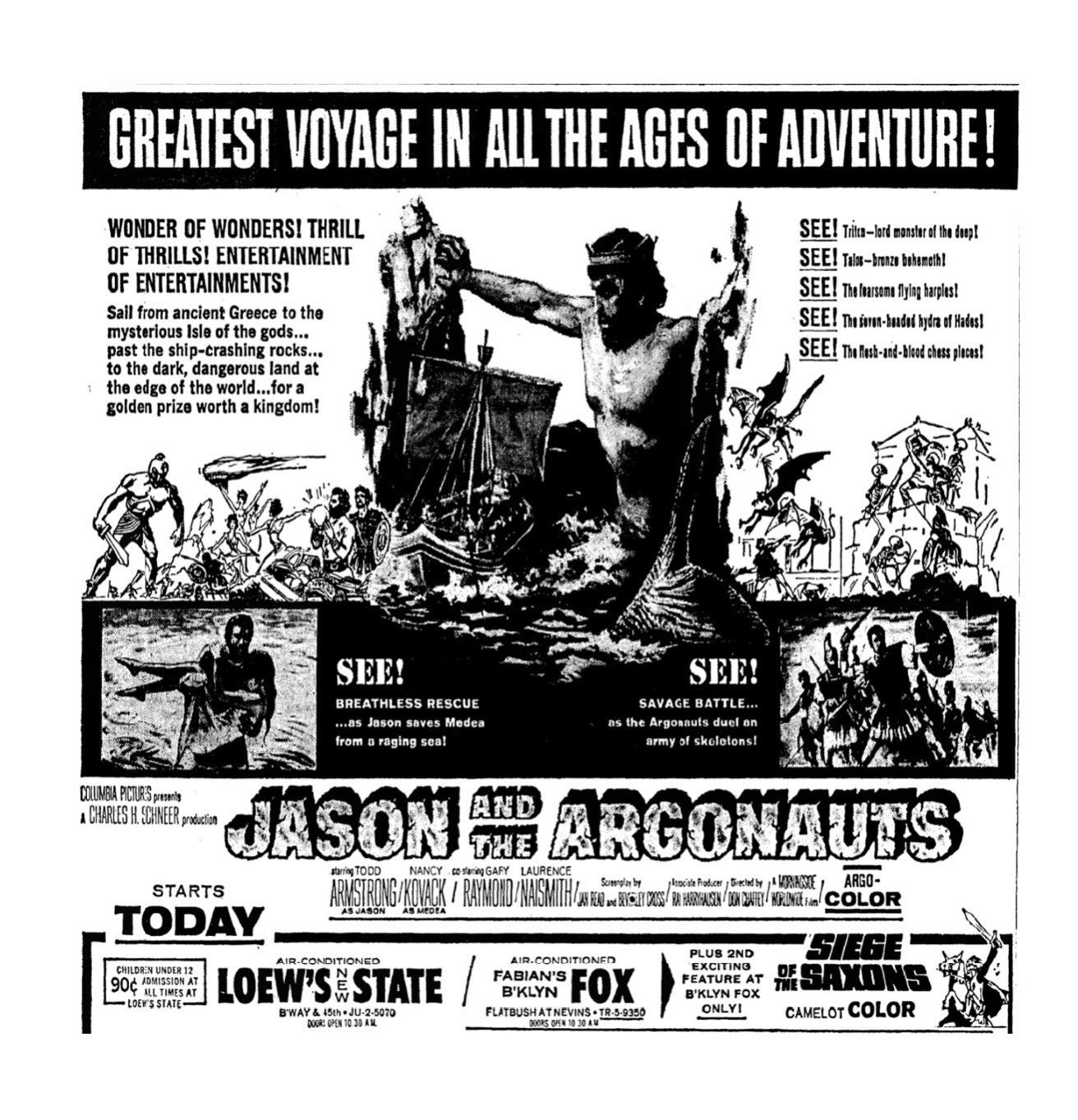
“Jason and the Argonauts” is mostly celebrated today for Ray Harryhausen’s wildly imaginative stop-motion animation special effects. Two sequences stand out as being among the most original ever put on film: the giant blank-eyed bronze statue of the titan Talos coming to life and the climactic sword duel between the Golden Fleece-fleecing Argonauts and a squad of sword-swinging skeletons. Nothing in today’s world of CGI wizardry can even come close to the innovative brilliance of those extraordinary sequences.
But “Jason and the Argonauts” goes beyond special effects. There are amusing segments with the droll Olympian gods Hera (Honor Blackman) and Zeus (Niall MacGinnis) watching the shenanigans on Earth as if it was a game while casually one-upping each other through the adventures of Jason. There is also a wonderfully unlikely Hercules in the form of Nigel Green – with his gray-streaked beard and sturdy but non-muscular physique, he comes across like Steve Reeves’ grandfather rather than the legendary muscleman. Unfortunately, Hercules leaves the story after he joins the fey youth Hylas (played by Scottish actor John Cairney) in a disastrous attempt to steal the riches from the base of Talos’ statue.
Bernard Herrmann fans have cited the film’s score as being among the composer’s finest, even though he recycled parts of at least six of his previous film scores (including “Vertigo”) for the soundtrack. The sound effects on the film are remarkable, especially in the eerie rusty creaks heard in Talos segment.
As for fidelity to its source material, that’s another story. “Jason and the Argonauts” is a hodgepodge of reinvented Greek mythology shoehorned into the tight parameters of B-grade adventure. It’s a world of black-and-white morality, chaste romance and a rugged disregard for the basic tenets of logic. The acting is mostly casual to the point of being careless – director Don Chaffey probably spent the bulk of his time trying to keep his cast from laughing while delivering their awkward lines with straight faces. Columbia Pictures’ contract players Todd Armstrong (as a humorless Jason) and Nancy Kovack (as Medea – or a Minsky’s-style facsimile) were given top billing, but British actors dubbed their voices so they wouldn’t stand out from their Anglo castmates.
Ultimately, the film’s pluses outweigh its negatives. Unlike other mythology-inspired films of its era, it never grows dull during the course of the running time. And the special effects never overwhelm the story. The Harryhausen trickery pops in and out at the right times to maintain the proper degree of outlandish violence that makes this genre so addictive.
Strangely, “Jason and the Argonauts” ends on a note that suggests a sequel was being planned. There was no “Jason 2,” which was clearly for the best – this is a very rare Hollywood example of knowing when to leave well enough alone.