

Two operatives on a mission to a city inhabited by creatures from thousands of different planets discover a devious plot that threatens to destroy the entire universe, and they must stop at nothing to put an end to it.
Brought to the screen by none other than Luc Besson, a director already known for making visually moving masterpieces like The Fifth Element, Valerian is a spiritual successor of sorts, with all of Besson’s trademark visionary stylings on full display, down to his slightly excessive runtime. Valerian overstays its welcome a little, but it also feels necessary to expand upon every plotline set up through the first act of the film, and it looks so gorgeous, I certainly didn’t mind. I was lucky enough to catch Valerian during its theatrical run, and it’s a stunning piece of art, just as most of Besson’s work is. Taking the source material of the Valerian and Laureline comic books by Pierre Christin and Jean-Claude Mézières and turning it into a film was no easy task, and yet Besson did so with ease and finesse.
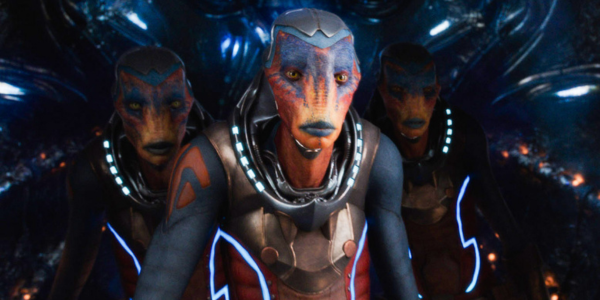
Even if the acting is a little overdone. While I’m a big fan of Dane DeHaan, as I think he’s a criminally underrated actor who has done some really impressive work in film, he’s not exactly the right casting for the character of Valerian. He lacks the charisma and charm needed to really sell the character, and comes off as if he’s trying a tad too hard. The same can be said about Cara Delevigne, who does slightly better than DeHaan, but not much. And the chemistry between these two winds up feeling more like siblings than romantic partners, as much as they want us to believe the latter. We’re also gifted with a number of celebrity cameos and smaller roles, with Clive Owen, Ethan Hawke, Rutger Hauer, and… Rihanna. It’s an interesting cast, I’ll give them that. Good thing we’re not here for them, though.
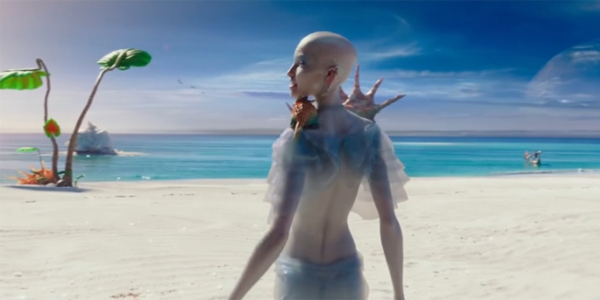
As I said above, Valerian is a visually stunning masterpiece, and that’s in large part due to the incredible CGI and special effects team working behind the scenes. Thierry Arbogast gives us some phenomenal cinematography, and the color palette is so striking and beautiful, especially during the “pearl people” sequences, you’ll find yourself unable to look away from the screen just for the sake of how it’s unlike anything else you’ve ever seen. It transports you to an entirely different world that you actually feel like you get to live in for the span of the film. The score and sound design add to this immersion, too, amplifying the emotional impact and leaving you feeling almost melancholy when it’s over.
The bad thing about a movie with a sky high budget that’s based on a comic book that’s mainly only popular in France is the fact that, despite performing better than hundreds of other films, it’ll still be labeled a “box office bomb” in America if it doesn’t turn a massive profit. Thus is the case with Valerian and the City of a Thousand Planets, which is an all around good film that deserved to be seen on the big screen, but it fell victim to curbed expectations and not enough marketing, and now it’s all but forgotten amongst the general movie going public. And that’s a shame, because Valerian is not only an intelligent commentary on current social and political standards, but it’s also really gorgeous to look at while also being thoroughly entertaining. A victim of bad marketing and a cast that didn’t quite have the star power to bring people to the theatre, Valerian and the City of a Thousand Planets is fun, entertaining, and above all else, really damn pretty to look at. It’s Besson, after all. Of course it is.