
 The history of opposing Yakuza gangs is followed through the life of one’s don in Sadao Nakajima’s The Japanese Godfather Trilogy. Now on Blu-ray via Radiance Films.
The Japanese Godfather trilogy, from 1977 and 1978, written by Koji Takada and directed by Sadao Nakajima, encompasses the travails and fights, ups and downs, and personal issues of the Japanese Yakuza over a decade and some. Wide-ranging and with strong personal connections, it’s often thrilling and entrancing. But at six hours and forty minutes over three films, it was a bit too much for me, getting lost in the ins and outs. But then again, I watched them in quick succession. Perhaps having space would have helped.
It would also helped, for me, if I had more cultural touchstones. That’s on me. Not the films. I am not the intended audience, and I do not wish to be spoon-fed. Honestly, I wish I liked the Japanese Godfather trilogy more. It’s the sort where I appreciate what I’m seeing, and I know it has a power and push, even if it didn’t fully connect with me. But I also feel I should give it another spin, and think I’ll appreciate it more on the second viewing. Those more in line with the culture, history, and world of Japan during this period – whether living it or being away. Similar to Ogre of Athens or Blood of Revenge, something is lost for a modern American viewer like me. But I’m an educator, with a certificate in history (and English and Film), thus I always want to seek out more I’m not aware of culturally and historically. So, a continued thank you to Radiance Films for putting these niches in front of my eyes. I appreciate that. But take this into account in my review and words.
Even outside of full knowledge of the culture around it (it is based on a real story, despite the card at the start saying it’s not) and being kept a little out, I did really enjoy Japanese Godfather on the whole. The titular character is Kazumasa Sakura, head of a Nakajima corporation and syndicate, and we follow his work across the years as power is gained and lost; groups fight for heights, avoid lows. There are internal and external conflicts, personal and business. An older yakuza, how does he deal with the newer, younger men who have different ideas about how to do the work (in a visual take, those in traditional Japanese wear or in Western suits and ties). On the other side is Kanto Alliance, led by Japanese acting legend Toshiro Mifune. He comes in during the second film and gets more time in the third. I think this may have been my first time seeing him outside of Akira Kurosawa. Normally seeing him in the 50s in Rashomon, Seven Samurai and Thonre of Blood, it’s a shift for a modern look (okay High and Low is the 60s and modern, but I digress). Cool to see Sonny Chiba too! In a great method of turn, this dichotomy is often thrown in a loop with third parties coming between and pushing them even more against one another.
Though a few times here and there I got lost in just who was who and what side they were on, the internal machinations, I was able to keep up well, and even if I didn’t know exactly what happened, it was thrilling to watch, and I eventually got there. Maybe I’m not the only one, as occasionally voice over fills in, reorients anything I had wrong, and gets back on track.
It’s worth noting with the name connection, Japanese Godfather isn’t just a “take the Copolla movies (not a trilogy at the time with just I and II) and put a new culture and time”. This is its own thing, even if it is obviously in debt to the Puzo adaptations, with some aspects and scenes lining up. But the focus is different. Coppola’s dulogy has stronger family connections with Michael’s descent as the driving force, Nakajima’s films are far more about the ins and outs of the rival groups, how they shift and change; the different generations and how they affect one another, and approach the “business” There are family connections and how it affects them, but it comes in goes. Takada notes this in the special features: in the Yakuza, the family connections weren’t there in real life, so lessened in the Japanese films. The most interesting side of this, closest to Michael, is how Sakura’s medical doctor son-in-law has his moments of moving towards darkness.
Nakajima crafts the film with a measured ease, moving the films along quickly. Even if I got lost in the individuals, I was continually invested in the goings on. I was often awed by the beautiful compositions and use of the range of Japanese exteriors as the story moved around the country. Gorgeous. Nakajima also gains an amazing performance from Shin Saburi as Sakura. The whole rests on Saburi’s shoulders, and he plays the wide swatch needed for Sakura in perfection.
The Japanese Godfather trilogy, written by Koji Takada and directed by Sadao Nakajima, is a compelling and dramatic tragedy of crime and family, though more on the former. I appreciate how well this was pulled together over the span of two years.
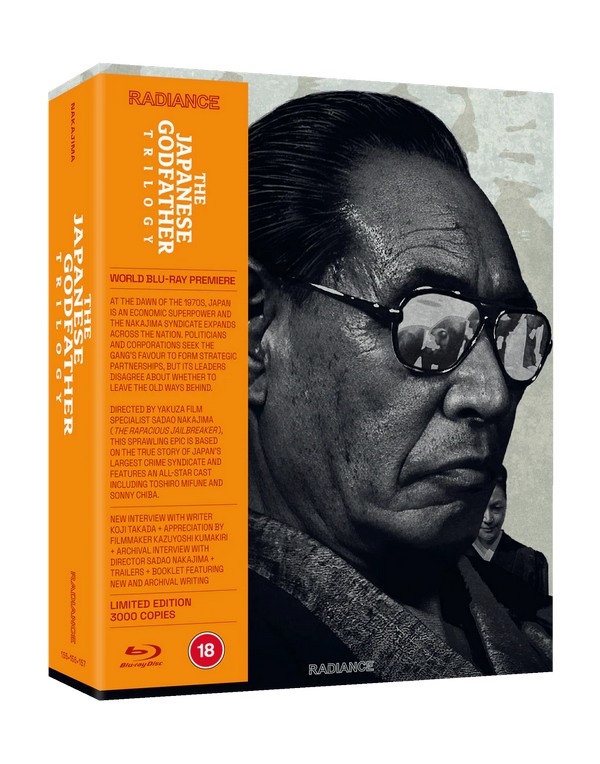
The Package
Radiance presents the first Blu-Rays of the set over three discs, each with its own case. Each case has reversible sleeves with art based on the older art. The collection slides into a box with new art. As normal for Radiance, it’s wrapped in a removable paper slip. The trilogy is limited to 3000 units.
The Presentation
Wow. This looks amazing, especially in the third film (far more colorful than the first two). Incredible detail, in the beautiful, wide, expanded, and personal interiors. The colors stand out, and the variety of life in Japan at the time shines. Amazing detail on the lived-in Japanese world. Audio is uncompressed mono in Japanese with English subtitle options.
The Features
Radiance goes a little light in this case, witha mere three interviews, one for each film/disc, a booklet, and trailers.
Disc 1:
Sadao Nakajima (2020)
This interview with the director (who died in 2023) is an example of me not connecting in not having the knowledge. He has a lot to say, but so much that I had no idea what he was talking about. But I’m sure it’s great if you know!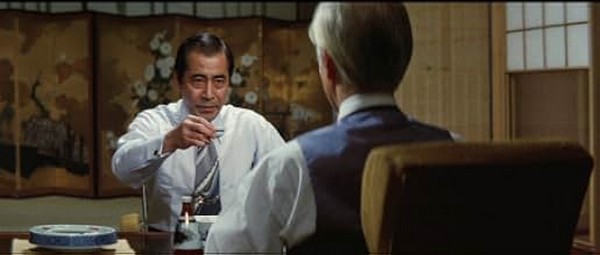
Disc 2
Kazuyoshi Kumakiki (new)
The modern director gives an appreciation of Nakajima and this film, talking of working under Nakajima in film school, the differences in generations in filmmaking, and more. I did find this more interesting and connected. (16m)
Disc 3
Koji Takada (new)
Wow. Takada is 92! And still as active and interesting to listen to as John Boorman was on Excalibur. Loved hearing him talk about the films, his career, working with Nakajima to make these films, what he pulled from Coppola, and what they made their own. Fascinating in the process. (29m)
Trailers
Booklet
Radiance includes a beautiful 40-page booklet. It contains stills, production information, and 3 wonderful writings that highly enhance my understanding of the film, making me want to rewatch right now, as it fills in what unfooted me in watching. “The Toei Studio and The Yamaguchi-Gumi” by Akihiko Ito gives the history of the genre before and after the movie, and the cultural and historical context I missed coming in. A big help and highly illuminating.” Familiar Faces” by Tom Mes talks about the possibility of including postcards with the release with info on who was who (thus, I wasn’t the one confused on those details), but abandoned due to how many people play multiple characters. The essay discusses those multiple performances. Finally, cinematographer Toshio Masuda breaks down his methods by highlighting some scenes.
Final Thoughts
Japanese Godfather trilogy looks great, and is a fascinating slice of Japanese crime culture of the 60s and 70s, using Francis Ford Coppola’s Godfather films as a basis, but making it purely Japanese. I look forward to returning to it after going through the short but illuminating special features. Check it out.