
 A woman has to deal with repercussions and changes after she exits a ten-year time loop in the powerfully understated and performed Again Again. Directed by writer/star Mia Moore & Heather Ballish, it has its world premiere at the 52nd Seattle International Film Festival.
The time loop an often-told concept of film and TV. Harold Ramis’s Groundhog Day might be the apex of the genre, the touchstone when writing and talking about Happy Death Day, Palm Springs, the bank-robbery episode of The X-Files, or countless other tales. Hell, I’m making those references this early in the review as well. It’s review law, sorry. But Again Again, co-directed (with Heather Ballish), written, and starring Mia Moore, makes a new way to use the subgenre. Most of these stories end when the loop is broken: Again, Again starts with the exit. In doing so, the Lilly Wachowski-produced films explore personal connections, histories, changes that we realize and don’t, and the choices we make. Again Again shows the raw talent of a fresh filmmaker in a wonderful debut.
Mia Moore, our writer and co-director, also stars as Agatha, giving a commanding but brimming with truth performance as Aggie, a transwoman who has somehow broken out of a ten-year repeated day cycle after restarting every day in an RV outside of Aberdeen, Washington (Moore’s hometown) with her best friend and sometimes lover Tess, a radiant Aria Taylor. Where most of these films are larger reflections, big sci-fi moments, and large colorful characters: Aggie and Tess are grounded and all-too-real, two people in a cycle of somewhere between unhappiness and content, that lost feeling of one’s mid-20s.
Unlike others of the type, the breaking is not from a huge thing, a major character shift. It happens; how do you hold it, the 10 years of memories and thoughts, a different person than someone knew you as, two years ago in real life or a year ago in a repetition? Does a history really matter if it’s erased the next day? If one person runs away, regrets the last day, whether it be literally the last day for Tess or a looped day for Agatha (written on her hand, updated daily), makes a change, but it doesn’t stick, does it have implications? Does it change how someone feels about another? As the story continues, time is shifted in the new world of a finally new day, to the pairs or other days together, and further to the past. Moore’s script is expert in the construction to have it build and inform th past to the now. It flows with ease, filled with pain of lost or fresh memory, with the possibilities of a future without the shackles of the past. Perhaps Again Again doesn’t quite stick the landing, meandering what might function as a close. But with exerting before a real sense of closure of connection is reached, but then again, that’s life, and reflective of the film.
But just as much, the film is just a reality, one without prejudice. Refreshingly, it’s a film packed with queer people, but not explicitly about queerness. Akin to 2024’s SIFF smash, Jane Schoenbrun’s I Saw the TV Glow, Again Again is a unique way to talk about being trans via metaphor and overall feeling. Now, I’m a cismale, and I’m not going to pretend I can speak truly to the trans experience, and I’ll leave others to dig into the details, and I look forward to reading the discourse. I do love having films that speak to the aspects without being direct, making a strength in the telling. People can read I Saw the TV Glow and Again Again in multiple ways, and that’s why; the room for interpretation and shifting ideas. But there’s something to be explored in the person presented is different than the person within; what’s remember and what’s held on to; is someone able to truly move forward in their lives without changing, a world of endless doldrums or more like it accepting of the change they desperately want and find solid footing that doesn’t come (really connecting to I Saw the TV Glow there). Even with ten years’ reflection, the future is uncertain, even if out of the rut.
Additionally, Laffrey Witbrod’s cinematography holds the film close. Their matter-of-fact, low-key show highlights the grey nothing of Aberdeen, Washington. The long-dying, slow-moving seaside town is best known as the escape point for Kurt Cobain. It’s not a place of quick change or big moments, seeping into Again Again’s tone. It’s an outsider world representing the sunless cycles of Agatha and Tess’s life together. Witbroad keeps the camera close and personal, pulling in quiet expressions, emotions, and moments. Again Again has an understated power. The flashbacks to various days in the ten-year journey are in black-and-white, highlighting the lost media of memory. Moore and Ballish have a great sense of their world and how to present it to gain the headspace of their characters.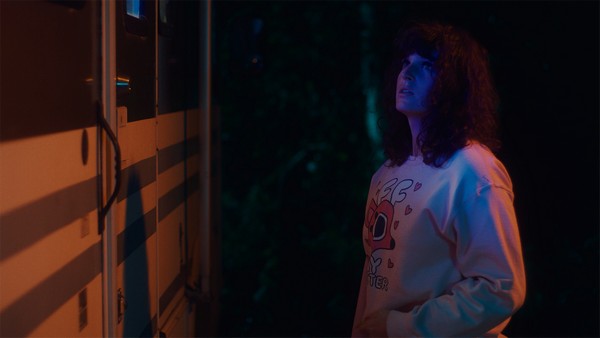
Again Again is an astounding debut from a new voice in film, all that special to come from the nearby town down the coast. One can see the raw talent brimming through the frame, not unlike Jane Schloenbrun in seeing We’re All Going to the World’s Fair and thinking “the next one is going to knock it out of the park.” That’s here in Again Again, as directed by Mia Moore and Heather Ballish’s work. Looking back to the now, it’s a remarkable film, a strong character piece of change, ruts, and reflection.
Again Again has been the early darling of this year’s SIFF, selling out both original planned shows and now a newly added one. For locals, I highly recommend hitting the standby line; for those elsewhere or who miss it, seek it out when it breaks out of Seattle. Again Again is presented as part of the 52nd Seattle International Film Festival, running May 7th through May 17th, 2026. Find more details and the schedule at www.siff.net/festival.