
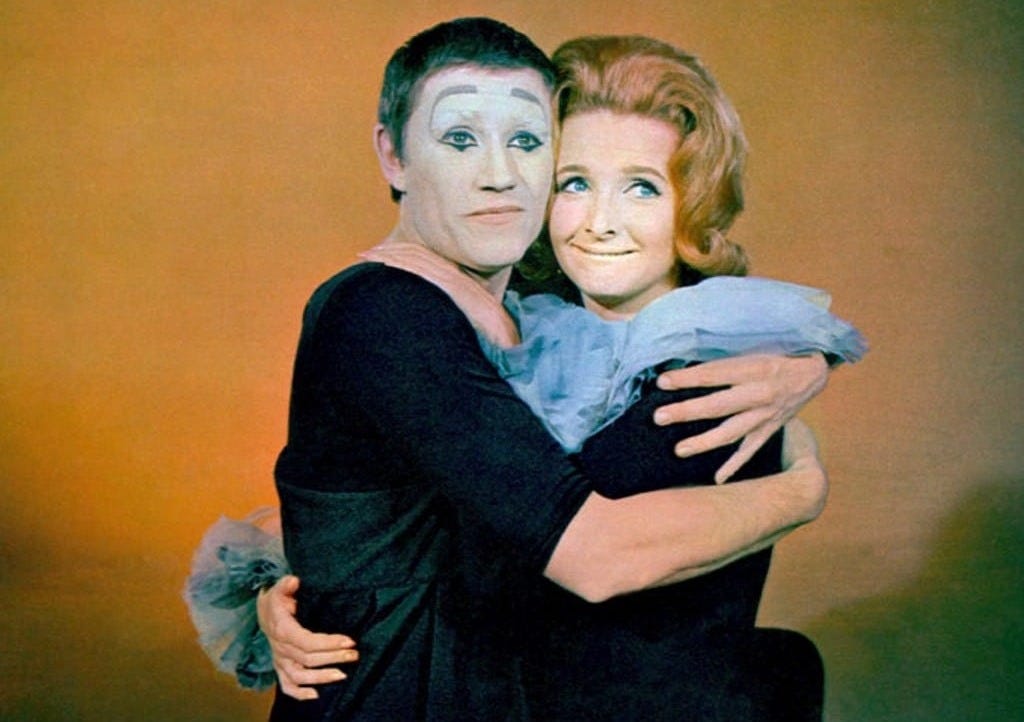
It has never been clearly determined why Anthony Newley chose not to recreate his West End and Broadway triumph for the film version of “Stop the World: I Want to Get Off.” Perhaps Newley realized that the show’s distinctive theatrical nature could not be expanded for a big screen treatment. Or maybe he was just afraid that his hit show, which he co-wrote with Leslie Bricusse, would be a movie flop?
In lieu of the larger-than-life Newley, London stage star Tony Tanner had his first (and only) starring film role as Littlechap, whose rise from Brixton school boy to Member of Parliament is played out in a circus environment. While Tanner is more than capable of capturing the insouciance of Littlechap’s personality in the show’s amusing pantomime sequences and harsh comic songs (especially “Lumbered”), he never resonates when the time comes to perform the show’s classic dramatic tunes. Indeed, his interpretations of “Gonna Build a Mountain,” “Once in a Lifetime” and “What Kind of Fool Am I?” comes across as recital numbers rather than gut-punched performances – the range and pitch of his singing is prime, but there’s no soul in the lyrical delivery. As a result, the show’s emotional balance is frequently off-kilter – wonderful comic moments are interrupted with benign serious turns.
But that’s not to say this film is a mess. Director Philip Saville daringly keeps the film adaptation in a theatrical setting – complete with a full orchestra and conductor below the stage level and a well-dressed opening night crowd applauding the musical numbers from the audience. But Saville’s clever scene set-ups and Oswald Morris’ crisp cinematography never allows the viewer to feel that they’re watching a filmed play.
The film also gets much of its fuel with the ebullient Millicent Martin playing the multiple roles of Littlechap’s different loves: his beleaguered wife, a Soviet trade official, a Japanese domestic servant and a New York showgirl. Martin’s performance of the bitingly sarcastic “Typically English” and the soothing Russian-style lullaby “Meilinki, Meilchick” captures the depth of intellectual and emotional strength that the Newley-Bricusse score empowered. When she is on the screen, you do not want this world to stop.