
I remember the first time I ever sat through “Fight Club.” Like many of American audiences I expected an action movie about brawlers and didn’t see this gritty, ugly, and grimy tale about psychos and self-mutilation coming to me. And I hated it. Not just that, but I despised it. And the larger my internet presence became, the more it became something I was largely about. People always questioned by credibility through my hatred for “Fight Club,” and once I even received an e-mail from a reader begging me to post his own review for “Fight Club” on Cinema Crazed since he insisted I missed the entire point of the movie.
And perhaps I did.
For years it was on my Top 10 Worst Movies of All Time List. But then, over the years, something changed. Not inexplicably, or suddenly. Something changed gradually. Very gradually as a matter of fact. With films I hate, often times I watch them again later on to see if I changed my mind. With “Titanic” three tries indicated the movie was awful. Same for “Armageddon.” But years since the release of “Fight Club” I watched it again. And then again. And again, even. Often times whenever it was on TV, I’d put it on and watch it from beginning to end. Since its release in 1999, I’ve probably seen “Fight Club” about fifty times. Maybe more.
I know, that’s nothing compared to hardcore fans of the film, many of whom likely viewed the film fifty times a month since its release on VHS back in 2000. But you have to understand, I hated this movie for a very long time. So fifty times is not only remarkable for me, but over the course of the years I came to realize that I wasn’t tuning in to “Fight Club” because I considered it “So Bad it was Good,” but because I really did enjoy the movie. I kind of love it, to be honest.
Yes, it is possible for people to change their opinions on movies, and it’s very possible to have a change of heart on a movie you once loved or once derided. With “Fight Club” the movie somehow wormed itself in to my brain and made a home there for a long time. In 1999, I was sixteen, and now I’m on the verge of thirty and very conscious about politics and societal problems. I’ve also been very keen on the evolution of sexuality, and sexual politics in this world, and how it’s changed.
Here in 2013, most of the men in America have no real direction. Their materialism is how they define themselves. Once upon a time, the male animal would be inducted in to manhood through a ceremony or right of passage. They’d kill something, or go on a journey, or learn something about themselves. I’m not interested in killing an animal to prove myself, but I am aware we’re currently in a world where men haven’t had that sign post to indicate that they are indeed men ready to mature, and take on responsibility.
Much of the male mold has been devolved in to embarrassing sub-sets, including my most despised “The Man Child.” This is a common mold of man in America, today. The man who never quite grew up, and doesn’t want to accept responsibility. And they’re laughed at, because somehow it’s charming. The other half of the male population anxious to be manly are either accused of “Over compensating” and are genuinely chastised for wanting to be a man. Want to hold a door open for woman? How patronizing. Giving a woman your coat? Who do you think you are?
“Fight Club” is that movie about re-claiming the male spirit and building your identity in a world that uses material goods to define a man one hundred percent. It’s not about what we’ve accomplished anymore. It’s about what we’ve bought from an online outlet, or in vogue clothing shop. In a world where identity is personified through materialism, how does a boy become a man? “Fight Club” is also by and large a metaphor for the Narrator’s sexual ambiguity. Tyler Durden is not just the man the Narrator wants to be, he’s the man the Narrator wants. Durden is free of restrictions like sexual identity, and an identity, period. The Narrator reflects on that over the course of the film, and emulates that attitude to where he not only longs for Marla Singer, but also seems jealous she is sleeping with Tyler Durden.
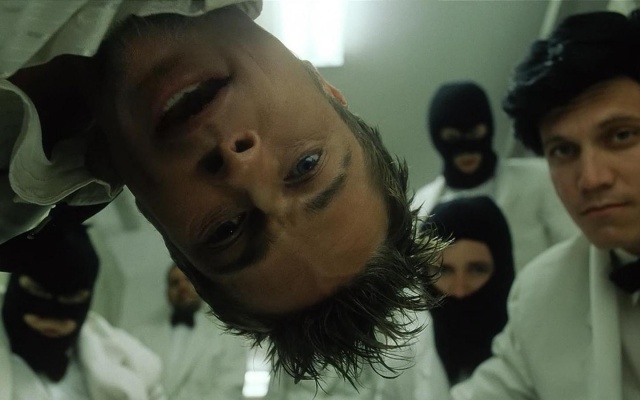
There are definite shades of homosexuality and homoeroticism there. Meatloaf’s breasts. The homoerotic nature behind the fight club that is supposed to unleash their aggression, the narrator’s own fetish for male on male violence, Tyler’s own flamboyance and shades of gray sexuality, etc. Mainly though, what I take from “Fight Club” is a requiem for the end of manhood, now being lost in a wave of new ideals that push to feminize the male experience greatly. I’m all for equality of the sexes, but there’s also nothing terrible about men spending time together to bond and find their own identity.
“Fight Club” is about a cult of men who are so repressed and unable to express their masculinity that they seek active ways to prove themselves in the fight clubs that are mostly held underground, lest they be shun for their violent practices. “Fight Club” is quite brilliant in its effort to show a legion of men obtaining their sense of self, but also re-claiming the world once more, and trying to change the status quo for better and for worse.
Edward Norton is excellent, Brad Pitt is fantastic, and the overtones still pack a punch for the conscious viewer. Hopefully, new male viewers of “Fight Club” will leave it with the assurance that every once in a while, it’s okay to be a traditional man. It’s okay to bond with other men.
My earned love for “Fight Club” didn’t come from pressure or insults, but more from a movie that I just didn’t approach with an open mind, initially. After many viewings, it’s become a favorite and consistently on rotation for me. I may not be a huge fan of the directorial works of David Fincher, but “Fight Club” is a pretty excellent and entertaining film with something to say, and it’s earned its cult status.
Your experience with Fight Club is like mine with Blade Runner. That’s not to say I hated Blade Runner, but didn’t initially fall head over heels for it either. It’s since become a movie that I seem drawn too, and have only grown more fond of with each viewing. If Fight Club is a requiem for manhood in the modern age, then Blade Runner is the requiem for spirituality in the age of science.