
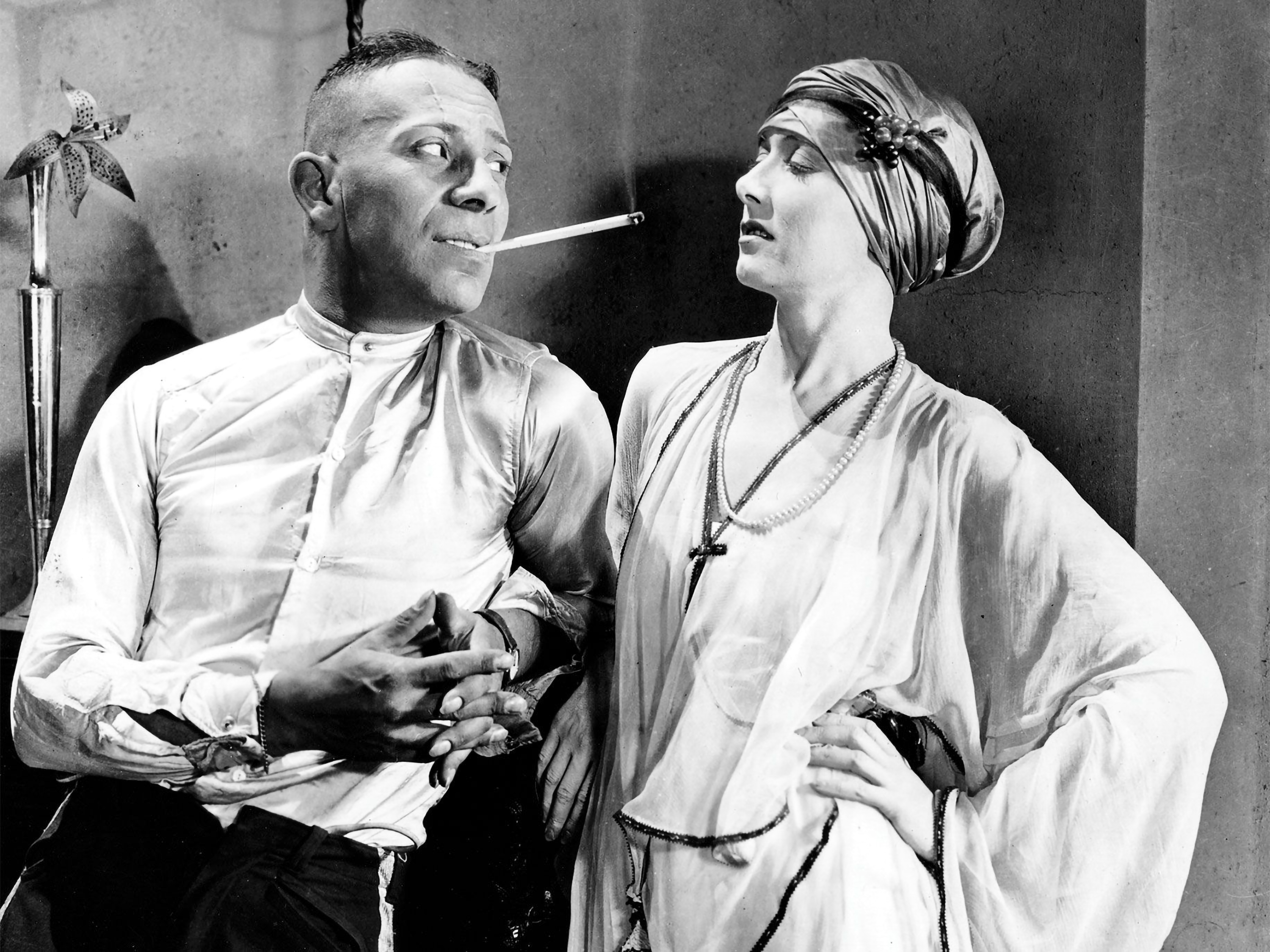
Billed as the “first million-dollar movie” when it was released in 1922, Erich von Stroheim’s “Foolish Wives” is a film whose reputation is greater than its contents.
Stroheim stars as a grifter who pretends to be a Russian count – a pair of his ex-lovers masquerade as his cousins, also putting on the fraudulent personas of being aristocrats of the tsarist orbit. They live a precarious existence in Monte Carlo, paying their mounting bills with counterfeit money while staking out rich suckers for extortion. The “count” finds his latest mark in the young and naïve wife of a newly-arrived American diplomat – but he overplays his hand when he juggles his chicanery with lascivious recklessness involving the affections of a chambermaid and the mentally retarded teenage daughter of his counterfeit money provider.
The million dollars that went into the film is visible on the screen with extravagant sets recreating Monte Carlo and a small army of extras to populate the scenery; rich color effects also make this film stand out. Stroheim was originally budgeted $250,000 but he overspent the studio’s money – interestingly, Universal played up the hemorrhaged budget in its marketing, even going so far as to praise the filmmaker for his lavish vision.
But Stroheim makes the mistake that many self-directing actors make – he winds up monopolizing his film, throwing the sense of ensemble out of whack by keeping himself front and center as the most interesting person on the screen. In “Foolish Wives,” Stroheim’s character is the only one with a three-dimensional personality – whether he is establishing his loathsomeness with a breakfast of oxblood and caviar or turning on his faux-aristocrat charm at full-throttle on the dazzled young American, Stroheim creates a memorable villain.
Unfortunately, his villainy is in something of a void because the other characters are strictly cardboard flat – none of the other performances resonate at any emotional level. It also doesn’t help that the film’s story unwinds at a rather leisurely pace – anyone expecting a fast-paced drama is in the wrong film. This problem might be the result of the severe editing on “Foolish Wives” – Stroheim shot anywhere from six to 10 hours of footage, but Universal edited it down to a compact 117 minutes.
The new Blu-ray/DVD presentation of “Foolish Wives” from Flicker Alley runs 147 minutes and comes from the 4K restoration commissioned by the San Francisco Silent Film Festival and the Museum of Modern Art. The film looks great, to be certain, and this silent film has a lush new score by Timothy Brock performed by the Real Filharmonica de Galicia. This is certainly an improvement over the multiple public domain versions floating around online.