
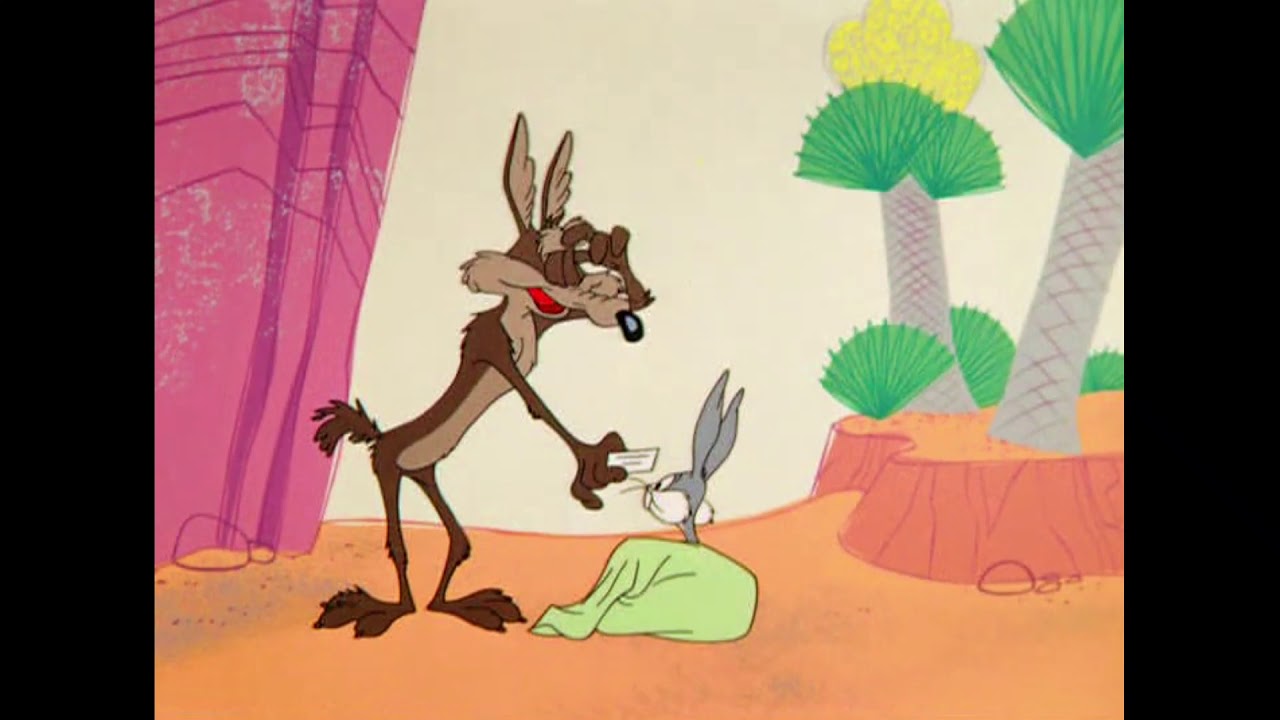
To Hare is Human (1956)
Directed by Chuck Jones
Story by Michael Maltese
Animation by Abe Levitow, Richard Thompson, Ken Harris, Ben Washam
Music by Milt Franklyn
Wile E. Coyote wants Bugs Bunny for breakfast – not as a guest, but as his meal – but the self-proclaimed genius quickly discovers capturing his prey is beyond his intellectual capacities. For this pursuit, the coyote installs a supersized Univac computer in his cave and consults the machine for strategies on catching Bugs. The computer offers several ideas, but all these seemingly ingenious efforts wildly backfire on the coyote.
Wile E. Coyote first turned up in the Bugs Bunny series with the wonderful 1952 “Operation: Rabbit,” and this character’s self-assured pretension – complete with a supercilious Mid-Atlantic accent – was an inspired contrast to the usual dimwitted or hotheaded foes that Bugs would mostly encounter. It was a pleasure to see him back, and the idea of his using the Univac computer to plot assaults on Bugs was a fun idea – the monstrous machine, with its scores of buttons and switches that result in paper-receipt answers, ultimately proves to be the worst possible ally in this campaign.
But “To Hare is Human” doesn’t work because director Chuck Jones and writer Michael Maltese made a bizarre decision to present Bugs as a cutesy character. Throughout the cartoon, Bugs is skipping, dancing, singing silly tunes, and wearing funny costumes. At one point, he is vacuuming his underground home while resembling a cleaning lady with his ears tied over his head like a kerchief and an apron tied around his waist. In this characterization, Bugs comes across as a buffoon – mercifully, this change to his personality didn’t occur again.
Wile E. Coyote is the sole source of the cartoon’s laughs – and, thankfully, one can never get bored of the coyote’s inevitable failures as he plunges down cliffs, gets blown up with dynamite, or has boulders dropped on his head.