
Ali Baba Bunny (1957)
Directed by Chuck Jones
Story by Michael Maltese
Music by Carl Stalling and Milt Franklyn
Animation by Richard Thompson, Ken Harris, Abe Levitow, Ben Washam and Harry Love
The major problem with the Bugs Bunny-Daffy Duck frenemy cartoons is the surplus amount gags focused on Daffy, with Bugs serving mostly as a polite onlooker to the violent humiliation generated by his web-footed friend’s self-destructive greed, jealousy, and rudeness. “Ali Baba Bunny” is the best of these pairings because Bugs shares an equal load of generated laughs with Daffy, and the two work in unison in dealing with a memorable adversary. The result is one of the very best of the Bugs Bunny series, as well as one of the most comically satisfying cartoons ever made.
There isn’t a single wasted frame in “Ali Baba Bunny.” From its set-up with the diminutive sultan riding an equally miniscule camel ordering the massive guard Hassan to guard the cave full of treasures to its closing gag of the absurdly shrunken Daffy clutching a pearl within a clam, the film is a riot of imaginative imagery, brilliant music and sound effects, highly quotable dialogue, and pricelessly funny sight gags.
Michael Maltese’s screenplay gives Bugs and Daffy a depth of texture that had not been evident since their “hunting trilogy” with Elmer Fudd. In their pairings with “Beanstalk Bunny,” “This is a Life?” and “A Star is Bored,” Bugs and Daffy suffered from one-dimensional personalities. In “Ali Baba Bunny,” both carried fully dimensional characterizations. Bugs’ entry in the sultan’s cave is hilariously jubilant, emerging from a burrowed hole with outstretched arms and a cheerful declaration of “Well, here we are, Pismo Beach and all the clams we can eat!” – which is followed within seconds by confusion at being deep within a dark cave. He is even more confused after Daffy physically stomps him back into the hole while chanting “Mine, mine, mine!”, with the dazed rabbit emerging in genuine bafflement at Daffy’s sudden assault.
Daffy’s greed takes on a level of giddiness that was never duplicated in other cartoons where his cupidity proves to be his undoing. With lines like “I’m independently wealthy and socially secure” and “I’m rich, I’m a happy miser” delivered in fruity declarations, Daffy’s greed is rich in jollity.
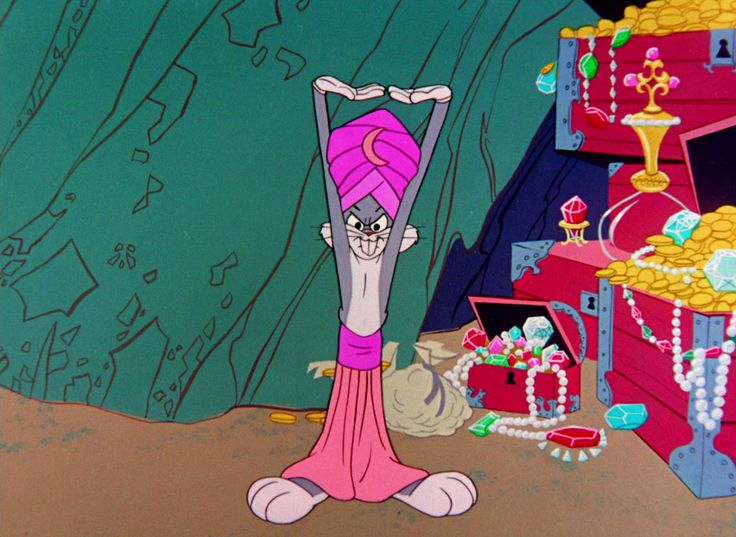
But the big difference here versus other Bugs-Daffy shorts since the “hunting trilogy” is that both characters evolve in unexpected ways. Bugs has one of the funniest moments in his screen life when he fools Hassan by doing the genie dance with serpentine movements and gibberish chanting, while Daffy is hilarious going into a smiling state of shock as Hassan’s scimitar slices his hat in half, exposing a single upstanding hair strand that slowly peels in half. The two characters have a great off-camera exchange with Bugs expressing Bud Abbott-level disappointment over Daffy’s behavior while Daffy sobbingly responds in Lou Costello-worthy cadences, “I can’t help it, I’m a greedy slob—it’s my hobby.”
Then there’s Hassan, who is one of the best one-shot villains in the Bugs Bunny series. With his overbuilt upper body and skinny legs, he is a wonderfully ridiculous sight to behold. His fearsomeness is perfectly balanced by his awkward embarrassment when he forgets the cave’s password and timidly goes through a long inventory of words beginning with the letter “S.” His later subservience to Bugs’ faux-genie and his diving into the cave’s treasures is so excessively out of character that it becomes a joy to behold. And, of course, his chasing Daffy while holding up his scimitar and yelling “Hassan chop!” provides one of the genius catchphrases of all time.
“Ali Baba Bunny” was a true lightning in bottle achievement – and an argument could be made that this was the last true masterpiece of the Bugs Bunny series. Yes, I know “What’s Opera, Doc” came later, but I truly believe “Ali Baba Bunny” is superior at every level. Because no matter how many times it is viewed, this gem never fails to create a vibrant laugh-out-loud experience.