
People seek out movie reviews to learn about the latest cinematic offering. But did you ever stop and ask yourself about where and when movies were first made?
The earliest attempts at capturing images on moving pictures in the United States were made by Thomas Edison’s laboratories, although it is unclear if this occurred in June 1889 or November 1890. The first of these efforts was an experimental short running a few seconds long and dubbed “Monkeyshines No. 1.”
Initially, the Edison team did not consider projecting images on a big screen, but instead they believed it would be better if these films were viewed by one person at a time looking through a peephole window into a contraption called a Kinetoscope. The film would be attached on a cylinder and the viewer would see the images moving as the cylinder turned. The films being presented would be shot on a primitive motion picture camera called the Kinetograph.
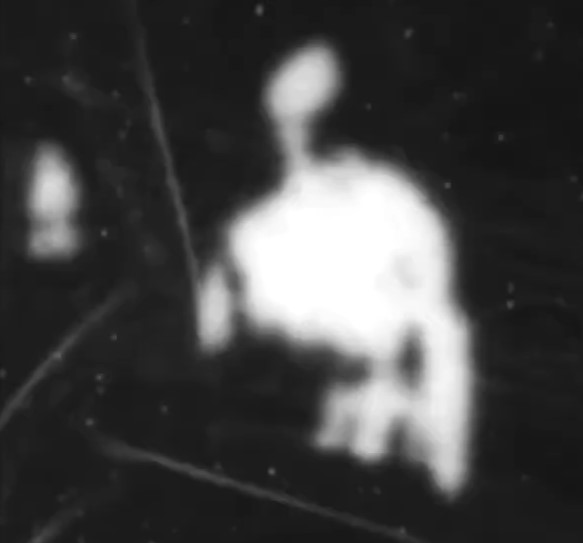
“Monkeyshines No. 1” was an experimental test film that was meant to work out the kinks in this new technology. William K.L. Dickson and William Heis were credited with running this test. The person on camera is not known – film scholars believe it could be Edison workers Fred Ott or Giuseppe Sacco Albanese, but it doesn’t really matter since the imagery captured in this experiment was blurred.
But while “Monkeyshines No. 1” not a successful test, it emerges as the most fascinating failure imaginable. The blurred image, with its ghostly white body set against a dark black setting, has a wonderful ghostly quality – it looks as if an ectoplasmic entity made itself known through avant-garde shape shifting. At one point, it looks as if the being’s head detaches from its neck, only to suddenly become reattached as the upper body fuses into a giant block shape. It is possible to make out arms being swung and hands clasping in what might be a prayer gesture. The absence of sound on this test makes the experience eerier to behold.
Two additional “Monkeyshines” tests were made and the visual quality improved slightly, though they were still unsatisfactory. Edison would later realize there was more commercial viability in projecting films for an audience and his kinetoscope operations would be jettisoned.
“Monkeyshines No. 1” was never intended for public viewing, and only became known many years after the Edison film works ceased operations and archivists dug through the works left behind. While it was certainly a shaky first step for cinematic production, its survival and availability offer a fascinating reminder of where American filmmaking began.