
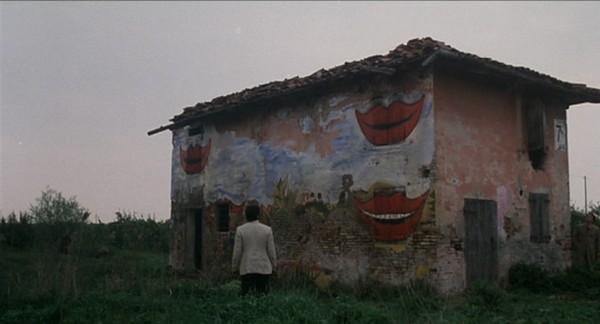
 An expert in art restoration works on a strange fresco in a church, awakening a town’s memory of an old serial killer in Pupi Avati’s 1976 giallo The House with Laughing Windows; presented in a new special edition from Arrow Video.
The Film
The House with Laughing Windows might not be as flashy or stylish as its giallo brethren. The 1976 film has no strange color uses, Goblin soundtrack, or black gloved killers. But that doesn’t mean the work, directed by Pupi Avati and written by Avati, Antonio Avati, Gianni Cavina & Maurizio Contanzo, is any less than the more notable output by Argento or Bava. It’s a fascinating mystery of lost history bubbling to the surface, compelling and strange in its own way; especially in later reveals (shhh, spoilers, sweetie).
Stefano, an art restorer played by Lino Capolicchio, is called out to an isolated village to inspect a painting found under muck at a dilapidated, but still in use, church. Depicting the martyrdom of St. Sebastian, the subject looks in terrible pain. Almost lifelike pain. You see, it’s rumoured a local but well-known author might have killed to get the expressions he wanted. With the art reveal and Stefano poking around, it turns out the past might not be as buried as thought. Additionally, Stefano connects with people in the town: a weird altar boy/assistant at the church, a beautiful school teacher, and a short businessman. For reasons, he ends up living in a decaying mansion on the edge of town with a decaying old woman dying upstairs, with its own secrets.
 The focus is on finding more about who this painter is, what happened to him, and if he truly is a serial killer. If so, what happened to the victims? There’s other stuff going on: a friend shows him around, a priest doesn’t want him messing with the church, a local businessman might be up to skeevy things, and a relationship with the teacher. It wouldn’t be a good giallo if it didn’t have narrative cul-de-sacs, people set up just to die, and set-ups for weird sequences.
Avati’s narrative draws in with a unique story. Cinematographer Pasquale Rachini shoots wonderfully, using the darkness and strangeness of the old house and other locations to great effect, and the whole has an unnerving nature. As noted, there are fewer stalk-and-slash or Big Giallo Moments; not as many blood or murder set pieces, but there are enough, and the work is unnerving than “ooh, that was cool!”, but I didn’t mind as I highly enjoyed watching this different take unfold. Without giving away, I really dug where it went.
Avati’s giallo The House with Laughing Windows is different but just as fascinating. In fact, in avoiding the visual tropes, Avati can focus on letting the story unfold in its own odd ways. Highly recommended if you’ve not seen it before.

Source: Arrow Video
The Package
Arrow’s new release is available in both 4k UHD and Blu-Ray (separately). Both have the same packaging and feature set. The hard case, which houses the disc, has a reversible slip with original and new artwork by Peter Strain. It also contains a reversal poster with the same art. This release also has a collector’s book with five new essays. All of these are packaged within an exterior box displaying the new art.
The Presentation
I’ve seen the film before, but never this nice, via a new 4k restoration from the original negative. The detail is rich, and Rachini’s muted color palette sets an uneasy tone. The only audio track is the restored original lossless Italian mono track, with only newly translated English offered for subtitles.
The Features
Arrow puts together a very detailed, expansive collection of materials. All of which is new to this release.
Commentary Tracks
- Critics Alexandra Heller-Nocolas and Josh Nelson
The pair have a great conversation on the film and the wider giallo. As I did in my own review, they start with a discussion on the giallo tropes and how they are not present, but this is still wholly in the genre, and why, from the vibe and overall tone. Interesting talk on the translations of the film, and others, and how it reshapes the film. A fantastic discussion.
2. Critics Eugenio Ercolani and Troy Howath
While some of the same information is covered, mostly in the details of the film itself (on priests in film), the pair offer different points of view. They offer a detailed history of filmmaking around the film, deeply diving into Italian cinema and gialli. I loved the folk horror discussion.
Painted Screams
A feature-length documentary directed by Federico Caddeo. Less of a documentary and more of an edited collection of interviews with cast and crew. I honestly think this would have worked better as separate interviews for features as it doesn’t flow as a documentary, and I got lost with the cutting around of whose story was whose. In Italian with subtitles (94 Min)
La Casa e Sola
A visual essay by Rue Morgue’s Chris Alexander. An energetic essay on the film covering a variety of topics and connecting to film in culture, from the opening credits, the Italian (cinematic) history of WWII, and growth of Italian genre flicks, and more. Wide-ranging, and filled with zest as Alexander jumps from topic to topic. Perhaps wished ot stay on some aspects longer, but it does give a jumping point to look into on my own (though as a fan of Gialli and Italian Neo-Realism I kinda know a bunch!) (19m)
Art of Suffering
Visual essay by Kat Ellinger. Gotta love it when Ellinger calls the film the Twin Peak of giallo due to the uncanny mystery. I can see it. As I noted in my review, looking past the stylist elements, the film is still a giallo but a different take. Fascinating discussing the duality of Nietzsche’s Apollonian and Dionysian – rational vs chaotic – and how they influence this film specifically and the genre overall. Inquiries about opening a darkness of the rational vs folk horror, urban vs rural. I love these film class-style digs into the films.
It also includes the Italian theatrical trailer
Final Thoughts
Arrow’s new release of the classic giallo is fully worth a pick up from fans of the subgenre (ahem, me), both as an example of how they can be done differently but still expertly, and for the robust special feature package (even if I feel the documentary interviews would work better differently formatted; but that’s just me). It looks and sounds great, and is just a damned fine movie.