
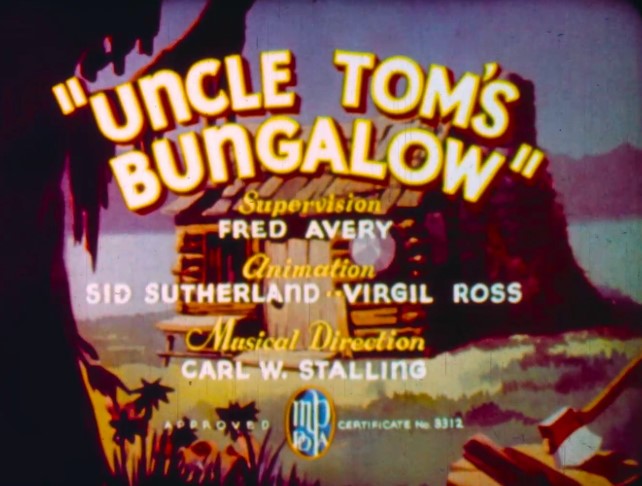
BOOTLEG FILES 941: “Uncle Tom’s Bungalow” (1937 animated short directed by Tex Avery).
LAST SEEN: On Vimeo.
AMERICAN HOME VIDEO: An excerpt was featured in a 1989 VHS video release.
REASON FOR BOOTLEG STATUS: It was withdrawn from circulation.
CHANCES OF SEEING A COMMERCIAL DVD RELEASE: None.
The slavery era represented one of the most painful chapters of American history, and the idea of making a comedy out of this tragedy is incomprehensible. Incredibly, the Warner Bros. animation unit thought it would be a fun idea to take Harriet Beecher Stowe’s anti-slavery landmark “Uncle Tom’s Cabin” and turn it into a breezy, irreverent romp.
Not surprisingly, the resulting “Uncle Tom’s Bungalow” from 1937 is a mess. The talent behind this misguided work is considerable: Tex Avery as director, Ben Hardaway writing the screenplay, Carl Stalling providing the music score, and ace animators Sid Sutherland and Virgil Ross bringing it to life. And this is what makes the cartoon such a wildly incomprehensible debacle. How did so many gifted and imaginative people get together and create something that is just not funny?
“Uncle Tom’s Bungalow” is presented as a tongue-in-cheek riff on the old sawdust melodramas. The cartoon begins with an overbearing narrator (voiced by Tedd Pierce) slowly introducing the story’s characters one at a time. This approach gets off on the wrong foot by starting with Little Eva as a cutesy blonde tyke who shoots off a considerably gruff voice when annoyed by the narrator. The film’s Black characters – Topsy, Uncle Tom, and Eliza – are designed in an exaggerated racial stereotypical manner. The villain is Simon Simon Legree, who is presented with a subtitle telling the viewer his double first name is pronounced “Seemoan Seemoan” – this is a very dated joke based on the publicity surrounding the Hollywood arrival of French actress Simone Simon, which offered a phonetic tip on correctly pronouncing her name.
The introduction also includes a trio of hounds, although only one speaks with annoyance when prodded by the narrator. This introductory segment takes up roughly the first three-and-a-half minutes of the cartoon.
By the time we get into the story, Simon Simon Legree is preparing to sell the slave Uncle Tom. As the slaveowner cracks his whip, Uncle Tom valiantly declares, “My body might belong to you, but my soul belongs to Warner Bros.” Little Eva and Topsy come skipping by, holding hands (an unusual cross-racial gesture for that filmmaking era), and they offer to buy Uncle Tom. Simon Simon warns them he will repossess the elderly slave if they fall behind on their payments.
Little Eva, Topsy, and Uncle Tom go home to a plantation mansion – it would seem that Little Eva lives there without parents. But when the payments on Uncle Tom falls behind, the girls hide the old ex-slave by having him pose inside a picture frame hanging on the wall.
Simon Simon searches for Uncle Tom, turning into a snake while investigating the mansion. He threatens the children with his whip, but Eliza knocks him out with a swinging door and grabs the children, heading off into the wintry snow. Simon Simon takes his hounds to chase Eliza, who carries the children in her arms across an icy river. But just when Simon Simon catches up and begins to thrash them, a newly affluent Uncle Tom comes driving up in his luxury car and stuffs a thick wad of dollars into the slaveowner’s hands. The narrator wonders if Uncle Tom suddenly became rich thanks to Social Security, but he reveals the source of newfound wealth as a pair of crooked dice.
“Uncle Tom’s Bungalow” tries to work in anachronistic sight gags to liven up the story, including an electric outlet where Simon Simon sticks his fingers for a shocking reaction and a self-service ice machine with a slot machine readout that Eliza uses to create the ice for her dash across the river. This humor is lame, and the decision to have a constant narration throughout the cartoon quickly becomes a bore.
As for the racially insensitive depiction of the characters, it is just as bad as you might fear. To their credit, the Warner Bros. crew assigned the voice performance duties for Uncle Tom to Roy Glenn, a Black character actor, and he gives Uncle Tom a vocal dignity that doesn’t match his caricature appearance. A white radio actress, Elvia Allman, voiced Liza and Topsy, while Bernice Hansen played Little Eva and Billy Bletcher was Simon Simon.
Tex Avery would give this material another shot when he was at 1947 with “Uncle Tom’s Cabaña.” While that film also indulges in racial stereotyping with the image of Uncle Tom, it is a much more imaginative and truly funny romp.
“Uncle Tom’s Bungalow” received good reviews when it played theatrically in 1937, but it gained more attention in the late 1950s and early 1960s when it was shown on television. In 1968, the film was one of the “Censored Eleven” cartoons that were withdrawn from broadcast because of its denigrating contents. Over the years, it only turned up twice in official showcases. Fragments of the film were used in the 1989 home video release “Cartoons For Big Kids” and it received a rare screening with the other films at the TCM Film Festival in Hollywood on April 24, 2010.
There were announced plans to have the “Censored Eleven” cartoons gathered for a DVD release, but that never came about. Thus, if you want to see “Uncle Tom’s Bungalow,” check out this slightly faded print in an unauthorized Vimeo upload:
IMPORTANT NOTICE: While this weekly column acknowledges the presence of rare film and television productions through the so-called collector-to-collector market, this should not be seen as encouraging or condoning the unauthorized duplication and distribution of copyright-protected material, either through DVDs or Blu-ray discs or through postings on Internet video sites.
Listen to Phil Hall’s award-winning podcast “The Online Movie Show with Phil Hall” on SoundCloud and his radio show “Nutmeg Chatter” on WAPJ-FM in Torrington, Connecticut, with a new episode every Sunday. You can also follow his book reviews at The Epoch Times.
It was often OK for black and white kids to hold hands and play together in movies or cartoons at that time. (The Our Gang kids treat each other as equals.) Same thing with white kids and their black nannies. The problem would have been with adults touching each other.