
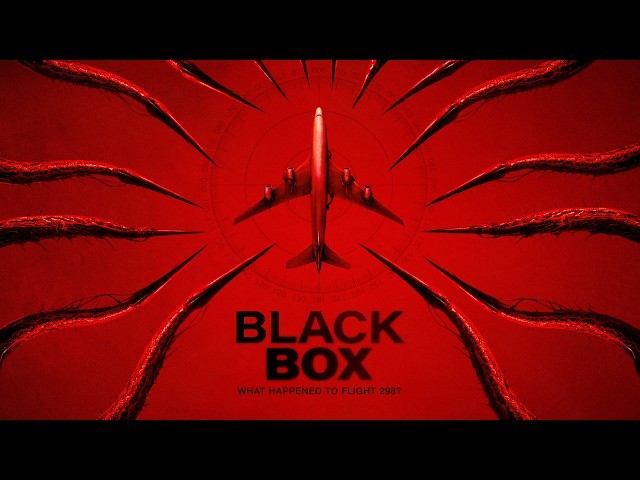
What begins as an ordinary routine evening flight spirals into a terrifying experience that changes everyone involved.
Black Box is a film that weaponizes familiarity. Written by Stephen Susco and directed by Steven Quale, the film takes the contained, claustrophobic architecture of a commercial aircraft. It transforms it into one of the most effective horror environments. Quale, constructs tension with a disciplined precision, understanding that the single-location constraint is not a limitation but a pressure cooker. There is nowhere to go. There is no one to call. Flight 298 departs on a routine evening route carrying a full load of passengers, among them a young man traveling alone and a flight attendant working to keep the cabin comfortable and the mood light. A disturbance in the rear galley, a storm outside, sick passengers, and then something far worse than turbulence pressing itself against the windows with a terrible, deliberate intelligence, creating an environment set for horrific chaos.
Tom Brittney plays Jeremy with a grounded, methodical intelligence that makes him the ideal anchor. He is the kind of person who steps up not because he is fearless but because someone has to, whose medical background gives him tools to interpret what is happening even when interpretation feels like the least useful possible response to the situation at hand. Brittney plays Jeremy’s logical mind working against an illogical reality with a convincing urgency that keeps the audience oriented even as the film works hard to disorient them. His desire to understand, to name what is happening and find its mechanism, becomes the film’s spine, and Brittney carries that function without ever reducing Jeremy to a mere plot device. He is fully human in the middle of something deeply inhuman, and that quality is what makes the stakes feel real.
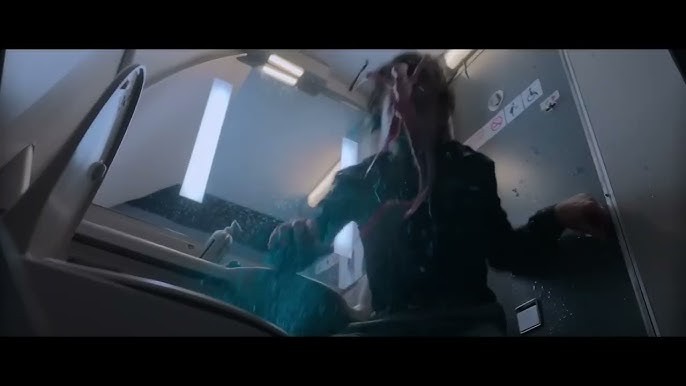
Holly Leena White’s Emma operates in an entirely different register and is all the more valuable for it. As the flight attendant whose entire professional identity is built around keeping things smooth and everyone calm, Emma becomes the film’s most quietly heartbreaking presence as that identity is systematically stripped away by circumstances no amount of training could have prepared her for. White plays the transition from composure to crisis with a naturalism that grounds the film’s more heightened sequences; her Emma never losing the instinct to help even when helping becomes genuinely dangerous. She is the human face of a film that is partly about what happens when the systems we trust to keep us safe reveal themselves to be insufficient, and White makes that theme felt rather than merely stated.
In the film, the aircraft interior was shot with a relentless, intimate urgency that transforms the familiar geometry of economy cabin and galley and cockpit into something alien and threatening. The film’s color palette shifts as Flight 298’s situation deteriorates, warm cabin lighting giving way to something colder and more wrong, the pulsing visual phenomena outside the windows rendered with a genuinely unsettling beauty. The creature work is deliberate and precise, deployed with a restraint that makes each appearance land with maximum impact rather than diminishing through overexposure. The sound design is the film’s secret weapon, frequencies and vibrations used to create a physical unease that bypasses rational processing entirely.
Black Box carries unmistakable shades of classic Twilight Zone unease and the creeping, paranoid dread of Invasion of the Body Snatchers, filtered through a genuinely modern and propulsive sci-fi horror sensibility that keeps the film moving at a pace that never allows the audience a moment to settle. The film is exactly what great sci-fi horror should be: a premise that sounds contained until it reveals itself to be enormous, executed with the confidence to stay in one place and let the walls close in slowly. By the time Flight 298 touches down, you will not look at the passengers around you the same way again.