
 A cop accused of murder has 90 minutes to prove his innocence to an AI judge in Timur Bekmambetov’s painfully bad Mercy.
Chris Raven, played by Chris Pratt, wakes up with a hangover and a harrowing task: prove his innocence for his wife’s murder in 90 minutes or die. Mercy is a court system AI, played by Rebecca Ferguson, wherein the accused pores through everyone’s cellphones, emails, and a few calls to others (let’s hope they are home, we know they aren’t hanging out Who Wants to be Millionaire style) to convince the AI there’s a reasonable doubt. Thus begins Timur Bekmambetov’s mind-bogglingly dumb Mercy. Be prepared, I’m going to go deep into the terrible script, but still trying to avoid direct spoilers, and ideas that got this film made. How anyone read this script and said “yeah, spend 60 million dollars on this is beyond me. Yes, a rant-view, but it must be done.
Mercy dies by the failure of its premise. The script, by Marco Van Belle, puts the audience in a Phillip K. Dick sort of scenario, a sci-fi overreach of power. Yes, it’s a bit of the point where the system is flawed. But the actual setup we’re meant to believe has been accepted is so ludicrous, it can’t pass suspension of belief muster. It cracks immediately, leaving the remaining 90 minutes a collection of “really?
Shoving someone, unprepared, into a murder chair and telling them they have 90 minutes to drop their “guilty percentage” to 92% (Pratt starts at 97.5) is instantly suspect. To prove their innocence, they have to find evidence on the fly, given access to the “community grid.” In this future, everything everyone does is legally required to be backed up ot the cloud at all times. Surveillance state is cool, and everyone’s alright with it, I guess. Lucky he’s a cop with resources at his disposal and knows how things work. Heck, he’s personally sent several people into the Mercy court. A layperson dropped in? Never. Not to mention, the onus is on the accused, not the prosecution, to prove it.
It’s an interesting concept, and there are so many kangaroo courts, trials with little evidence, and we all know of the two-level justice system, and its massive flaws in real life. But Mercy asks us to go along with an arrest and quick trial when, sigh, the murder scene is still being processed. Police are all over the house, collecting evidence. Not even a quick cover-up or the like. Just “hey, the broken Ring camera that doesn’t’ show him come into the house noted he was there just before the murder,” and some blood on his suit (a mere trace after a violent stabbing), and his fingerprints at the scene. Gasp, fingerprints of his… in his own house? So it’s OBVIOUSLY him. But yes, any rudimentary investigation, such as the quickened version Raven performs in 90 minutes, would reveal cracks in the case instantaneously, ending the film. When the film presented a reasonable doubt within minutes, it couldn’t sustain.
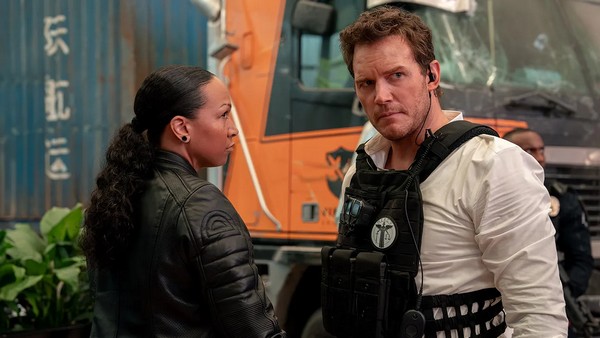 Over two years, the Mercy system has reportedly been successfully executed 18 times. Apparently, this has dropped the crime rate by 68%. To note: the death penalty is not a deterrent. There is little that actually deters crime except providing the resources at a basic Sorry folks of a certain thought: the poor aren’t automatically criminals for being poor. This falls into the Purge mindset of crime: violent crime is the only crime, and is done by terrible people who can’t wait to do it when given license to act out against their fellow man. For, apparently, this high-crime LA has also gathered up all the criminals and tossed them into lawless red zones, of continual violence and riots? The first Mercy case seemed to occur in one of these, where murder would be continual from what we see. In that case, if the first Mercy case, would never make muster to get a second. In one of the “Really?” moments, a “Red zone” that has working, decent hotels because the characters need to be at one.
I refuse to believe the courts in LA have only used this system once a month; we all know perfectly well they’d toss anyone in there and call it a day. It’s the same issue as the Purge, we all know crime won’t vanish because people have a strange desire: whether it be allowed ot do crime for 12 hours or this weird ass court proceeding, one which apparently has no humans watching or going through it at all, except social media polls? But people observing the actual trial? Nah, because if we did, it can’t continue.
Awful trusting of the AI. We know how often AI is wrong in real life. Toss a simple question in Google and get nonsense back. Although it’s handwaved in the movie, “AI and humans make mistakes, shrug” like railroading someone in an unbalanced system is the same as spilling the milk at breakfast. No doubt, Mercy is pro-surveillance, pro-compiling of data, and pro-police. It briefly mentions, then drops, the idea that Mercy may have miscarried justice before. Mostly, part of the plot is based on a previous trial (with heavyhanded set up, it’s no surprise), but it’s still attributed to humans deliberately acting in a specific way, which ruins the case for Mercy even more.
Speaking of the plotting? It’s insulting. The villain? Instantly pointed at as “that’s our guilty party.” The plan? It makes zero sense. It makes even less sense when explained further. How it flows, and the connection made to get the truth and move the plot, are tenuous at best, highly coincidental otherwise. 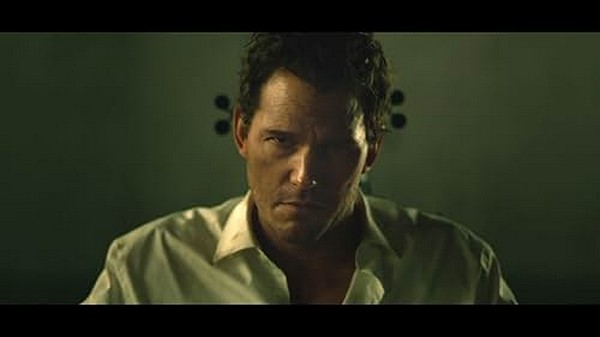 It’s not all for loss. So many times, it’s unintentionally hilarious how Bekmambetov films and presents the images. The sheer incredulity of the events caused so amny in my theatre to raise their hands in “WTF, mate?” The lines from Van Belle’s script that the characters have to say, partially Chris Sullivan, as Raven’s sponsor and his wife’s coworker, and Kylie Rogers as the daughter. Cringe. At least the film has enough mercy (heh) on us to use the 90-minute timer to keep a countdown of how much remains right there on the screen. No need to check the watch with each sigh. In non-snark: there are a few interesting moments in the presentation of the screenlife scenario. A few moments of the never-ending camera movement present a holodeck setup, surrounding Raven. But they’re fleeting, mostly watching Pratt watch screens and yell at people.
Chris Pratt is not a good dramatic actor. As much as I have issues with him as a person, he does a great comedic performance. Actually trying to emote? Not so much. Mercy is 100 minutes of Pratt strapped to a chair, trying so hard to display as many emotions as possible and failing. Rebecca Ferguson can barely muster any interest. If you told me she filmed her parts between set-ups on Dune Messiah in front of a green screen, I’d believe you. She’s 100% checked out. Sure, she’s playing an AI, but there’s a big difference between playing a character who speaks flatly and robotically and a whole performance. It’s such an oddity, even in not-so-good things, she’s often the highlight. Not here.
As noted, I cannot get over the quickness to execute the man. We review the movie we have, not what we think it should be, but this film could work in a 12 Angry Men sort of situation, with Juror 8 also being the accused. The case is done, execution is looming, and it’s a last-ditch appeal to prove it. But of course, if that way we wouldn’t have the active rush of all the pieces moving in real time. But at least it would solve the biggest, glariingest issue.
Mercy is a total mess, failing in concept and in execution. One can ignore glaring flaws; other issues work, but it all falls flat on its face. Inane direction from Timur Bekmambetov, terrible writing by Marco van Belle, and bad performances. The only respite is the occasional laughs within the sighs. Provide Mecy on yourself, and skip this film.