
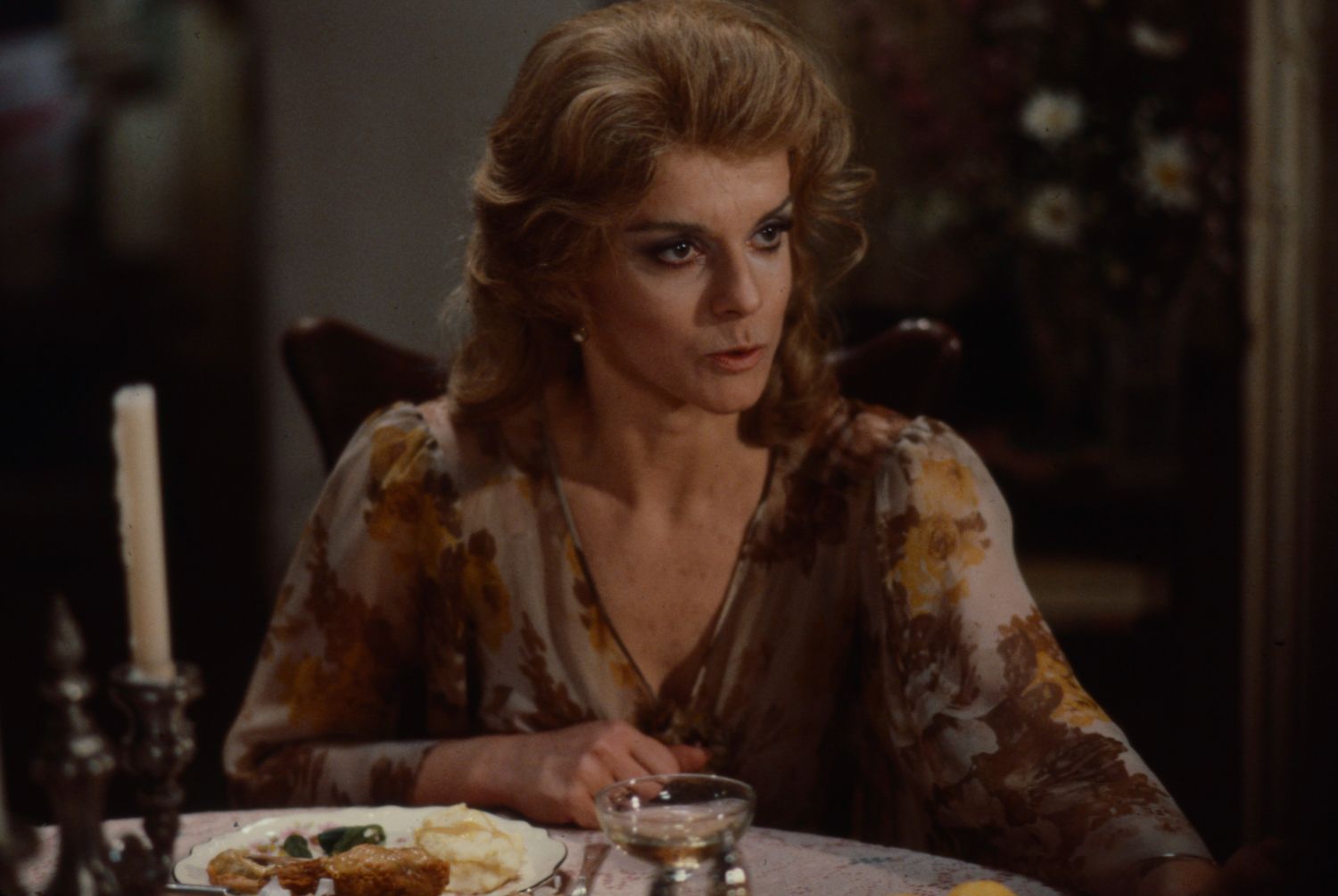
BOOTLEG FILES 928: “A Streetcar Named Desire” (1984 made-for-television film starring Ann-Margret and Treat Williams).
LAST SEEN: On YouTube.
AMERICAN HOME VIDEO: As a VHS video release only.
REASON FOR BOOTLEG STATUS: I have no idea why this is out of circulation.
CHANCES OF SEEING A COMMERCIAL DVD RELEASE: Nothing on the immediate horizon.
Remaking a classic film is always a thankless task, for nine times out of ten the remake is a pallid shadow that is eons removed from the artistry that made the original a beloved work. During the 1970s and 1980s there were plenty of misguided small-screen remakes of big-screen classics. Even the presence of genuine talent in those made-for television remakes couldn’t save them from being weak carbon copies – think of the 1972 “The Man Who Came to Dinner” with Orson Welles and Joan Collins, or the 1974 “Brief Encounter” with Richard Burton and Sophia Loren, or the 1976 “Dark Victory” with Elizabeth Montgomery and Anthony Hopkins, or the 1986 “Stagecoach” with Johnny Cash, Kris Kristofferson, and Willie Nelson.
One of the most ambitious made-for-television remakes might have been the 1984 version of “A Streetcar Named Desire.” For starters, the film had a major advantage over its 1951 predecessor by not being subject to Hollywood censorship. The original adaptation needed to make a few significant changes to the Tennessee Williams play to get Production Code approval – and while those changes didn’t ruin the film, they nonetheless diluted the emotional effectiveness of the screenplay when compared to the source material.
Perhaps the most daring aspect of the remake was the unlikely casting of Ann-Margret as Blanche Dubois. While mostly celebrated as a musical comedy star, Ann-Margret was a capable actress when given the right material. After all, she received Oscar nominations for her performances in “Carnal Knowledge” and “Tommy” and an Emmy for “Who Will Love My Children?”, while I believe that her finest performance was in the underrated 1985 British film “Return of the Soldier” where she held her own against Glenda Jackson, Julie Christie, and Alan Bates while offering a flawless English accent.
To her credit, Ann-Margret’s Blanche is not a carbon copy of the Vivien Leigh performance in the 1951 film. Instead of the neurotic and emotionally jittery woman that Leigh embodied, Ann-Margret’s Blanche comes across as a much more steely personality. This is evident in her two key scenes with Randy Quaid’s Mitch – when she bitterly recalls the discovery of her late husband’s homosexuality (one of the scenes scrubbed out of the film version by censors) and her plea of “I don’t want realism, I want magic” when she is directly confronted about her age – she is angry that her defenses are being assaulted and greets the encroachment with barely concealed rage.
It was a noble attempt to take a different approach to the role, but it throws off the tragedy of Blanche’s ultimate downfall and degradation. When this Blanche gives her parting line about always depending on the kindness of strangers, the pain of her emotional ruin is missing in Ann-Margret’s brittle line reading.
Part of the problem with Ann-Margret’s performance is that she has an inadequate Stanley Kowalski in Treat Williams. Of course, the Marlon Brando performance in the 1951 film is an achievement that might be too great to overtake – although back in the day, some critics claimed Anthony Quinn was a better Stanley when he replaced Brando in the Broadway production.
Williams offers a credible Louisiana accent and the right physique for the role, but he fails to register any of the feral sexual energy and raw brutality that made the character so compelling. His Stanley is handsome but crude, without any trace of animal magnetism. Here, it is impossible imagine why anyone would waste their time with such a loser.
Quaid’s Mitch and Beverly D’Angelo’s Stella are strictly adequate, though surprisingly strong performances come in the minor characters of the upstairs neighbor Eunice (played fiercely by Erica Yohn) and the young man collecting newspaper subscriptions (played with great charm by Raphael Sbarge). John Erman’s direction is typical for the 1980s made-for-television genre – efficient, if not necessarily effective.
“A Streetcar Named Desire” was broadcast on ABC on March 4, 1984, to mostly positive reviews. Tennessee Williams helped promote the production by praising its glamorous star. When award season rolled around, it received 11 Emmy nominations and won four technical prizes. Ann-Margret was among the Emmy nominees – she lost to Jane Fonda in “The Dollmaker,” but won a Golden Globe for her work.
This production was released on VHS video in 1999, but to date there has been no DVD or Blu-ray version. I have no idea why the film is commercially unavailable in the home entertainment market, but this unauthorized upload from the VHS video is available on YouTube:
IMPORTANT NOTICE: While this weekly column acknowledges the presence of rare film and television productions through the so-called collector-to-collector market, this should not be seen as encouraging or condoning the unauthorized duplication and distribution of copyright-protected material, either through DVDs or Blu-ray discs or through postings on Internet video sites.
Listen to Phil Hall’s award-winning podcast “The Online Movie Show with Phil Hall” on SoundCloud and his radio show “Nutmeg Chatter” on WAPJ-FM in Torrington, Connecticut, with a new episode every Sunday. You can also follow his book reviews at The Epoch Times.