
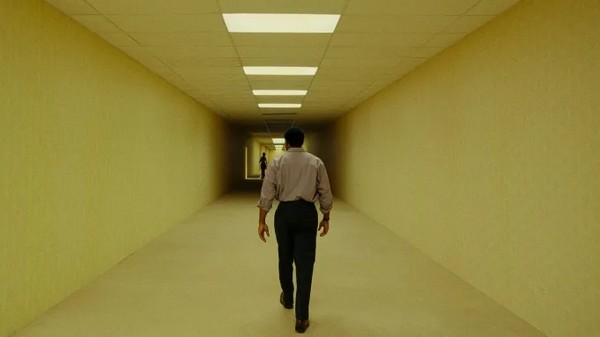
 A furniture salesman and a psychologist find themselves trapped in a never-ending labyrinth of danger and discomfort. Backrooms, Kane Parsons’ 2026 film, works best when it focuses on the horror and oddity, but falters when it tries to give it a story.
Working with liminal space is not new: the art of MC Escher, the literature of Mark Z. Danielewski’s 2011 novel House of Leaves and Shirley Jackson’s The Haunting of Hill House, and even cinematically in Stanley Kubrick’s adaptation of Stephen King’s The Shining featured impossible geography in The Overlook Hotel. King himself reflected on Hill House with the Seattle-based miniseries Rose Red. However, in modern takes, Kane Parsons’s two dozen shorts of Backrooms, initially created as a special effects test while pulling from the creepypasta, were made famous when they took the internet by storm in 2022. In its uncomfortable wake was AppleTV’s Severance, the video game and movie Exit 8, and a general online push (so many AI videos have been popping up in my reels, ugh). Now, Parsons expands the shorts into a feature written by Will Soodik of Ash vs. the Evil Dead, produced through A24. Backrooms falls squarely in the I Wish I Liked This More camp. I enjoyed the shorts, even with diminishing returns, and love liminal horror in culture and life (watching many non-AI YouTube and reels of explorers). When it works, Backrooms works exceedingly well, but just as often is dull and stretched, struggling to make something more fully cinematic out of the basic concept.
The concept and series work on the base fear of “this shouldn’t work, this shouldn’t be here, I shouldn’t be here” of the places that feel weird and off in our world. Buildings used to being full of life, now quiet and empty like a subway station at 2 am (Exit 8 tapped this), endless hotel corridors (anyone who has worked an event at a hotel or arena can attest to the labyrinthian backstage areas), or too many other places. It’s too quiet, too still; stale air and perhaps a slightly mildewy smell. A noise in the distance – is it a person who will get you in trouble for maybe doing some urban exploring, or a real danger? Maybe even a monster?
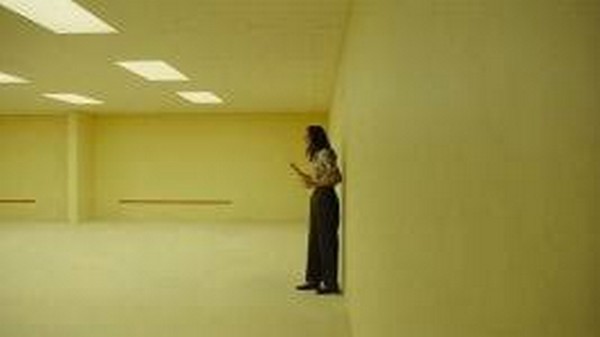 In adapting the web series to film, Soodik and Parsons are most effective when focusing on the horror over the story, replicating the feel of the original shorts. While the shorts were created in computer software, Backrooms, the movie, is physical. The sprawling location, the impressively and physically built 32,000 square foot set, is chilling and uncomfortable (some CG is used to increase the madness); twisting and turning on itself in a Lynchian hellscape. Danny Virmette’s production design feels wrong in the right ways. Within those walls, so many moments of shocking effectiveness build on the general unease and rising tension of the claustrophobia of the location. Quick bouts of truly insane and messed-up moments hit hard (a sequence towards the end plays like a twist on Texas Chain Saw’s memorable dinner scenes). When it goes well, it goes hard. It gets deliciously messed up in action outside of the horror of the scenario itself. It’s doubly effective when on a camcorder, calling back to the handheld look of the shorts and adding an additional level of disconnect (liminal woods horror of The Blair Witch Project calling).
The film hits the same wall of the shorts in keeping it interesting, but in a different way: after the concept, where do you go? For the shorts, Parsons tried to add in explanation and scientists (represented in the film by Creep’s Mark Duplass in a useless character that ends the movie with a thud). In the film, a wider story of characters finding their way to the liminal space is added. In 1990, Chiwetel Ejifor’s Clark is a struggling furniture store owner, angry, drunk, and depressed about how his life is turning out. His therapist is Dr. Mary Kline, played by Renate Reinsve; she’s also dealing with the crushing loneliness of her life, plagued by memories of her childhood with an unwell mother. Both Oscar-nominated performers (he for 12 Years a Slave in 2014, she for Sentimental Value last season) do very well in giving their characters life, setting a sad, low-key feel of the film, and much of the titular location. But giving so much to them distracts from the story, and ultimately doesn’t matter. I appreciate the setup, but after an effective opening, the film stutters for 40 minutes.
But for a movie like Backrooms, it’s damned if you do, damned if you don’t. Part of what makes the shorts work is the free-flowing, nearly storyless nature; sure flashes of character in the scientists and the unlucky folks who wander in, but it’s that uncomfortable, alien feel that makes it work. It’s a film that works in the vibe and visuals, rather than the whys and wherefores. Even if not explaining the Backrooms (thankfully Parsons didn’t, outside of about two sentences from Duplass, no Psycho Psychologist holds the audience’s hand exposition here), adding in character and more story around it lessens the impact. But the film, as a feature, can’t exist without it. Look at Skinamarink, I liked it more than others, but it’s exhausting in a continual stretch of static sequences.
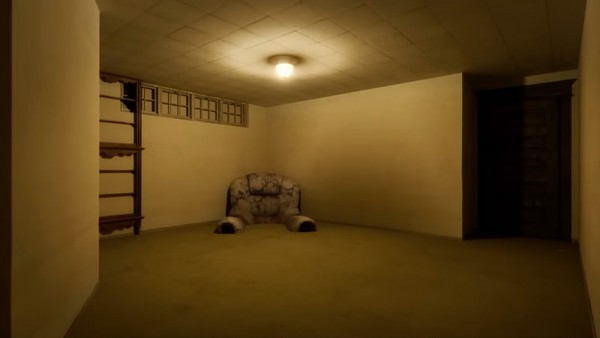 It’s a balance that’s hard to achieve, and unfortunately does not. Clark and Mary are interesting characters to start, digging into their loneliness, histories, and insecurities that are reflected in teh black mirror of the Backrooms in interesting ways. But everything set up for them becomes nearly nothing, descending into near incoherence. Sure, their psyches are noted in the design, but it hits empty. Sequences of them wandering around calling out lessen the impact and stretch the sharp scare of the location to a dull repetition, waiting for the film to move on. The same can be said in many non-horror sequences, stretching the points or conversations awkwardly. There’s a much more effective 90 minutes within these 110.
Even with my issues, I highly appreciate the film. I appreciate Kane Parsons for not taking the option and churning out something more standard. Keep it weird, keep it strange, follow your messed-up vision. Please. Thirteen hours after my screening, writing the initial draft, the film has sat better than walking out; settling in over initial disappointment. Something works surely, I actually had Backroom nightmares that night. That’s unique, and harks to the core effectiveness of the film and its concept. I’m incredibly glad this is the year of YouTube personalities making a splash (after last year’s pair of disappointments in House on Eden and Shelby Oaks): Curry Barker’s Obsession is already a cultural touchstone, and Markiplier’s Iron Lung is as buoyant at the box office.
In the end, I still recommend sliding into that strange hole in the wall and checking out Backrooms. While so much didn’t work for me, what did has had a staying power. It’s weird, it’s messed up, it’s something truly different, and that goes a long way. Kudos to Kane Parsons, only 20 years old, for getting something this grand made. It’s impressive.