post

The Last Rodeo (2025)

In “The Last Rodeo,” Neal McDonough stars as Joe Wainwright, a retired rodeo champion in his fifties who works as a blacksmith in a small Texas town. A widower, Joe wants his grandson Cody (Graham Cody) to follow him in bull riding, but his daughter Sal (Sarah Jones) is opposed – especially since Joe’s rodeo career ended with a neck-breaking accident that resulted her becoming his caretaker in the years before he regained his health.
Continue reading

post

The Bootleg Files: Rabbit Habit

BOOTLEG FILES 908: “Rabbit Habit” (1975 parody of the Warner Bros. cartoons).

LAST SEEN: On YouTube and Internet Archive.

AMERICAN HOME VIDEO: None.

REASON FOR BOOTLEG STATUS: A wildly unauthorized use of copyright protected material.

CHANCES OF SEEING A COMMERCIAL DVD RELEASE: Not likely.

Over the years, this column has occasionally featured underground cartoons that wickedly parodied beloved animated characters – “Apocalypse Pooh,” “Bring Me the Head of Charlie Brown,” “A Charlie Brown Kwanzaa” and “Mickey Mouse in Vietnam” were among best titles that I’ve celebrated. However, I must apologize for taking so long to highlight a true masterpiece of this micro-genre: the 1975 “Rabbit Habit,” which imagines the Looney Tunes icons as drug dealers and addicts.
Continue reading

post

Every Bugs Bunny Ever: Baby Buggy Bunny (1954)

Baby Buggy Bunny (1954)
Directed by Charles M. Jones
Story by Michael Maltese
Animation by Ken Harris, Abe Levitow, Lloyd Vaughan, Ben Washam
Music by Milt Franklyn

Of all the adversaries who challenged Bugs Bunny, Baby Face Finster was arguably the most inventive concept of a villain. The idea of an adult (and rather butch) midget disguising himself as a baby was pure genius, and Finster’s fracas with Bugs was among the most original and invigorating in the history of the character’s films.
Continue reading

post

The Swimmer (1968)

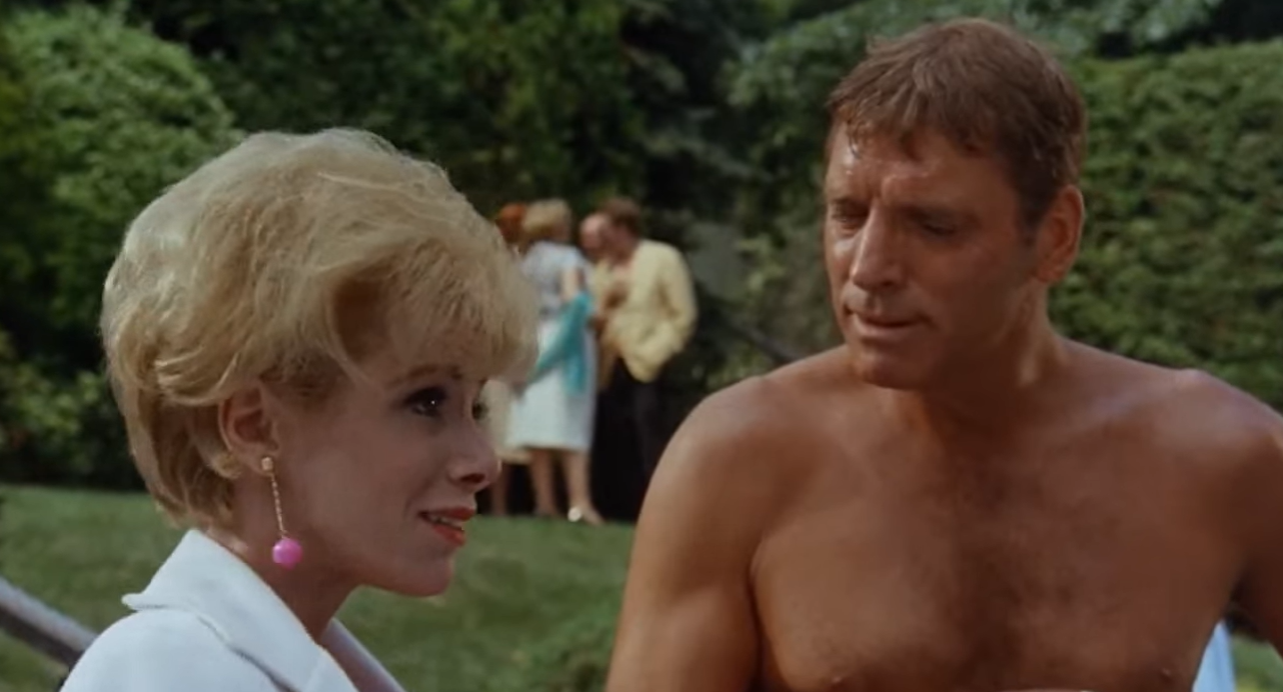
It’s a shame that “The Twilight Zone” ended its television run just before John Cheever’s short story “The Swimmer” appeared in The New Yorker – Rod Serling’s half-hour anthology drama would have been a perfect environment for adapting Cheever’s surreal and disturbing 12-page tale. Instead, the husband-and-wife team of Frank and Eleanor Perry opted to greatly expand the Cheever story into a feature-length film. The result was the cinematic equivalent of building a three-story home on a one-story foundation.
Continue reading

post

The Bootleg Files: A Weighty Problem

BOOTLEG FILES 907: “A Weighty Problem” (1980 educational filmstrip featuring characters from “The Flintstones”).

LAST SEEN: A restored version is on YouTube.

AMERICAN HOME VIDEO: None.

REASON FOR BOOTLEG STATUS: Educational filmstrips have no perceived commercial reissue value.

CHANCES OF SEEING A COMMERCIAL DVD RELEASE: Not likely, unless a documentary on the subject is made.

If you were a K-12 student in American schools during the 1960s and 1970s, you probably remember the use of filmstrips in your classes. Filmstrips were a spool of 35mm film that featured still photographs on each frame. The filmstrips were shown via a hand-operated projector, with one frame at a time projected on a screen while a soundtrack recording on either an album or a cassette tape provided narration or character dialogue to match the images. The soundtrack recording would offer a beep or a ding, which was the cue to the projector’s operator to turn the spool to the next image.
Continue reading

post

Every Bugs Bunny Ever: Yankee Doodle Bugs (1954)

Yankee Doodle Bugs (1954)
Directed by Friz Freleng
Story by Warren Foster
Animation by Arthur Davis, Manuel Perez, Virgil Ross
Music by Milt Franklyn

While few animation scholars would cite “Yankee Doodle Bugs” as being among the finest of the Warner Bros. output, I freely admit this is one of my favorite cartoons in the Bugs Bunny series. Yeah, it is not an artistic classic, but it is a cute film that has good-natured fun with Colonial American history.
Continue reading

post

The Passion of the Christ (2004)

In 2004, the faith-based film genre received a jolt from an unlikely source. Mel Gibson, who secured his international movie stardom in the “Mad Max” and “Lethal Weapon” franchises, had proven his worth as a filmmaker with the 1995 “Braveheart,” winning Academy Awards for Best Picture and Best Director. Gibson was no stranger to Jesus-centric films – his Icon Productions was one of the companies that backed the animated feature “The Miracle Maker” – and the financial success he secured from his movies enabled him to independently finance his own feature on Jesus.

Continue reading