

For many years, the 1910 version of “Frankenstein” was the subject of endless speculation when the film was believed to be irretrievably lost. The agitation over its absence was understandable, since it represented an early foray into the horror genre and it was the first film adaptation of the Mary Shelley novel.
Strangely, much less interest has been generated by the second film version of the Mary Shelley novel. This 1915 production, titled “Life Without Soul,” was somewhat closer to its source material than the 1910 film, and it was later at the center of one of the most unusual intellectual property legal cases to emerge in the 1930s.
“Life Without Soul” was the first endeavor from the Ocean Film Corporation, a New York-based production company that opened for business in 1915 with the grand plan “to produce unusual features of themes never heretofore touched, largely adaptations from literary masterpieces.” A film version of “Frankenstein” was announced to be the first of eight feature-length films. This was something of a bold choice, as the 1910 “Frankenstein” and horror had yet to gain solid acceptance from film audiences. It is unclear why the production did not keep “Frankenstein” as its title.
Jesse J. Goldburg, the company’s vice president and general manager, wrote the screenplay while Joseph Smiley, a prolific actor and director of the silent era, took the directing credit. Percy Standing, an English actor and a member of the distinguished Standing family of theatrical thespians, was cast as the monster (called “The Creation” in the film). The production was shot on locations in Florida and Georgia, with one sequence filmed aboard a steamship sailing the Georgia shoreline.
“Life Without Soul” begins with a contemporary American physician/scientist named Victor Frawley (played by William A. Cohill), whose laboratory experiments result in a serum that he declares to be a “life-giving fluid.” Taking a respite from his work, Dr. Frawley relaxes with a copy of Mary Shelley’s Frankenstein, but falls asleep while holding the book. (One should assume that his abrupt slumber is due to his excessive workload and not to Mrs. Shelley’s literary shortcomings.)
The film drifts into an extended dream sequence, with Dr. Frawley becoming none other than Dr. Frankenstein. The dream mirrors the celebrated book, with the doctor’s fiancé, family and friends gathered about with equal parts awe and apprehension about his ongoing experiments. Dr. Frankenstein announced that he created a serum that can bring about life from inanimate objects, and he proves its power with a giant clay statue. Thanks to this remarkable elixir, the huge statue is transformed into a hulking, fearsome man.
Sadly, “The Creation” is not welcomed in the company of Dr. Frankenstein’s friends and family – or by any other people, for that matter. Anguished by his pariah status, The Creation begs the doctor to give him a mate for companionship. Dr. Frankenstein reluctantly agrees but breaks his promise. Enraged, The Creation goes on a killing spree that takes the lives of the doctor’s sister and best friend. Dr. Frankenstein flees his creation, but tragedy strikes on the doctor’s wedding night when The Creation tracks down this creator and murders the new Mrs. Frankenstein.
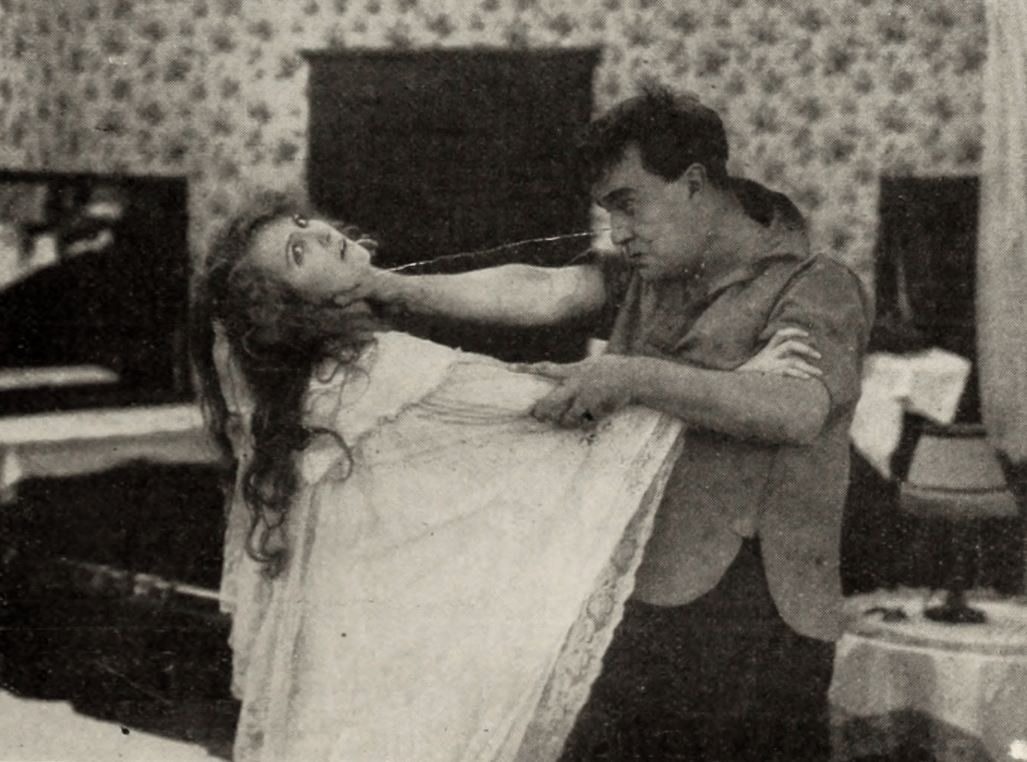
Dr. Frankenstein attempts to escape The Creation by sea, but the monster manages to board the ship and kill off the entire crew by throwing them overboard. But whereas Mary Shelley’s characters perished in the Arctic, “Life Without Soul” centers its violent climax at the Grand Canyon (with Georgia’s mountains used for the location shots). Recognizing that his monster cannot be killed, Dr. Frankenstein manages to lure The Creation into a deep cave. Once The Creation is within the cave, Dr. Frankenstein uses dynamite to blow up the cave’s entrance, permanently imprisoning The Creation within. At this point, Dr. Frawley awakens from his horrible dream and hurriedly destroys his new elixir.
The journal Motography gave the film a glowing review, with particular praise for its interpretation of the monster. “The superman, a creature of superb physique who, without conscience, makes no attempt to restrain the cravings of his healthy body, is an exceptionally suspenseful figure for the photoplay,” the anonymous Motography critic proclaimed, adding that Percy Standing “acts with consistency and his performance is one that is certain to meet with general approval.”
If surviving still photographs from the production are any indication, Standing’s monster looked more like a brutish human than a laboratory-conceived monster. Standing avoided the grotesque make-up excesses carried by Charles Ogle in the 1910 “Frankenstein” and instead used rough body movements and facial emoting to bring The Creation to life.
“Life Without Soul” was in release through 1915, but it was not a box office hit. Another company, Raver Film Corporation, put the film back into release in 1916 and incorporated additional footage from educational films that showed blood circulation through veins, cells conjugating and (somewhat curiously) reproduction habits of fish. That version also failed to appeal to audiences.
Ocean Film Corporation, sadly, was not able to pursue its grand plans and went out of business within a few years of the premiere of “Life Without Soul.” The film vanished from sight until 1931 when a Russian-born independent producer named Michael Mindlin located surviving prints of the film with the plan to re-release it in theaters under the “Frankenstein” title – this was done solely to cash in on the publicity that Universal Pictures was generating for its James Whale-directed adaptation of the classic work. The trade publication Film Daily reported that Mindlin had planned to add a narration to the silent film to make it more palatable to audiences that favored talkies over the old silents.
Universal, not surprisingly, was displeased by Mindlin’s actions. And while Mindlin’s Mindhyam Theatrical Co. lacked the distribution machinery that the Hollywood studio enjoyed, it nonetheless saw the upstart as an irritation that needed to be stopped. Universal dragged Mindlin into New York Supreme Court to prevent him from releasing “Life Without Soul” under the Frankenstein label. Although Mindlin correctly noted that Mary Shelley’s Frankenstein was in the public domain, the court ruled against him. “It is apparent that the only purpose of the use of the word ‘Frankenstein’ in the advertising, exploitation and publicity of the defendant’s motion picture, “Life Without Soul” or “Body Without Soul” would be to confuse and mislead the public.”
Mindlin lacked the funds and the fury to wage war against Universal. There is no record that his re-release of “Life Without Soul” was ever theatrically screened.
At this point, “Life Without Soul” disappeared. For years, rumors circulated that a print resided in a European archive – Forrest J. Ackerman, the beloved editor of the Famous Monsters of Filmland magazine, reported on this print’s potential survival outside of the United States. But as with too many rumors of lost films allegedly in far-flung and inaccessible locations, no print ever turned up.
And whereas the once-lost 1910 “Frankenstein” is now easily available for online viewing, the 1915 “Life Without Soul” can no longer be appreciated.