
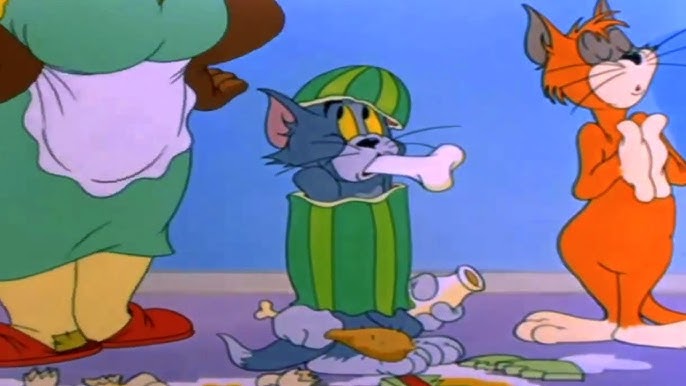
One of the most misunderstood (and, subsequently, controversial) characters in animation history is the amply proportioned Black woman who appeared in 19 of the Tom and Jerry shorts. Contemporary sources refer to as “Mammy Two Shoes,” but that name was never used on-screen or in the screenplays – that moniker was first applied incorrectly in a 1975 Film Comment article and stuck ever since. Not only did she not have a name, but viewers never saw her face (outside of a split-second gag in the 1950 “Saturday Evening Puss”) and never truly understood her relationship to the troublesome cat and mouse duo. It is widely assumed she is a maid or housekeeper because she wears an apron, but if that is the case her (presumably white) employers are never shown or even mentioned. In “Saturday Evening Puss,” she refers to the residence as “my house,” suggesting homeownership rather than domestic servitude.
Fred Quimby, the producer of the Tom and Jerry cartoons, explained in a 1951 interview with The Hollywood Reporter that the character’s face was not seen because he felt that would be a distraction from the cat and mouse, who were the central focus of the shorts. The character was voiced by Lillian Randolph, a Black actress who was best known in the 1940s as the jolly housekeeper on “The Great Gildersleeve” radio series. Although the scripts required Randolph to use a “Mammy”-style manner of speech, Randolph invested a surplus amount of humor into her line readings – and this made the character a genuinely hilarious feature of the Tom and Jerry series.
Alas, the NAACP didn’t find the female character funny and successfully forced her removal from the cartoons while they were still in theatrical release. Later in the television and home entertainment eras, the cartoons featuring the character were either kept out of release or redubbed by another actress doing a more refined voice performance – but that new voice was nowhere near as funny as Randolph’s original work.
“Old Rockin’ Chair Tom” is one of the cartoons featuring this female character that doesn’t get shown on television; I am calling her “female character” for this review since the exact nature of her identity is hazy.
The cartoon opens with Jerry gleefully antagonizing the female character, who is standing on top of a stool screaming for Tom to get rid of the mouse. A lazy and sleepy Tom shows up and spectacularly fails in trying to catch Jerry. The female character declares with exasperation, “Thomas, if you is a mousecatcher, I is Lana Turner, which I ain’t. The trouble with you is, you is gettin’ too old to catch mice.”
The female character brings in another cat to do Tom’s job, an orange feline named Lightning. And his name is appropriate – he flies across the room at supersonic speed, with a trail of electrical fire following him. Lightning immediately evicts Jerry from the house, while Tom is left looking on feebly. Lightning then pastes a fake white beard on the wobbly Tom while the female character tells him to “take good care of poor old Uncle Tom.” (Okay, that joke crosses a line.)
But once the female character retires for the night, Lightning begins to raid the refrigerator. The female character hears the gluttonous assault and comes to the kitchen, where Lightning quickly frames Tom as the ravenous culprit. Tom gets evicted from the house, and in his backyard exile he conspires with Jerry to wreak revenge on Lightning.
“Old Rockin’ Chair Tom” shows the Tom and Jerry series at the peak of its creativity. The sight gags are inventive and (pardon the expression) lightning fast, and the boisterous music score (including an unexpected but brilliant sampling from “The Trolley Song”) gives the short an extra pep boost. This is also among the few cartoons where Tom and Jerry work together as partners against a common foe, with Tom clearly enjoying his newfound camaraderie with Jerry as they gleefully destroy Lightning’s reputation with the female character and regain the comfort of their home.
The original uncut version of “Old Rockin’ Chair Tom” with Lillian Randolph’s voice performance can be found online. For sheer slapstick merriment, the cartoon is a gem.