
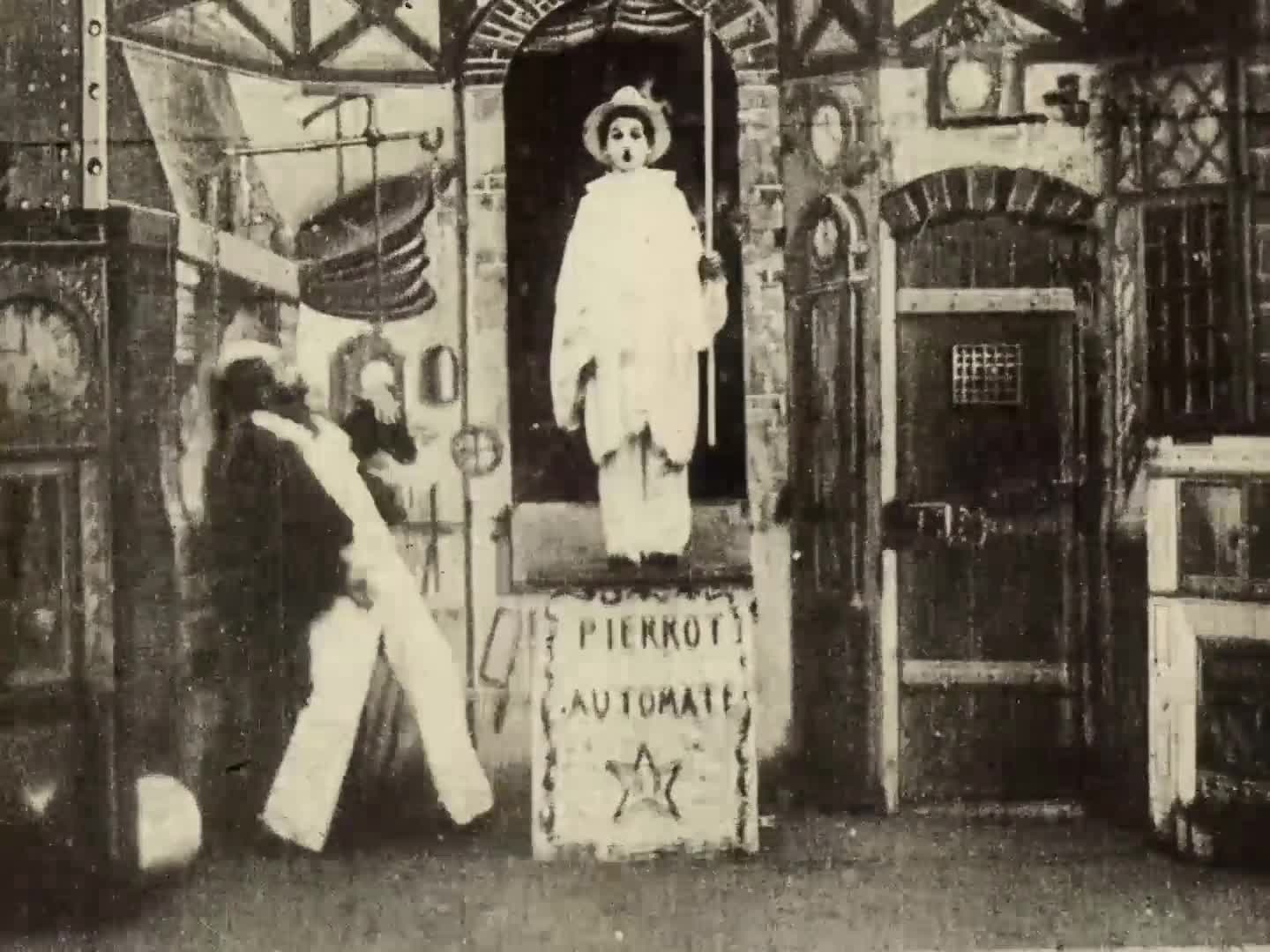
BOOTLEG FILES 935: “Gugusse and the Automaton” (1897 short film by Georges Méliès).
LAST SEEN: On the Library of Congress website.
AMERICAN HOME VIDEO: None.
REASON FOR BOOTLEG STATUS: It was one of many films from the late 19th century that were bootlegged.
CHANCES OF SEEING A COMMERCIAL DVD RELEASE: Maybe someday in an anthology of rediscovered lost films.
During the height of his film production career, the pioneering French producer/director Georges Méliès fought a losing battle against miscreants who made bootlegged copies of his films and profited in selling these unauthorized prints. The bootlegging was particularly acute in the American market, where Méliès was forced to set up a sales office to fight against the characters who were pirating his work.
Méliès was not alone if having to deal with this problem. Other prominent producers during the early years of the motion picture industry found their works were being duped and sold by shady distributors. Legal enforcement of cinematic intellectual property was still in its infancy at that time, so the threat of litigation wasn’t powerful. One strategy that was used to signify ownership of a film production was to include the producer’s logo on the screen. Perhaps the most dramatic example of that approach was the 1903 Biblical drama “La Vie et la Passion de Jésus Christ” that involved the production company, Pathé Frères, sticking its rooster logo on the walls, stairways, and even the side of a boat in the film’s ancient Judean setting.
Méliès placed his company’s logo, a black edged star, in visible positions in many of his films. This included the 1897 romp “Gugusse and the Automaton,” where the star logo was highly visible on the box where the robotic puppet stands. But that didn’t stop the bootleggers from duping prints of this work and selling them illegally.
While this created a great financial loss for Méliès during his time, it turned out to be a blessing in disguise. In February, the Library of Congress announced that it was in possession to the only known surviving copy of “Gugusse and the Automaton.” And as luck would have it, this cop was a duplicate estimated to be at least three times removed from the original print. Thus, the original copies of the film are considered lost forever – Méliès destroyed many of his films after his motion picture company failed – but this bootlegged version miraculously survived.
According to the Library of Congress, this 35mm nitrate print was part of the collection of William Delisle Frisbee, a Pennsylvania potato farmer and schoolteacher who had a side gig in the late 19th and early 20th centuries hosting film shows in small towns. Using phonograph recordings to give a soundtrack to these silent films, Frisbee introduced many rural communities to the magic of the movies. The Méliès films, with their playful special effects, were particularly popular with these audiences. Frisbee’s collection was passed down through generations of his family before being presented to the Library of Congress for preservation and restoration.
The 45-second “Gugusse and the Automaton” is typical of Méliès’ work. It involves static camerawork capturing frantic actions that used trick photography to create unlikely but wonderous happenings.
In this film, Méliès is the magician Gugusse, who has built an automaton dressed like the clown Pierrot. The automaton stands on a giant box with a crank that Gugusse turns. With each turn, the size of the automaton grows, from a boy to a young adult to an adult. When the automaton reaches adulthood, it hits Gugusse over the head with a stick. Gugusse takes the automaton from its place atop to box and places it on the floor and then begins to hit it on the head with a giant mallet. With each whack, the automaton shrinks, going from adult-size to young adult-size to boy-size before being reduced to the height of a dolls. Gugusse gives the object a final whack, obliterating it completely.
The rediscovery of “Gugusse and the Automaton” gives film scholars hope that other long-lost works will someday turn up. And if you haven’t had a chance to see this rare work yet, here it is courtesy of the Library of Congress:
IMPORTANT NOTICE: While this weekly column acknowledges the presence of rare film and television productions through the so-called collector-to-collector market, this should not be seen as encouraging or condoning the unauthorized duplication and distribution of copyright-protected material, either through DVDs or Blu-ray discs or through postings on Internet video sites.
Listen to Phil Hall’s award-winning podcast “The Online Movie Show with Phil Hall” on SoundCloud and his radio show “Nutmeg Chatter” on WAPJ-FM in Torrington, Connecticut, with a new episode every Sunday. You can also follow his book reviews at The Epoch Times.
Mon Dieu! Melies is the guy who got me interested in silent movies when I was seven or so.