post

The First Monday in May (2016)

Forget about the “Ghostbuster” broads – the funniest woman on screen today is Anna Wintour, the Vogue editor-in-chief, who steals the show in Andrew Rossi’s documentary on the creation of the 2015 “China: Through the Looking Glass” exhibit at New York’s Metropolitan Museum of Art.

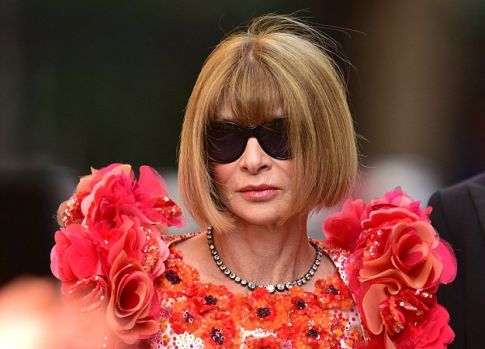
Okay, Wintour is not trying to be funny in this film. In fact, she gives the impression that she has no sense of humor. But the woman’s overwhelming sense of self-importance, the exaggerated majesty that she receives – she travels with a small army of sycophantic babes and mincing queers, and her every word is absorbed with near-religious mania – and her impatience at anyone that fails to achieve her goal of glamour can inspire laughs for those with a delightfully cruel sense of humor. And, of course, there is her style: a clunky helmet of a hair, sunglasses that are two sizes too big and a garish wardrobe that would have embarrassed Phyllis Diller. For someone who is supposed to be an infallible expert on what’s chic, the real-life Wintour is more hilarious than the make-believe Wintour played by Meryl Streep in “The Devil Wears Prada.” (And, yes, some clueless reporter asks Wintour about that vehicle – her attempt to conceal contempt while offering a well-rehearsed diplomatic response is priceless.)

As for the rest of the film – well, let’s just say that it offers a none-too-flattering view of the cultural insensitivity and burdensome vanity that goes into simultaneously mounting an exhibit on Chinese-inspired Western fashions while setting up the museum’s annual Met Gala that is chaired by Wintour. (That is the event where starlets and singers vamp the red carpet while wearing outlandish gowns for the benefit of celebrity tabloids.) For people that may believe museum administrators are sophisticated and erudite, this grueling and lethargically paced portrait of ego, flattery and jittery planning skills will be quite an eye-opener – provided  you don’t fall asleep during the film’s Wintour-less moments.

post

Yoani’s Trip (2016)

In 2013, a change to Cuban passport laws enabled the controversial blogger Yoani Sánchez to leave her country for a trip abroad – she had previously been rejected 20 times for an exit permit. This documentary by Peppe Siffredi and Raphael Bottino follows Sánchez on a February 2013 trip to Brazil, where she is greeted with a mix of praise and hostility.

While Sánchez’s schedule is packed with media interviews and guest appearances at special events, she is constantly shadowed by angry protestors that call her a traitor to her country and the spirit of the Castro revolution. Sánchez appears to be mostly amused by her detractors – it is never entirely clear who is organizing their efforts – and her presence in Brazil is overwhelmingly greeted with positive feedback from the reporters, government officials and students she encounters.

While the film offers disturbing insight on the extreme measures used the Cuban government to censor and limit Internet access among its people, Sánchez’s power as a writer is presented mostly by reputation than substance. Relatively little of the writing from her famous Generation Y blog is offered to the viewer. And what is presented – a relatively mild and vaguely academic criticism of the Castro regime and an inventory of the problems facing Cubans – seems rather tame by the roughhouse standards of American blogging.

Oddly, at 70 minutes the film feels a bit flabby – some tighter editing would have made it more effective. But as a consideration on the continued lack of free expression in Cuba, this production is a welcome arrival.

post

The Babushkas of Chernobyl (2016)

In the 30 years since the Chernobyl catastrophe, a 1,000-square-mile Dead Zone surrounding the wrecked nuclear power plant is still one of the most highly radioactive places in the world. And while this section of Ukraine is guarded by the military and off-limits to most civilians, it is still home to roughly 100 elderly women that refused to leave their homes and successfully fought against evacuation from the area.

Filmmakers Holly Morris and Ann Bogart capture an extraordinary portrait of the resilience in the face of calamity. The eponymous babushkas happily go about their lives in their small homes in the woods around Chernobyl: they fish in a stream, collect rain water, grow fruits and vegetables in their gardens and make their own wine. Military scientists bring them bread while recording radioactivity levels as government welfare workers deliver pension payments—four months late, due to Ukraine’s political instability—as well as bags of food. Most of the women appear to be in vibrant physical and emotional health, despite the contamination to the water and soil, although one woman is evacuated after a painful fall left her incapacitated. (She later died in a nursing home.)

The film also presents insights on Chernobyl’s environmental legacy from Mary Mycio, author of Wormwood Forest: A Natural History of Chernobyl, as well as insight into the creation of a grand sarcophagus that will entomb the disabled reactor and prevent further radiation releases. The most unusual part of this film follows the clandestine antics of young rogues that call themselves “Stalkers” and slip into the Dead Zone to visit its abandoned structures and proclaim inanities such as “This is a post-apocalyptic romance” while viewing the ruined landscape.

This astonishing portrait of the three-decade-old residue of Chernobyl is utterly compelling. Even more amazing is the perseverance of the babushkas amid extraordinary circumstances—they are the funniest, brightest and most inspiring women ever captured on film. This production is one of the most fascinating and invigorating non-fiction films of the year.

post

Specter of the Rose (1946)

In 1946, low-rent Republic Studios lured Oscar-winning writer Ben Hecht with the offer of being able to produce and direct films. But while the studio gave Hecht creative liberty, it imprisoned him within its ridiculously low budget framework. For his first (and, it turned out, only) Republic offering, Hecht had $200,000 to spend.

The resulting work, “Specter of the Rose,” turned out to be one of the most bewildering features of Hollywood’s Golden Age. Part-thriller, part-light comedy and part-ballet, the production was an emotionally bipolar experience. It also betrayed Hecht’s limitations as a filmmaker – cinematographer Lee Garmes shared co-director status, albeit with minimal prominence in the credits.

“Specter of the Rose” focused on the efforts of would-be impresario Max Poliakoff (played by Russian acting teacher and occasional thespian Michael Chekov) trying to pull together various dubious talents for a major ballet endeavor. Aging ex-ballerina Madame La Sylph (Judith Anderson) reluctantly agrees to get pulled into Poliakoff’s scheme, which involve bringing the elusive ballet star Andre Sanine (Ivan Kirov) back to the stage. Sanine had been sidelined following the on-stage death of his wife, and in his grief he began proclaiming that he was responsible for her death. But the offer to star and choreograph a new production, coupled with his sudden infatuation for Haidi, one of Madame La Sylph’s students (Viola Essen), brings Sanine back to performing.

However, the endeavor is wrought with endless problems: Poliakoff runs up debts and resorts to outrageous lies to keep his creditors pacified while a degenerate poet (Lionel Stander) whose love for Haidi goes unrequited stalks the ballerina. Haida winds up marrying Sanine, but his mental health begins to fray after their wedding – and it appears that his distraught claims about being responsible for his wife’s death had a ring of truth.

“Specter of the Rose” is notable for carrying some of the most pretentiously peculiar dialogue in the history of English-language cinema. Lines such as “The lunacy of great artists usually produces masterpieces, not murders” and “The suffering of the masses is a minor phenomenon beside one man’s tears” and “Hug me with your eyes” crash throughout the story, and it is hard to determine whether Hecht was trying to make an artistic statement or if he wrote the script while drunk.

There is also the bizarre performance by Chekov – with his wavy hair, oversized boutonnière and florid use of language (everyone is called “darling,” regardless of gender), his Poliakoff vividly shredded the Production Code’s taboo on obvious homosexual characters. The character’s atrocious behavior – deliberate mistruths, unctuous flattery and silly threats – makes him maddening rather than amusing. Matching Chekov for sheer strangeness is Stander, the gravel-voiced character actor whose line readings of Hecht’s overripe dialogue are so tortured that it feels like he is reciting his part phonetically.

And as for the grand ballet that is promised for the first two-thirds of the film, the resulting production is such a Republic-caliber cheapjack offering that it feels like the screenplay’s endless teasing of a masterwork was the ultimate bait-and-switch – especially since the title and a few dialogue references to the ballet “Le Spectre de la Rose” seem to suggest there would be a version of that masterwork on screen.

Nonetheless, “Specter of the Rose” keeps the viewer attention through Garmes’ effective noir-style cinematography (which mostly hides the poverty of the budget) and a stunning performance by Ivanov, a Broadway chorus dancer making his film debut. His rugged physical presence and offbeat interpretation of the increasingly unhinged ballet star dominates the film – and even if Tamara Geva’s choreography is less than stellar, Kirov’s physicality and emotional interpretation of the work saves the day. (Sadly, this was his only film appearance.)

And for all of its failings and weirdness, “Specter of the Rose” ties up brilliantly for its startling climax, where Sanine’s madness and sense of artistry duel over him. Without giving too much away, it can be said that this sequence embodies an astonishing mix of Garmes’ visual style, Kirov’s magnificent dramatic and physical talent and Hecht’s audacity to ratchet up the bizarre to a level of intellectual horror. This leaves the viewer with a sense of “what the hell was that?” – but, also, a subsequent consideration of “wow, that was really different!”

post

First Degree (2016)

Two-time Academy Award-nominated filmmaker Roger Weisberg (“Sound and Fury,” “Why Can’t We Be a Family Again?”) helmed this intriguing documentary short on efforts by New York’s notorious Sing Sing Prison to reduce recidivism through higher education.

A primary force in this endeavor is Sean Pica, who first came to Sing Sing as a 16-year-old convict—he earned his Bachelor’s Degree while incarcerated and later returned to run the prison’s program in conjunction with Mercy College. Also interviewed is Jermaine Archer, a former drug dealer and convicted murderer who is banking on his degree to help facilitate a successful reintegration with the outside world. Also included here is graduation ceremony within the prison—and no less a figure than legendary singer/actor Harry Belafonte is the commencement speaker, offering an upbeat pep talk for the unlikely student body.

The film details how the program also provides job-hunting consultation involving work-appropriate clothing, resume writing and interview training. One graduate, Clarence Maclin, benefits from this last boost and is able to gain work as a social worker counseling juvenile offenders. There is also a financial consideration of how the investment in education proves to be more cost-effective: recidivism among graduates of the Sing Sing program is miniscule.

Sadly, “First Degree” has a troubling post-script: funding for this type of program has been shrinking over the years while the U.S. prison population is ballooning. Hopefully, this well-made and moving tribute to the power of education can help change minds and bring more money back to this worthy cause.

post

Fall Seven Times, Get Up Eight: The Japanese War Brides (2015)

The directors of this documentary short—Lucy Craft, Karen Kasmauski and Kathryn Tolbert—are journalists whose fathers were U.S. service members stationed in post-World War II Japan and whose mothers were among the tens of thousands of so-called “Japanese war brides.”

The three Japanese women profiled here—Hiroko Furukawa, Emiko Fukumoto and Atsuko Onda—frankly acknowledge to their daughters that they did not marry strictly for romantic reasons, but because they were eager to leave the economic chaos of Japan in favor of the chance of a better life across the Pacific. However, their only knowledge of the American way of life came from movies and the mostly positive impressions of the Americans involved in the occupation period.

Although the U.S. military was initially opposed to these marriages—in many states, interracial marriage was illegal—it quickly realized that it was unable to prevent fraternizing between U.S. military men and Japanese women. The military switched gears and worked to educate the Japanese women on what they should expect in their American lives—albeit with lessons on baking cakes and wearing make-up.

But once they arrived in the U.S., the challenges faced by the women in their new country were significant. Their spouses’ families were not entirely pleased with their presence, while the wider society was not eager to embrace the mixed raced marriages. The women also faced numerous problems in assimilating into the behavioral patterns of their adopted homes, especially when it came to raising children—strict Japanese parental expectations were dramatically out of step with the more leisurely American approach to raising children, which created additional stress in their households.

At 26 minutes, the film barely scratches the surface on the lives of the directors’ mothers or the wider social upheaval created by the war brides. (The thoughts of the men that married them are not recorded in this film.) But, nonetheless, it offers an intriguing glimpse into a long-forgotten chapter of post-World War II history.

post

The Belle of Samoa (1929)

Unless you are a die-hard aficionado of the films of the late 1920s and early 1930s, there is a good chance that you never heard of the comedy team of Bobby Clark and Paul McCullough. This duo worked their way up from the rough-and-tumble worlds of circus entertainment and vaudeville before reaching Broadway stardom in the mid-1920s. When Hollywood jettisoned the silent movies in favor of “talking pictures,” Clark and McCullough were among the many Broadway headliners to find their way to Hollywood.

In 1928 and 1929, Clark and McCullough starred in14 shorts produced by the Fox studio. Sadly, all but two of these films are considered lost: “Waltzing Around” (1929), which exists in private collections and is available for exhibition at the moment, and “The Belle of Samoa” (1929), which can be found in an unauthorized YouTube posting. (The team later made short films at RKO, but most of their work for that studio is not easily accessible for contemporary review.)

0000The comedy of Clark and McCullough has been polarizing among many film scholars – some praise the duo for bringing a rough anarchy to the medium, while others bemoan the uneven distribution of comedy that favored Clark’s motor-mouthed antics while McCullough was often treated like a glorified onlooker to the mayhem. In some ways, the comics never truly found a comfortable transition from stage to screen, particularly Clark with his painted-on eyeglasses and his tendency to enunciate as if he was still playing to the last seat in the balcony. The theatricality of their act is clearly demonstrated in “The Belle of Samoa,” which is presented like a filmed record of a stage revue.

The film opens with the duo walking on stage wearing funny clothing – Clark has a fez and oversized coat while McCullough wears a porkpie hat and plaid pants – and immediately announce that they are in Samoa. They knock on a door and are greeted by a large, somber man wearing greasepaint make-up and a wild wig – this was the 1929 Hollywood idea of a Samoan native. The man is the guard at a sacred temple of the maidens of Samoa, and he tells the interlopers, “Speak softly.” Clark takes the instruction with flippancy, announcing, “Oh, it is a speakeasy!”

After tricking the guard with a gambling distraction, Clark and McCullough race inside and they find the temple consists of young women who are wearing exotic garb that seems closer to an Arabian Nights fantasy than a Samoan village. “All of these flappers are looking for a man!” Clark exclaims before a Samoan princess (played by Lois Moran, a popular film star of the era who was transitioning into talkies). Clark feels that McCullough is crimping his style and whacks him in the chest with a cane, to which McCullough moans, “Oooooh, my operation!” Clark then explains McCullough to the princess by stating, “That’s my valet – he look like a hill, but he’s really a valet.”

Just when it feels like Clark is wearing out his welcome, a curtain passes across the stage to signal a change of scene. For the next several minutes, the audience is treated to an extended musical sequence starring Filoi and her army of 60 Samoan singers and dancers. After this interlude, Clark and McCullough return to face death by beheading for defiling the maidens’ temple. The princess begs her father to spare the duo, and their salvation is rewarded by the princess performing a decidedly non-Samoan pop ditty while backed with her own small army of singers and dancers. At the end, everyone runs out on stage to take a bow.

Admittedly, “The Belle of Samoa” is no one’s idea of a classic. But it offers an idea of what Clark and McCullough’s Broadway offerings of that distant era may have looked like. Yes, the comedy is too corny and too politically incorrect for today’s tastes, but it moves with a rapid speed and a heavy sense of self-confidence that compensates for whatever it is missing in the aesthetics department. Clark muffs two lines, but recovers quickly and keeps firing away with his material. McCullough, however, is the real joy – he watches the proceedings with a slacker’s bemusement, and his cackle-voice delivery gives an odd charm to whatever he says. And while the Samoan musical segment requires a bit of patience, Lois Moran’s solo is fun and sexy – and it is a shame that she left films a few years after “The Belle of Samoa,” as she clearly possessed a star power that warranted a longer screen presence.

“The Belle of Samoa” is a hoary and somewhat creaky affair, but it is valuable as a reminder of where American comedy came from.