
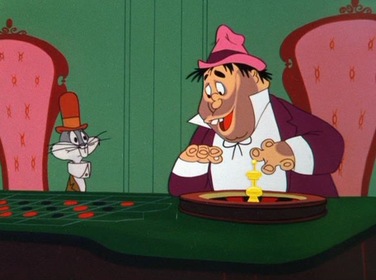
Barbary-Coast Bunny (1956)
Directed by Chuck Jones
Story by Tedd Pierce
Animation by Abe Levitow, Richard Thompson, Ken Harris
Music by Carl Stalling
Bugs Bunny is burrowing underground to visit his cousin Herman in San Francisco when he bangs head-first into a giant gold nugget. The swindler Nasty Canasta tricks Bugs into believing he has a depository bank for storing the gold, and Bugs entrusts his new fortune with the miscreant. After Nasty violently waylays Bugs, the angry rabbit vows revenge. Six months later, he tracks down Nasty to the San Francisco casino that he built with Bugs’ gold. Bugs disguises himself as a naïve rural visitor, but this seemingly innocent façade enables him to casually drain the casino of its money by winning Nasty’s rigged games.
“Barbary-Coast Bunny” is notable for the reinvention of Nasty Canasta from a physically imposing and near-silent cowboy villain in a pair of Daffy Duck cartoons into a slovenly, cigar-chomping character with a silly voice. Clearly, that earlier character – whose stoic and machismo menace brilliantly played off Daffy’s frantic neuroticism – would not work with Bugs.
There are a couple of amusing moments when Bugs’ faux-rube mistakes a slot machine for a “telly-o-phone” and later when he spins the cylinder of Nasty’s revolver and generates a gold coin shower from the weapon. But sadly, the cartoon falls flat. Tedd Pierce’s screenplay is annoyingly verbose, and even Bugs’ trademark “Of course you realize this means war” is stretched out to a wordier (but not funnier) “You realize this is not going to go unchallenged.” Even worse, the casino action is lethargic, with Nasty mostly sitting around while trying (and failing) to rip off Bugs. Thus, the cartoon degenerates into being all talk and nearly no significant motion.
While an unbilled Daws Butler offers a nicely silly voice for Nasty, the reconfigured character was ultimately a dull adversary that never turned up again in the Golden Age cartoons.