
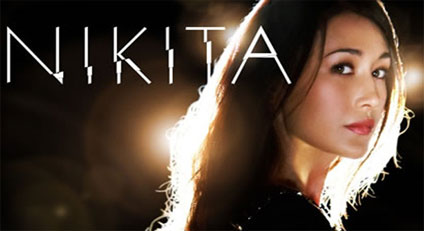
So far this is the third variation of the Luc Besson spy thriller masterpiece “La Femme Nikita,” and the more variations we see of it, the more the actual point of the premise is loss. We had “Point of No Return” a remake with Bridget Fonda I think I’d rather forget if only for being a piss poor adaptation of Besson’s film and for becoming a relatively obscure nineties fixture that put some nails in to Fonda’s career coffin. Then there was the basic cable spy thriller starring Peta Wilson that I really never bothered to watch mainly because it felt like a version of “Mission: Impossible,” and now there’s “Nikita.”
I originally approached “Nikita” with an experimental mindset mainly because I’m prone to watching anything that tickles my fancy and I was open to the notion that Maggie Q had finally found her vehicle after so many years of minor roles as the mysterious Asian woman in forgettable films like “Balls of Fury,” “Live Free or Die Hard” and “The King of Fighters.” This 2010 series is less a raw adaptation of Besson’s source material and more just a launch off of the basic concept building on its own path set by Besson. It takes the general idea and just creates its own ideas and personalities. “Nikita” is an adaptation in only the slightest sense twisting the premise and focusing in on a woman named Nikita who may or may not be Anne Parillaud’s character. She’s Asian and not French, she’s limber and graceful and not as rugged as her predecessor, and only bears a scant similarity in nature.
The hint is that there have been different women with the name Nikita at one time like a codename, but they do stick closely to the character mold from Besson’s film in which Nikita is a woman who was once a gangster and druggie is kidnapped after a botched crime and groomed to perfection to become a killing machine. And like the original Nikita, she accidentally fell in love. From there on in we’re told Nikita (this Nikita apparently) eventually decided to leave the life of a spy behind and chose marriage. Her husband was never seen from her again, and she rebelled against the corporation that groomed her. The only scenes we see of Nikita’s past life are a few throwaway scenes of her and her husband in bed engaging in goofy romantic dialogue that failed to really strike a chord and thankfully the writers never try to mimic the classic scene in “La Femme Nikita” in where Nikita’s newlywed husband declares his love for her outside the bathroom door as she sits at the window sill prepared to shoot down a target struggling between her loyalties.
I’m still not sure where “Nikita” falls in with Besson’s original film, in the end. We’re also told that Nikita is only one in a school of spies kidnapped and turned in to killing machines, and she is doing everything humanly possible to bring them down from the inside out. She’s not one person groomed to become the perfect killing machine but one in an assembly line of lost souls who are kidnapped, turned in to ghosts, and given the tools that allow them to corrupt any environment and knock off a target of the program’s choosing. And mid-season we’re told there are such a thing as Cleaners in this variation, but it’s mentioned in passing and surely is a hint of things to come in future seasons destined to provide a real difficulty for Nikita and her cohorts in the heat of battle. As we saw in “La Femme Nikita” with Jean Reno, cleaners are silent, remorseless, vicious, juggernauts of death who get in and get out without being stopped.
The more you come to grips with the fact that this series is marketing on the name recognition of Besson’s film, the more you’ll find some entertainment value in this series geared more toward women than a general audience. The writing team only takes ideas from the original movie as a source of series plot lines and beyond that doesn’t go any further in pressing the European appeal. It’s often a soapy, romanticized spy thriller that doesn’t really turn its female characters in to anything more than sexy warriors, and keeps its male characters hunky props and villains. The show was given a bit of controversy for its “racy” promotional posters featuring star Maggie Q, but beyond that nonsense “Nikita” is a series that takes a little patience to enjoy, but elevates to a higher level of entertainment with every passing episode shedding the melodrama in exchange for espionage and surprise twists aplenty. Maggie Q finally has her vehicle as a respectful intelligent beautiful rogue spy free of Asian stereotypes (there’s mercifully very little attention called to her nationality) who watches from her outpost interrupting every mission her ex-corporation the Division takes part in and she does so with her mole Alex.
Alex is another of her ilk kidnapped in the midst of a botched jailbreak and brought in to the fold of the Division being groomed and trained to be a killing machine. Training alongside others of her kind, she lives within the bowels of the corporation and secretly tracks information and codes to her handler Nikita who intercepts every assassination attempt botching the Division’s plans at every turn. Lyndsy Fonseca of “Kick-Ass” fame is a genuine scene/episode stealer as protagonist Alex, a young woman of various personalities, cloudy morals, and goals who is Nikita’s eyes and ears and is always on the brink of being caught during secret missions in the sanctum. In one episode she is strapped down to a pulse sensitive straight jacket where she basically has an nervous breakdown at the behest of team psychologist Amanda who is convinced throughout the season that Alex is hiding something and comes dangerously close to discovering her crucial secret. While Maggie Q is fantastic in her role as title character Nikita, Fonseca manages to run away with every episode she’s in time and time again offering up tension, suspense, and sympathetic storylines involving her relationship with her classmates, all the while avoiding the likes of conniving villains like operative Michael, computer hacker Birkhoff, and the head of Division Percy, all of whom are ruthless in their efforts to protect Division.
And throughout the series there is always the risk of Stockholm Syndrome which keeps Nikita and her charge Alex close allies, but potentially vicious enemies. Consisting of talented character actors like Shane West, Xander Berkey, Devon Sawa, and Aaron Stanford respectively, “Nikita” is a constant gallery of talent and skill with every episode tightening the noose behind Nikita and Alex’s efforts to corrupt the corporation in the cloak of darkness. I’d be remiss if I forgot to mention the gorgeous Melinda Clarke as enigmatic Division master manipulator Amanda, a woman who watches in corners always on the verge of catching Alex in the act. “Nikita” while originally intended to garner some female crowds is really a series that has something for everyone and puts to use some nineties stars that fell to the wayside including Devon Sawa who is barely recognizable at first glance as rogue agent Owen Elliot, a young man in the position Nikita is in who is sent on an undercover mission and gets too close to a neighbor of his. His sub-plot has been a very enduring strong point this year where Sawa is completely convincing in his skin and holds his own against Ms. Q with an endearing and genuinely gripping series of events that keep him capable of being an action hero while also standing out as a character capable of his own spin-off… if the CW/Warner is daring enough to try for it.
And of course Shane West is also given a chance to rebound as morally gray official Michael, always posing something of a slimy presence who also has much more to him than a brooding glare and intimidating presence. “Nikita” admittedly takes a lot of time to build-up in to something of a respectable action thriller geared toward the female persuasion, but once you bypass the hokey set up of the first two episodes (that lay it on heavy in terms of romantic undertones and love triangles), the CW/Warner series really can grow on its viewing audience providing some thrills, genuine shocks, and a fantastic romantic sub-plot between Nikita and her former handler Michael, both of whom despise one another but are always on the verge of sleeping together when in the same room. The heat is believable and it keeps “Nikita” on a state of suspense every second. “Nikita” is slowly transforming from a guilty pleasure in to a authentic quality series, and it’s one capable of acquiring a cult status and quite deservedly.
In a year filled with unadulterated let downs in the realm of television, I’m sticking with “Nikita” for the long haul.