
 “Ghostbusters” was a superb one and done premise that worked because it had such regular men who were called in to confront some spectacular circumstances, and in the end have to figure out how to live in a reality where they’ve essentially proven the existence of the supernatural. It’s surprising that the follow up is so sub-par and often monotonous as it almost has nothing to do with the original concept. It kind of goes through the motions and doesn’t exactly know how to continue building on these originally complex and flawed individuals. They don’t evolve much at all from when we last saw them, and writer Harold Ramis and Dan Akroyd seem to be painted in to a corner by devolving them and building them back up all over again.
Category Archives: Movie Reviews
Loro Chi? (Them Who?) (2015) [San Diego Italian Film Festival 2017]
 While trying to impress his boss at a job that his crushing his writer’s soul, Davide loses everything and finds a new way of living and thinking that eventually will lead him to happiness.
Hellboy Animated: Blood & Iron (2007)
 “Blood & Iron” is a stellar sequel to the entertaining and raucous “Sword of Storms,” and it’s a yet another faithful adaptation that emphasizes the lore and world of the BPRD. The animated follow ups to the movie, set somewhere between the movies, have been worthy of the time spent with excellent animation, and a compelling narrative, overall. The idea bout the audience watching outcasts defend our Earth and realm is continuously fascinating, and the cast bring their A game.
Hellboy Animated: Sword of Storms (2006)
 For folks that appreciated the subversive artistic style that launched Mike Mignola into stardom, “Sword of Storms” practices a lot of the grit and indie flavor, along with much of what made Del Toro’s films so stellar. There’s even voice work from the original films’ stars including Ron Perlman, Selma Blair, John Hurt, and Doug Jones, all of whom are about as fun as ever. Directors Phil Weinstein and Tad Stones’ animated movie is set between the live action installments, channeling creator Mike Mignola with dark and often grim animation, with the back drop of an exciting narrative that never trails from its original source material.
Veloce come il vento (Italian Race) (2016) [San Diego Italian Film Festival 2017]
 A young race car driver loses her father suddenly. Having no mother in the picture, she becomes in charge of her younger brother when their older brother, an addict and ex-racer himself, becomes their legal guardian.
Based on a story by Matteo Rovere who co-wrote the screenplay with Filippo Gravino and Francesca Manieri and also directed, Veloce come il vento is a touching family drama with a hopeful outlook on things. The film throws many curve balls at lead Giulia as she is trying to win in car racing, but nothing is going to stop her from winning and keeping her family together. The film has its ups and downs and it works well on all fronts. The balance of good moments versus sad moments creates a dynamic storyline and gives plenty for the characters to bond over. The film makes good use of the drama and the few comedic moments and builds itself towards an end that is a touch sad, but also perfect.
The Crescent (2017) [Brooklyn Horror Film Festival 2017]
 Following a death in their family, a woman and her son go to the family’s secluded house to try and heal and find their way.
Written by Darcy Spidle and directed by Seth A. Smith, The Crescent is more family drama than horror film, but it does have some horror elements involved. The story is one of the slowest burns seen this year or maybe even this decade, it’s slow to a painful crawl. The film has some good elements, but they get lost when the viewer loses interest due to the pace and the fact that most of the conversations are between a woman and her small child. Those conversations are cute at times, but they bring pretty much nothing to the story. If the film had been entirely silent as some of its scenes are, it may have had more impact. As it stands, the film’s dialogue eventually feels useless and like babbling. Missing parts of it is not that big of an issue, which is not something that helps keep attention to the film. The story itself feels a lot like something that could have made a short with a brisker pace and this would have been plenty time to tell the story.
Mayhem (2017)
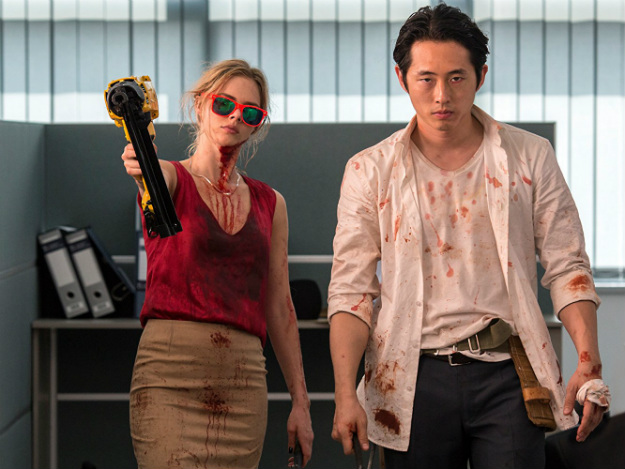 Joe Lynch is a filmmaker not prone to delivering just everyday horror and genre outings, and “Mayhem” is proof of that. This is a man who should be delivering his off beat storytelling and directorial style to big budget features like James Gunn, but that is by no means a slight on the director. “Mayhem” is a demented dark satire and horror film filled with gore, dark humor, and a biting commentary on the doldrums of the work place and world of corporate back stabbing. Director Joe Lynch takes “Wolf of Wall Street” and “Warning Sign” and drops it in to a blender creating one of the most ruthless balls to the wall meshing of genres I’ve seen in a while. While Lynch is very liberal with the use of gore and splatter, there’s a damn good reasoning for all of what goes down.