
 From what I’ve read, Dimension has the right to Clive Barker’s “Hellraiser” property and wants to remake the film series. But the ever troubled production has reached the point where the rights have run out. To keep the rights, Dimension basically rushed out a cheap shoddy sequel to the original “Hellraiser” series. This is a movie so horribly made and poorly constructed that the iconic Doug Bradley opted out of his star making role as the horrific Pinhead, due to his salary being chopped down from the low budget film. In his place is Stephan Smith Collins a poor bastard who has to live up to Bradley’s gravitas as Pinhead in every conceivable way and wages a losing battle from the very beginning.
Tag Archives: Horror
You Have to See This! Who Can Kill a Child? (1976)
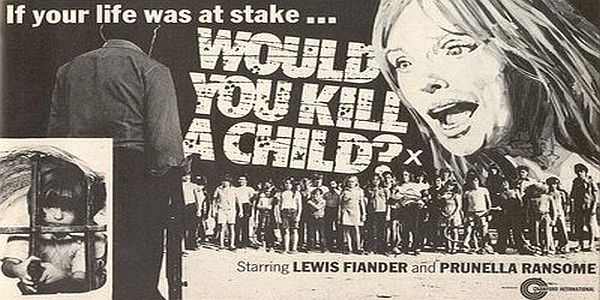 2012 saw the remake of “Who Can Kill a Child?” hit many movie festivals under the new title “Come Out and Play.” And while that movie has been, from what I’ve seen, met with mixed reviews on a mostly negative arena (one worst of 2012 list included the remake in its worst ten), there’s no denying that “Who Can Kill a Child?” will never actually be replaced.
When Tom and Evelyn seek to vacation in Spain, even in spite of reports of adult bodies washing ashore mutilated beyond repair, they go to a local tourist island for food, dance, and laughs only to discover the island has been taken over by children. And these almost infinite groups of prepubescent terrors are intent on viciously murdering anyone and everyone who isn’t a child. Can Tom and Evelyn survive long enough to make it off the island and back to shore to warn civilization?
While folks often cite “Village of the Damned” and or “Children of the Corn” as downright horrifying examples of children run amok and transformed in to monsters of terror, there’s often the omission of the 1976 Spanish horror film “Who Can Kill a Child?” An often shocking and absolutely disturbing film, director Narciso Ibáñez Serrador’s has been very misunderstood and gone through a lot of phases during its life. It’s been banned in certain countries and has been re-titled almost a dozen times.
It goes by its original moniker “¿Quién puede matar a un niño?” as well as “Island of the Damned,” “The Hex Massacre,” “Death is Child’s Play,” “Island of Death,” “The Killer’s Playground,” “Trapped,” and “Would You Kill a Child?” Not to mention it’s been edited down from its original form splicing out many of the murders in the film that revolve around children. In 2007, Dark Sky Films released a special edition unrated DVD of the film in its uncut glory, positing the film as something of an inexplicable turning of the tide in regards to man against nature, while Hitchcock’s “The Birds” showed what would happen if nature’s inexplicably turned man into its number one enemy.
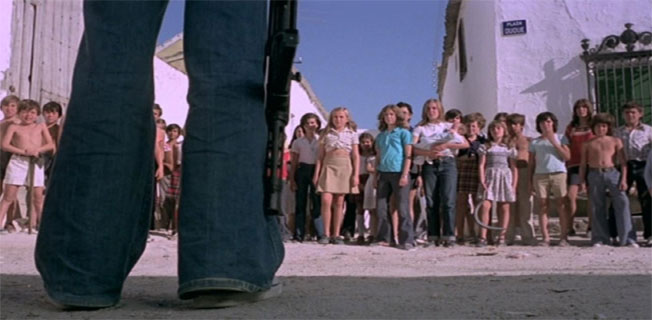
“Who Can Kill a Child?” shows what would happen if children suddenly decided that they simply have had enough of the adult population and became murderous, merciless monsters. The dilemma posed by the film is could you really kill a child? More on point, if your sweet seven year old daughter suddenly started attacking you with a machete intent on murdering you and bathing in your blood, could you murder her in self defense? “Who Can Kill a Child?” is an unnerving and calculated horror film that shows what happens when children just flip a switch and decide that friend or foe, they’re massacring every adult in the general vicinity. In one very horrifying instance, a mother screams at her son and daughter to go outside and even smacks them on the behind to get them moving.
The brother and sister are greeted by the swarm of psychotic ankle biters who approach the siblings, softly whispering in their ears in an almost inaudible string of words. Suddenly the looks of innocence and smiles on the siblings inexplicably transform in to sheer gleams of blood lust. When their mother greets them outside demanding they get to work her offspring are unresponsive, and behind her groups of children trickle down from the rocks preparing to unleash ungodly acts of pain on her.
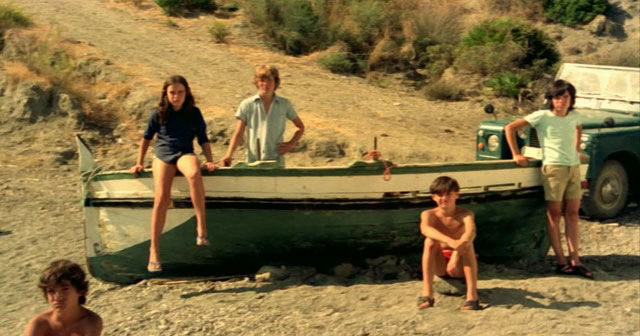
Director Narciso Ibáñez Serrador doesn’t really display much exposition behind the source of this evil; he just shows the audience that this turn of events was inevitable with footage of children being massacred during various wars, and young kids starving to death in villages. All of whom are casualties of the violent conflicts. When Tom and his pregnant wife Evelyn arrive at the local island prepared to relax during their vacation, they’re disturbed to discover that all of the adults on the island are nowhere to be found, and what civilization there are consists of children that run around seemingly innocent and committed to their own secret doings in the darkness.
When Tom and Evelyn discover that the children have not only slaughtered every adult on the island, but have made a game out of mutilating an old man in the village square, the fight for their lives become ever more harrowing, as the angelic monsters will stop at nothing to kill the duo. Narciso Ibáñez Serrador is never above tugging at the heart strings of audiences giving them some material to cringe at. Save for the ghastly prologue, there’s a moment where a male survivor is lured to his death by his bawling daughter who begs for her dad to bring her home after she’s injured herself, only for him to meet immediate death. And in one of the most creative death scenes I’ve ever witnessed in a horror film, wife Evelyn meets her fate in a manner you’ll never see coming.
“Who Can Kill a Child?” is a grueling and very harrowing horror masterpiece with a thick sense of urgency and an atmosphere that signals this sudden transformation is definitely in the favor of the cherubic moppets with the inability to show quarter toward their adult counterparts. It’s a gem that vastly outweighs “Village of the Damned” as an evil children feature.
Room 237 (2013)

There’s just so much mystery behind Stanley Kubrick’s “The Shining,” that you have to ponder on the mystery behind “Room 237.” The Rodney Ascher directed documentary is a film that explores the dimensions of “The Shining” but also garners its own curiosities in the mean time. I mean there’s no denying that “The Shining” was never meant to be anything more than a puzzle from Stanley Kubrick, but what is the puzzle? Did Kubrick really pay so much attention to the film to include a yet to be deciphered message within the film cells? Or is it just a pastiche of random imagery left for the laymen to tinker with for decades to come? Did Kubrick find cinematic immortality by simply giving his audience a movie to think about that ultimately just meant nothing? You have to wonder, why would Kubrick be so meticulous about scenery, props, and symbolism, but forget to hide the shadow of his chopper during the opening scenes of the film?
The ABC's of Death (2013)
 One aspect of “The ABC’s of Death” that many audiences will acknowledge. Even when it’s bad it’s really damn unique. “The ABC’s of Death” isn’t always a home run, and I will in no way consider it a masterpiece of modern cinema any time soon, but as an ambitious experience bold enough to include various themes that are normally considered in bad taste for mainstream cinema, I was fond of it. I appreciated its ambition. I respected its originality, and I really did love its sense of humor.
Our "Exposure" to Short Films

Back in the golden days of cable television, Syfy–known as the Sci Fi channel–was rather entertaining. I’d sometimes sit down in front of the television and watch it all day long basking in stuff like “The Twilight Zone,” that horrible show “Sightings,” and “Lost in Space,” while Saturdays brought cartoons, and anime. These days, though, I barely ever want to watch it unless there’s a marathon of “Firefly,” or a crappy television movie on, and even then it’s debatable. I don’t WANT to see “Lake Placid 6,” but… I couldn’t keep from watching it when it premiered! The reason for my hatred of Syfy is because, I have them to thank for my exposure to short independent films.
V/H/S (2012)

It’s been a while since we’ve had a really good anthology film. Not since “Trick r Treat” have we had the horror fans had an anthology horror film that not only changed the game for the sub-genre, but made waves as a horror film, period. The Collective of indie filmmakers that team to create “V/H/S” really do resort to the found footage genre for the sake of some sense of believability. That and the format is pretty cost effective, when you think about it. In either case, The Collective is allowed to be very creative and unusual in a film about a series of short vignettes viewed through old V/H/S tapes.
You Have to See This! Sorority Babes in the Slimeball Bowl-O-Rama (1988)
This is one of the many horror films from the eighties that features the trio of Scream Queen goddesses. Yes, Linnea Quigley, Brinke Stevens, and Michelle Bauer all star in one of the funniest and best horror comedies of the late eighties. Directed on a very low budget and on very limited scenery, “Sorority Babes” works as a low budget trash fest, and a goofy little time waster you can chuckle to. Tri Delta is looking to initiate their two newest recruits! After catching three nerds from the local fraternity watching the initiation, the trio, along with a few sorority sisters are forced to break in to the local Bowl-O-Rama at night and steal a prized trophy as a prank.
Accidentally unleashing a magical imp within the sacred trophy after knocking it over, they unleash Ol’ Uncle Impy, a magical imp who offers to grant their wildest dreams. After they all take advantage and are granted their own wishes, they find that often times, if something seems too good to be true, it probably is. Also known as “The Imp,” seasoned director David DeCouteau directs this goofy horror comedy that I was first introduced to back in the nineties. I fondly remember watching the edited version for “Sorority Babes” on USA’s Up All Night on cable television and always wanted to re-watch it.
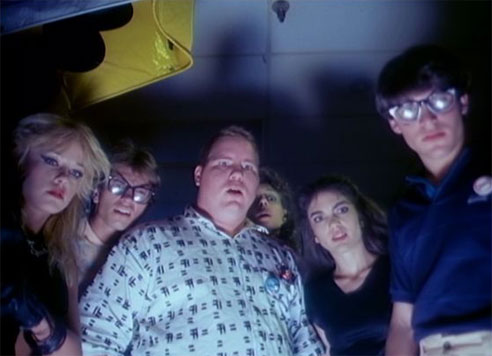
Years later, I bought the DVD and had a blast. Along with “The Gonk,” and “It’s Party Time” Bob Parr’s “Here In The Darkness,” the theme song to “Sorority Babes” has permanently burned itself in to my brain, and it’s fun to see such an eerie theme song for such a goofy horror comedy. Brinke Stevens and Michelle Bauer are on the receiving of a lot of gratuitous nudity as they’re spanked in the opening shots of the film for a sorority initiation for Tri Delta. While there, three geeks are caught and are forced in to the final act of being admitted in to Tri Delta. Ol’ Uncle Impy is one of the most unusual horror villains ever created. A combination of low budget puppetry and tricky lighting, he’s a trophy imp that grants wishes, and surely enough he can’t be trusted.
Linnea Quigley co-stars in one of the rare roles where she keeps all of her clothes on as juvenile delinquent Spider. She’s caught breaking in to arcades for petty change, and ends up having to fight for her life and live through the night. Impy can be tricked, but how? Most of the movie spends its time on the wishes granted and the painful fall out that comes from the wishes that begin to turn sour in a matter of hours. One sorority girl wishes to be a queen with her clothes rotting, one character wishes to be rich only for the treasure to be meaningless, and another character wishes for a girlfriend only for this girl to be incredibly aroused and aggressive when it comes to getting laid.
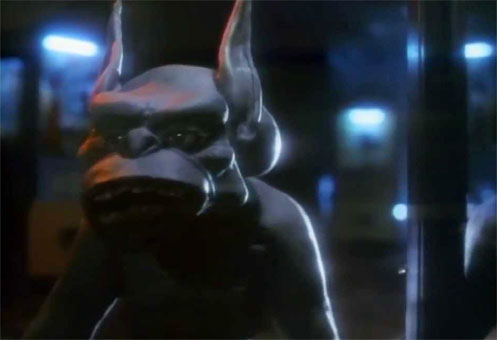
Meanwhile, the janitor of the Bowl-O-Rama is unfortunately stuck in his bathroom and oblivious to the horror happening all around him. Quigley decided she wanted a role as a punk this time around, and dons the punk attire as heroine Spider, who fends off the monsters machinations through this bowl o rama. Keeping money tight, the movie is set in the bowl o rama over night where no one is around, giving DeCouteau a real advantage in giving the setting mood and atmosphere without trying too hard to light the sets. Of course, all of the horror and turmoil dies out before opening time at the bowl o rama. This allows the characters to roam around chasing each other, and learning about the convoluted origin of Ol’ Uncle Impy and how he can turn a good wish in to a bad situation.
I, for one, love Uncle Impy. He’s a bargain basement villain who could have worked in a sequel if they ever had the budget for one. I could see the allure of asking for a wish from the Djinn in “Wishmaster,” but from a little demon in a bowling trophy? Come on, kids. Just say no. “Sorority Babes” is one of the last gasps of eighties horror, and it’s a delightfully goofy delicacy you can kick back to. If only to see Quigley reprise her punk attire yet again. Whether you know it as “The Imp,” or “Sorority Babes in the Slimeball Bowl-O-Rama,” this is a heck of a good horror comedy with the trifecta of scream queens doing battle with a horrific imp. They just don’t make movies like this anymore.
The Theme Song to “Sorority Babes”: