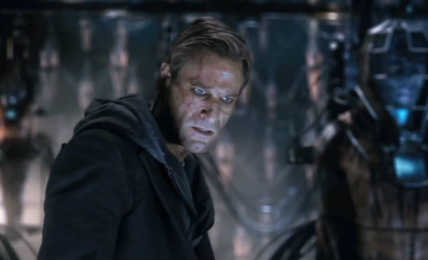
 “I Frankenstein” is so hopelessly convoluted that rather than watching the action unfold and allowing the audience to go along for the ride, the writers do nothing but explain. Characters walk from one room to another to explain things, and then explain the explanation. “We’re the Order of the Gargoyles and here’s why. You’ll be called Adam, and here’s why. These are our weapons that can defeat demons, we’ll explain why. Our ranks are falling but demons are more powerful than ever, and we’ll explain why.” Considering the heroes do nothing but talk, it’s a wonder they’re losing the battle of good and evil. And how original that Frankenstein is re-named Adam? I wish Hollywood would put that creaky cliché to bed.
It’s too bad the writers didn’t have the balls to re-name the monster Frank. Or Victor. Hell, Shelley would have been gutsy. After the usual events of the Mary Shelley novel, Frankenstein is attacked in a graveyard when he attempts to bury the body of his creator. Managing to barely survive, he’s taken in by the Order of the Gargoyle, a group of knights hired by the Queen to fight demons. For whatever reason, they’re gargoyles that can masquerade as human beings, and can revert to their beastial form to fight evil. On the other side, there’s a group of demons intent on capturing Frankenstein because he holds the key to immortality. No wait, he holds the key to building another Frankenstein body, as the demons plans to build an army of clones that can be possessed by demons.
Frankenstein is an anti-hero for the sake of being an anti-hero, torn between two fractions of the war. You know he’s an angry monster because he dons heavy eyeliner for a majority of the film, and despite his brute strength battles with swords like a horror version of “Crouching Tiger.” You figure a movie with gargoyles and demons and Frankenstein would be amazing, but in reality it’s unbearable. It’s droning, tedious, and incredibly boring, and not a single character is engaging. They bring in strong performers like Bill Nighy, Yvonne Strahovski and Miranda Otto, all of whom do nothing but look half asleep most of the time, while they drone on and on with clunky exposition.
In the first half there’s a massive battle between the demons and Gargoyles, and granted it would all be so amazing, if I knew who any of these characters were. We learn nothing about the heroes or villains in the film. Director and co-writer Stuart Beattie stuffs the screen with so many sub-plots and supporting characters all of whom have zero depth to them. They’re just cannon fodder we’re told to root for. “I Frankenstein” is much like the “Underworld” and “Resident Evil” movies. It’s all flash, explosions, and absolutely zero substance. “I Frankenstein” is an absolutely terrible attempt to turn a Gothic literary character in to a superhero, and here’s hoping there’s no follow-up to the amazingly dull adventures of Frankenstein’s Monster.

 I admit I’ve never been familiar with the comedy of the Ritz Brothers before. I just happened upon “The Gorilla” one night and couldn’t stop laughing while watching the comedy team happen upon Bela Lugosi. I’ve read from some that this isn’t their best comic output. If this is them at their weakest, I’m excited to see what their best is. “The Gorilla” is a public domain horror comedy that can literally be seen anywhere, from DVD, VHS, or Youtube, and I was able to watch one of the five copies available on the site for this review. Suffice it to say, I still find the 1939 horror comedy quite hilarious.

![Darklight[(049735)11-00-52]](https://www.cinema-crazed.com/blog/wp-content/uploads/2015/10/Darklight04973511-00-52.jpg)