
 The world featured in the newest documentary “Girl Model” features an entire world of people who have decided a model’s life. Except for the actual models themselves. When we first view the casting agents for the Switch agency, they’re lining up groups of incredibly beautiful prepubescent girls with potential to be international models and judging them incredibly harshly. They’re called fat, pigs, and told to go on major diets in spite of the fact most of these young girls could be knocked over with a gust of strong wind at any moment. “Girl Model” explores a world that doesn’t just appreciate youth. It lusts for it.
How Nightmare on Elm Street Should Have Ended

Planet of the Apes (2001)
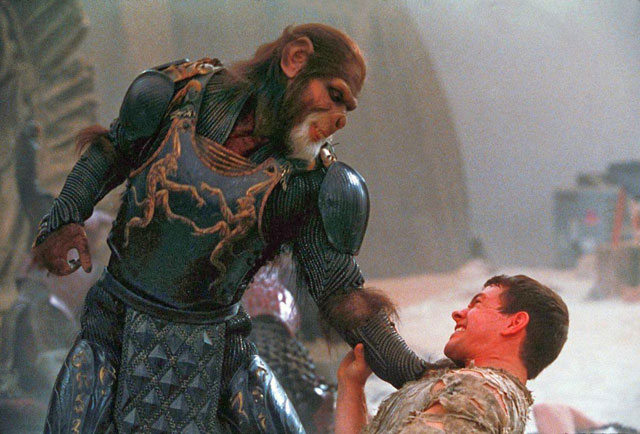 Subtlety has never been one of Tim Burton’s strong suits as a filmmaker. As a storyteller and overall director, Burton’s films rely on imagery and over enthusiastic narratives to do what he can’t as a craftsman. Oddly enough Burton is assigned to direct a remake of one of the most thematically subtle films of all time. “Planet of the Apes” is one of the most relevant commentaries on humanity and politics that has ever been brought to the big screen, and Burton never really grasps that aspect.
The Room (2003)

My love for The Room has not been an easy road. It took months of fine tuning, refinement, some conformity and skipping doses of my meds to get down to the level of Tommy Wiseau and his unmitigated cult masterpiece. Whether you’ve seen the movie in its true form, whether you’ve seen it play on the April Fool’s Day airings on cable television here in America, whether you were there during the great tirade of Wiseau on online critics, “The Room” and its charms are almost impossible to ignore. It’s a movie so bad, so inept, so unbelievably painful, it’s almost impossible to comprehend anyone thought it would be great on-screen, “The Room” is a film I constantly quote to this day–ohai Mark!
Ichi (2008)

I guess you can refer to “Ichi” as part of the official Zatoichi canon since the story of Ichi is one the reflects the effect Zatoichi the Blind Swordsman had on the people of Japan during his travels. Though not a remake or a reboot of the Zatoichi series, “Ichi” is an unofficial spin off that takes from the film series and creates its own branch off of an epic story about a beautiful young Goze who is taking a journey to find her savior before finally lying down to die. Haruka Ayase is incredibly beautiful and fierce as the Goze Ichi who spends most of her life wandering around from village to village trying to survive one more day while on a search for something in her life that’s kept her motivated to fight ever since she was a child.
Blind Fury (1989)
 One of my first introductions to the Zatoichi series was through the 1989 samurai action film “Blind Fury” which established the blind samurai to American audiences through actor Rutger Hauer. Since Hauer was king back in the eighties, this is one of the rare instances where he plays not just a hero, but a hero with an immense ability for good who is unbelievably charming. ‘Blind Fury” is a modernized and altered adaptation of the seventeenth “Zatoichi” film entitled “Zatoichi Challenged” which is in many ways fixed for the eighties set pieces, but possesses some of the same moments from the original film series. Including the moment where Zatoichi’s young ward tries to pass off a rock as a piece of candy to Zatoichi who surprises him by spitting it back in his face.
The Dead Pool (1988)
 And it ends not with a bang, but with a thud. “The Dead Pool” is a truly anti-climactic end for a man who has spent all of his five films running around and blasting assholes with his hand cannon without remorse and finally finds that he’s really not chasing much of an enemy in the end. “The Dead Pool” has some considerable mystery to it but the villain that is supplied for Harry Callahan’s last romp is not only boring, but doesn’t have much to do for the entirety of the film.