
 Marc Jarvis has made a good life for himself, a successful career, a house by the beach, great friends, and the love of his life by his side. That is until he is diagnosed with an incurable disease. He decides to live to the fullest and die on his own terms, then get cryogenically frozen until a time when his disease can be cured. When this day comes, he is put back together like some kind of futuristic Frankenstein’s Monster and brought back to life.
Tag Archives: Arthouse
There Is a New World Somewhere (2016)
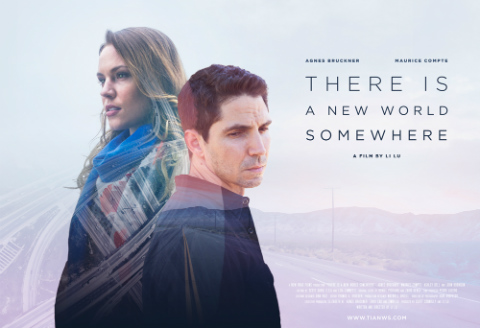 Li Lu’s drama “There Is a New World Somewhere” is another one of those dramas about thirty somethings looking for directions in life. It’s in the tradition of movies like “Garden State” and Greta Gerwig movies, while director Lu really tries to invent her own “Five Easy Pieces.” The problem is “There Is a New World Somewhere” doesn’t present enough of a dilemma for our protagonist Sylvia to begin hitting the open road and looking for some sort of purpose. We settle in with her for all of fifteen minutes before we’re told how restless she is, and then takes off with character Esteban who she meets at a party one night.
Agnes Brucker is a very strong actress with a unique energy and charisma that has never really been wisely utilized by other directors, and it’s a shame. She’s very good in “There Is a New World Somewhere” and literally carries what is only a mediocre road trip film about two people trying to find themselves. I think. Or maybe they’re trying to find the meaning of life. Or a purpose? I never did catch on. Either way, Bruckner is the highlight as Sylvia a struggling artist anxious to launch an opening at the gallery she works in to showcase her art. When she’s turned down, she begins questioning her life and is called to party with some long lost friends, many of whom are on the verge of being married.
After forming a connection with party goer Esteban, Sylvia skips town with him and begins traveling around the country. Along the way, the pair have a passionate affair and wander around from landmark to landmark discussing the meaning of life, their passion for certain parts of life, and how unfulfilled they feel. Li Lu has a wonderful directorial style providing some great wide shots and beautiful dream like moments and montages where Sylvia and Esteban linger in various spots and different cities trying to savor life. I just wish “There Is a New World Somewhere” had a much more solid narrative and a lot more character depth.
When Sylvia skips town on her friends to take a trip with a stranger, it feels like half baked motivation to set the plot in motion. When the pair of character do manage to get in to various escapades, it’s never all that interesting. That said, Lu’s direction is vibrant, while star Bruckner is a very good actress who shines in an otherwise middling drama.
Now on VOD, IVOD, and is in Limited Theatrical Release until August 31st.
The Alchemist Cookbook (2016) [Fantasia International Film Festival 2016]
 A man trying to survive in a shack in the woods plays with alchemy to discover an ancient secret to a better life. Inadvertently, he summons a dangerous being who doesn’t take too kindly to his dealings. The Alchemist cookbook is written and directed by Joel Potrykus who is known for independent horror films shot in Michigan and who considers his style in the vein of Jim Jarmusch which is something each viewer can judge for themselves, but this reviewer did not really see that.
Here he crafts a fairly slow boil of a film. It starts with an alchemy cooking sequence set to a great track, giving the impression that it might be an upbeat, fast moving film, but it soon becomes clear that the lead, Sean, is a paranoid man playing with forces he doesn’t fully understand. Unfortunately, past that opening scene, the film feels slow and like it might need some extra oomph or perhaps to be edited differently. It’s not boring but it’s not enthralling either.
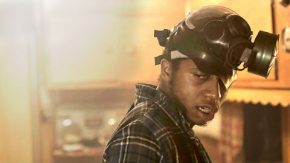
The cast for this small budget is, well, small. The lead of Sean is played by Ty Hickson who does great as the paranoid, perhaps desperate, man trying his hand at alchemy. His performance here is good and worth seeing and he proves he can carry a complete movie on his own as the only other actor has only a few scenes and those scenes are always with him. In the only other human role in the film is Amari Cheaton as Cortez a typical gangbanger who tries to help his friend Sean while also getting himself into trouble. His performance feels more exaggerated and caricatured while less on point than Ty Hickson’s. The last cast member listed is Fiji as Kaspar (the cat), as is usually the case with cats, he does a fabulous job while remaining rather nonchalant about the whole thing.
The film has some nice bits of science alchemy and some good effects. The last third does amp up the horror factor and what can be seen is well done and executed. These special effects are by Jeffery Husselman with visual effects by Scott Baisden and Daniel Falicki.
Also worth noting are the cinematography and the soundtrack. The cinematography by Adam J. Minnick does a great job at making all outdoors images feel desolate in their settings while the indoors shots feel cramped to go with small shack the lead lives in. This adds to the atmosphere here and is very well done.
The soundtrack for this film is mostly provided by way of an old tape deck that the lead character uses. The song choices and what is fast forwarded tell a lot about the character, which makes him feel real, more like the crazy, paranoid version of someone every viewer knows. His musical choices also reflect his internal turmoil, by letting him “choose” those songs, something so few films do.
The Alchemist cookbook is not a bad film but it has issues with pacing and with sections of the story feeling like filler. The acting by the lead is good and he carries the film well. The music is his best supporting character, but it’s not enough to make this reviewer want to see it again or be able to fully recommend it.
Fantasia International Film Festival runs from July 14th until August 3rd, 2016.
I, Olga Hepranova (2016) [Fantasia International Film Festival 2016]
 What pushes someone to once day decide they have had enough and that the only solution to be understood is to commit mass murder?
In 1973, in Prague (Czech Republic), 22 year old Olga Hepranova drove a truck into a waiting crowd, hitting 25 people and killing 8 of them. The film is the story of how Hepranova got to this massacre. Taking on the hard task of writing this story for the screen without falling into sensationalism or exploitation, writers Roman Cilek, Tomas Weinreb, and Petr Kazda, they took a delicate subject and turned it into a touching and beautiful story of a girl who feels as though she is being bullied and who has a long period of bad luck.
After long enough of asking for help and not receiving it, she decides to take drastic measures. They do not build Hepranova as a martyr or anti-hero but simply as a complex human being in need of help. Directors Petr Kasda and Tomas Weinreb took this script they co-wrote and turned it into a beautifully sad tale of a woman who possible could have been saved. The way they shot the film, in tandem with cinematographer Adam Kozakl in black and white and with very somber tomes is sublime. It takes this very heavy subject matter and make it bearable to watch. They craft a film that mesmerizes its audience while making them just a bit uncomfortable.
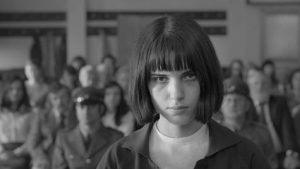
As so much of the film rests on her shoulders, the part of Olga Hepranova had to be cast perfectly. Actress Michalina Olszanska (mesmerizing in The Lure) was chosen and she is perfectly gloomy and fantastic. She clearly understood the depth and seriousness of the part, never over acting, always giving her all and stepping in Hepranova’s shoes, no matter how uncomfortable the process looks. She loses herself in the part and shows tremendous talent, proving that she is a start to keep watching. The rest of the cast is also very good to great with one stand, Klara Meliskova, as Olga’s cold, unloving mother.
She shows how one woman can be there and take care of basic needs for her child while showing absolutely no love or affection toward that child. Most characters are played as cruel or cold, except for the character of Miroslav, a man who tries to help Olga but has his own problems. This part is played by Martin Pechlat who brings a bit of light to the film by not being as serious as the rest of the cast. However, this is not in a funny or goofy way, but by showing just the right amount of light, even though highly flawed, to Olga’s life and the film.
The film is a must for fans of 70s Eastern Europe. The costumes by Aneta Grnakova and the art direction by Alexandr Kozak are perfectly on point. They give a great idea of what Prague and its people looked like in 1973. They do a very detailed job, bringing the era to life. I, Olga Hepranova is a somber film with a dark subject that is a part of Czech history. It was important that filmmakers behind the film pay attention to details and that they be careful to not over-dramatize the story. They do this while creating a perfectly gloomy film that should make any audience feel something.
The very timely subject matter of a mass murderer running people over with a truck is unfortunate but it should not keep people from seeing this film when the genre, style, or subject matter is something they would like to watch. This is not a film that is a feel good one; on the contrary, it’s depressing, sad, and beautiful.

Dongju: The Portrait of a Poet (2016) [New York Asian Film Festival 2016]
 In 1940s Korea, Japanese colonialists were banning Korea culture and the use of the Korean language in an effort to unify their territories and become a stronger world power. In this struggle, a young man named Yun Dongju starts writing poems in Korean while attempting to survive the assimilation of his people, reluctantly becoming a fighter in a battle to preserve Korea’s identity.
This historical film was written by Yeon-Shick Shin and directed by a new master of the genre, Joon-ik Lee. They create here a subtle and fairly easy to understand representation of what is considered a hard period in Korea through the eyes of a talented poet. The film takes its time showing the young life of Dongju as well as the societal shift that the Japanese colonizing brought. The poems read on black and white images of Korea are personal and real, they create a center for the story, an emotional anchor. These were carefully chosen amongst Dongju’s work to best suit the film and they bring a solemnity to the proceedings.
The casting for this film is pivotal as so much rests on how the lead of Dongju is interpreted. Kang Ha-Neul takes this character and develops him into a fully fleshed out human being, giving a voice for his soft yet emotional poems. He shows a wide range of emotions with subtle variations, giving life to this man whose story is mainly untold, especially to Western audiences. Supporting this performance are Jeong-min Park as Dongju’s cousin Song Monggyu who is someone who likes to stir the pot and possibly cause trouble for himself and those around him.
His performance is less subdued and a bit more in your face as time passes and the character requires the actor to be bolder. Also supporting Kang Ha-Neul is Moon Choi as Kumi, the girl who believes in him and does all she can to get him published, Her performance is also held back but stands out amongst the mostly male cast, showing a calm and strong female presence in a time when women were still encouraged to take a backseat to men’s dealings.
Shot in black and white, the look of the film is very serious which fits with the story and its developments. The way the Korean countryside is shot is absolutely beautiful, the images convey the seriousness of the situation the Koran people faced during that period. The pairing of filmed sequences with the reading of the poems is perfect. Unfortunately, a credit for cinematography could not be found online (in English or French) at the time this was written.
The black and white images and style in which the film is shot make sense for this film and its subject but they do make it feel slower and made it harder for this reviewer to concentrate on the story and the poems. The style is hypnotic but can also be sleep inducing if reading a lot of subtitles on a calm series of sequences is not one’s passion. The slowness here is deliberate to give the viewers time to absorb the emotions and pay attention to the poems.
Poet Yun Dongju led a tragic life, like most artists about whom movies are made, in the time period that was anything but easy. His story is worth watching for the quality of the film and the emotionality of his poems. Viewers will (should) also learn about a tumultuous time in Korea’s history, which can be considered a bonus. It’s a bit long and slow, but absolutely worth looking for and watching.
Sing Street (2016) [Blu-Ray/Digital]
 Very few films can manage to understand how music is a very important aspect of life and can sometimes drive us and move us in to aspirations, inspiration, and love. The other great music film released in 2016 was “Everybody Wants Some!!” While Linklater explored how music is the soundtrack of our lives, John Carney’s masterpiece “Sing Street” is about how music can launch us in to realms we never knew were there. Music can open up doors and allow us to see things about ourselves that are incredible, and sometimes very ugly. A beautiful amalgam of “Almost Famous,” and “Say Anything,” with a hint of “Once,” John Carney is again at his top conveying a musical drama centered on more impoverished characters.
Carney sets his film in the middle of 1985 in Dublin where our trio of protagonists is obsessed with music. For them music seems to be the only salvation in the drudgery that is their everyday lives. Conor is a teen approaching high school who manages to ignore his parents’ dying marriage and the failure of role models like his big brother and father with music. When we first see him he’s playing his guitar in his room attempting to tune out his mother and father arguing with one another, and then uses their rage to fuel his creativity. He reaches an epiphany when his older brother Conor helps him realize that music is what’s keeping the world in motion, as music videos cover the general stratosphere of local television.
Conor decides to form a band of his own as a means of coping with going to a public school run by his local church. The seams almost come together at once for Conor who begins to come of age through musical expression, all the while falling head over heels for unique beauty and aspiring model Raphina. “Sing Street” brings us through the journey of Conor and his band, as they try to create their own style of music all the while steering through a school that openly promotes conformity and is run by a very abusive head priest. Carney taps in to the magic of the eighties beautifully, revealing how they influence Conor and his friends to concoct their own unique style of music, while doling out the hits from bands like Duran Duran and The Clash.
Everything from the performances, to the narrative, right down to the music is incredible, while Ferdia Walsh-Peelo is pitch perfect as the awkward Conor who begins to blossom the more he embraces his individuality. Despite blunt violent rebuttals from the school bully, and the school’s staff, Conor inspires others to flash their individuality proudly. This helps him cope with the startling realization that failure and lack of fulfillment surround him, and he has to find a way to escape before he’s eventually dragged down in to the slums. Along with Walsh-Peelo, Lucy Boynton is excellent as enigmatic Raphina who becomes Conor’s virtual muse, and Jack Reynor the older brother and mentor to Conor who represents everything he could be, for better and for worse.
John Carney just continues impressing with brilliant, beautiful tributes to the magic of music and how much is represents the language of life. “Sing Street” is an absolute masterpiece. Featured in the release from Anchor Bay is the Digital Copy for consumers. There’s “Making Sing Street” a five minute exploration of the film’s story, how John Carney used his own experiences in the film, and how the film conveys his own wish fulfillment. Writer/Director John Carney & Adam Levine Talk Sing Street is a three minute discussion about the movie mixing music and film together and the realistic depictions of the 80’s. Finally, there is the Cast Auditions, which feature a slew of audition reels from the cast. There’s an introduction from John Carney, and footage featuring Ferdia Walsh-Peelo, Lucy Boynton, Mark McKenna, Ben Carolan, and more.
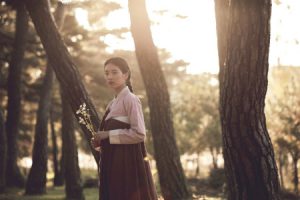
The Sound of a Flower (2015) [New York Asian Film Festival 2016]
 During the Joseon Dynasty in South Korea, Pansori opera was only sung by men as women were forbidden by law to sing. It was believed that a woman’s body was too weak to sing. Against those odds, Chae-Sun decides she wants to become a Pansori singer, going as far as dressing as a man to be allowed to sing. With much reticence, Pansori Master Shin Jae-hyo takes her under his tutelage and makes a great singer of her. When it’s found that the young man is in fact a woman, the master is imprisoned and the student makes a deal with the ruling Father-King Heung Seon Daewongun to save him.
The Sound of a Flower was written by almost a half a dozen people and still feels cohesive which means this is a great team and the director brought all of their work together with talent. Director Jong-pil Lee co-wrote the film with Ah-Young Kim, Jae-eun Jeong, Hye-rim Park, and Mi-na Chung. This team created a beautiful period piece and historical fiction where the history of Pansori opera and its first female singer is explored in a way that flows well and includes classic songs that most people outside of its country of origin have probably never heard. As the singing is very important in this film, the casting of a singer for the lead is not stunt casting as it often is but necessary.
In the part of Chae-Sun, the first female Pansori singer, is Bae Su-zy a member of the KPop group Miss A. Here she takes the part of Chae-Sun and disappears into it, becoming this other person, this sweet and timid, yet determined woman who takes on incredible odds to achieve a dream even the law forbade. From the get go, she gets the viewers to root for her and just keeps impressing them throughout the film, her subdued moments are contrasted by moment of pure courage and boldness and her performance shows great nuances and that she knows how to bring the right levels of emotions to each scene which makes her performance absolutely shine.
Playing opposite Bae Su-zy are Seung-ryong Ryu as the Pansori Master Shin Jae-hyo and Nam-gil Kim as Prince Daewon the King’s father. Shin Jae-hyo shows a calm determination for most of the film as well as a lot of care for Chae-Sun. His performance is subtle and strong, with emotions clearly held back most of the time, showing so much even in silent scenes. The man’s expressions talk for him many times, his eyes say so much. His emotions at times come through so well, they will break viewers’ hearts. Nam-gil Kim plays devilish with a passion, abandon even at times. His performance is less subtle and more extravagant with is entirely called for here with his more flamboyant character.
The attention to details in The Sound of a Flower is incredible. The costumes by Yoo-jin Kwon and Seung-hee Rim are beautiful and so well made. The production design by Jong-gun Lee looks stunning. These are showcased by cinematography by Hyun Seok Kim in scenes and sequences that linger on just the right things for just the right time. The balance in colors, brights, and darks is well thought out and gives room for the other visual aspects to shine. Of course, in a film about opera, the music is of high importance. Here the music by Tae Song Kim is subtle and adds perfectly to the classic Pansori songs and numbers.
The Sound of a Flower is a beautiful movie, well cast, well acted in stunning settings, with high quality costumes. Fans of historical dramas will love this musical and most viewers should learn a few things about Pansori opera. In all of this, it’s also a tragic love story based on historical facts that tugs at the heart.