
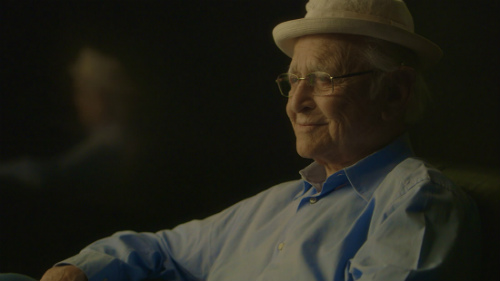
 Part of the “American Masters” documentary series, “Norman Lear” is a very bittersweet look in to a man who changed culture and television as we know it. Before Norman Lear, not many television shows and mainstream television networks were willing to step forward and address issues that confronted social and economic problems. Norman Lear is a man who grew up in a troubled family and spent a lot of his life remolding television in to a medium that could change how we think and ask us to reflect on our lives. Mr. Lear used a lot of his own experiences to help create some of the most important television series of all time. From “All in the Family” which brought important issues to our homes through comedy, “The Jeffersons” about changing the racial dynamic in a higher class setting. There was “Maude” which explored a very strong sitcom heroine of the feminist ilk, and “Good Times” which explored the life of a family in poverty.
Tag Archives: Biography
Hail to the King: 60 Years of Destruction (2015) [Horrible Imaginings Film Festival 2016]
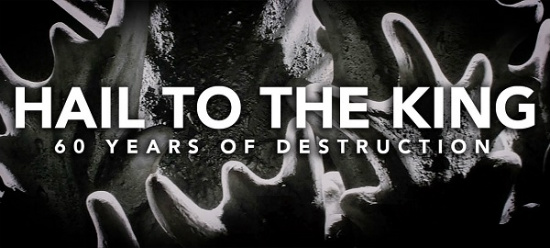 This American documentary shows what the Japanese think of the King of Kaijus, the big G, Godzilla. This documentary was shot using crowd funding to garner its budget. Director and uber Godzilla fan Kyle Yount went to Tokyo in July 2014 to film this fan love letter to his favorite monster.
DOOMED! The Untold Story of Roger Corman’s THE FANTASTIC FOUR (2016)
 This is the story of 1994’s “Roger Corman’s The Fantastic Four.”
Adapted from the iconic Marvel Comic, the film iteration was made on a measly budget of a million dollars with a joint venture by Fox, Marvel and Neue Constantin Films. After casting and initial filming was conducted, “The Fantastic Four” was a highly anticipated film covered in major magazines like Wizard and Film Threat. After a long tour of fan meetings and interviews with the press, the cast and crew learned that their hard work would result in a film that was cancelled by the studios and never to be released. Shortly after, the folks that took part in “The Fantastic Four” learned that, much to their horror, the film was never intended to ever be released. Worse, much of the struggles to conceive a fantastic cinematic vision in a decade bereft of epic comic book movies were merely to secure the rights for the comic book property and nothing more.
Beauties of the Night (2016) [Toronto International Film Festival 2016]
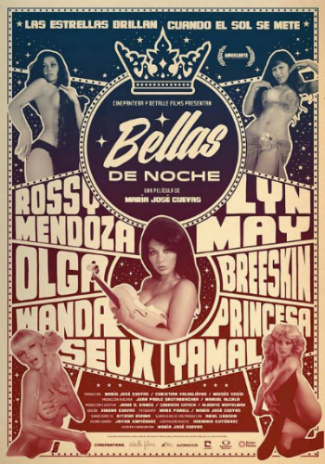 This film documents the rise to stardom, fall, and aging of some of Mexico’s most famous showgirls. These women did it all, they sang, danced, acted, modeled, etc. They were revered by armies of fans and had it all. Lyn May, Olga Breeskin, Princesa Yamal, Rossy Mendoza, and Wanda Seux discuss their rise to fame, their lives, and their dreams.
Raiders!: The Story of the Greatest Fan Film Ever Made (2016) [Blu-ray/DVD/Digital]
 “Raiders!” is easily one of the best films of 2016. It’s a compelling and incredibly emotional tale of how one movie influenced a trio of young boys, and how that piece of art not only paved the road for their future, but also save them in many ways. What becomes incredibly evident throughout the duration of “Raiders!” that makes what unfolds before our eyes a truly gut wrenching journey is that Steven Spielberg and George Lucas were men influenced by movies. Thanks to their love for serials and Westerns, they were motivated to make “Raiders of the Lost Ark” as a means of confronting their love for classic serial adventurers. After seeing “Raiders of the Lost Ark” in theaters, young Eric Zala sought out to remake of “Raiders” but with teenagers in place of the adult actors.

Dongju: The Portrait of a Poet (2016) [New York Asian Film Festival 2016]
 In 1940s Korea, Japanese colonialists were banning Korea culture and the use of the Korean language in an effort to unify their territories and become a stronger world power. In this struggle, a young man named Yun Dongju starts writing poems in Korean while attempting to survive the assimilation of his people, reluctantly becoming a fighter in a battle to preserve Korea’s identity.
This historical film was written by Yeon-Shick Shin and directed by a new master of the genre, Joon-ik Lee. They create here a subtle and fairly easy to understand representation of what is considered a hard period in Korea through the eyes of a talented poet. The film takes its time showing the young life of Dongju as well as the societal shift that the Japanese colonizing brought. The poems read on black and white images of Korea are personal and real, they create a center for the story, an emotional anchor. These were carefully chosen amongst Dongju’s work to best suit the film and they bring a solemnity to the proceedings.
The casting for this film is pivotal as so much rests on how the lead of Dongju is interpreted. Kang Ha-Neul takes this character and develops him into a fully fleshed out human being, giving a voice for his soft yet emotional poems. He shows a wide range of emotions with subtle variations, giving life to this man whose story is mainly untold, especially to Western audiences. Supporting this performance are Jeong-min Park as Dongju’s cousin Song Monggyu who is someone who likes to stir the pot and possibly cause trouble for himself and those around him.
His performance is less subdued and a bit more in your face as time passes and the character requires the actor to be bolder. Also supporting Kang Ha-Neul is Moon Choi as Kumi, the girl who believes in him and does all she can to get him published, Her performance is also held back but stands out amongst the mostly male cast, showing a calm and strong female presence in a time when women were still encouraged to take a backseat to men’s dealings.
Shot in black and white, the look of the film is very serious which fits with the story and its developments. The way the Korean countryside is shot is absolutely beautiful, the images convey the seriousness of the situation the Koran people faced during that period. The pairing of filmed sequences with the reading of the poems is perfect. Unfortunately, a credit for cinematography could not be found online (in English or French) at the time this was written.
The black and white images and style in which the film is shot make sense for this film and its subject but they do make it feel slower and made it harder for this reviewer to concentrate on the story and the poems. The style is hypnotic but can also be sleep inducing if reading a lot of subtitles on a calm series of sequences is not one’s passion. The slowness here is deliberate to give the viewers time to absorb the emotions and pay attention to the poems.
Poet Yun Dongju led a tragic life, like most artists about whom movies are made, in the time period that was anything but easy. His story is worth watching for the quality of the film and the emotionality of his poems. Viewers will (should) also learn about a tumultuous time in Korea’s history, which can be considered a bonus. It’s a bit long and slow, but absolutely worth looking for and watching.
The Sound of a Flower (2015) [New York Asian Film Festival 2016]
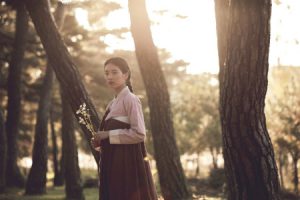
 During the Joseon Dynasty in South Korea, Pansori opera was only sung by men as women were forbidden by law to sing. It was believed that a woman’s body was too weak to sing. Against those odds, Chae-Sun decides she wants to become a Pansori singer, going as far as dressing as a man to be allowed to sing. With much reticence, Pansori Master Shin Jae-hyo takes her under his tutelage and makes a great singer of her. When it’s found that the young man is in fact a woman, the master is imprisoned and the student makes a deal with the ruling Father-King Heung Seon Daewongun to save him.
The Sound of a Flower was written by almost a half a dozen people and still feels cohesive which means this is a great team and the director brought all of their work together with talent. Director Jong-pil Lee co-wrote the film with Ah-Young Kim, Jae-eun Jeong, Hye-rim Park, and Mi-na Chung. This team created a beautiful period piece and historical fiction where the history of Pansori opera and its first female singer is explored in a way that flows well and includes classic songs that most people outside of its country of origin have probably never heard. As the singing is very important in this film, the casting of a singer for the lead is not stunt casting as it often is but necessary.
In the part of Chae-Sun, the first female Pansori singer, is Bae Su-zy a member of the KPop group Miss A. Here she takes the part of Chae-Sun and disappears into it, becoming this other person, this sweet and timid, yet determined woman who takes on incredible odds to achieve a dream even the law forbade. From the get go, she gets the viewers to root for her and just keeps impressing them throughout the film, her subdued moments are contrasted by moment of pure courage and boldness and her performance shows great nuances and that she knows how to bring the right levels of emotions to each scene which makes her performance absolutely shine.
Playing opposite Bae Su-zy are Seung-ryong Ryu as the Pansori Master Shin Jae-hyo and Nam-gil Kim as Prince Daewon the King’s father. Shin Jae-hyo shows a calm determination for most of the film as well as a lot of care for Chae-Sun. His performance is subtle and strong, with emotions clearly held back most of the time, showing so much even in silent scenes. The man’s expressions talk for him many times, his eyes say so much. His emotions at times come through so well, they will break viewers’ hearts. Nam-gil Kim plays devilish with a passion, abandon even at times. His performance is less subtle and more extravagant with is entirely called for here with his more flamboyant character.
The attention to details in The Sound of a Flower is incredible. The costumes by Yoo-jin Kwon and Seung-hee Rim are beautiful and so well made. The production design by Jong-gun Lee looks stunning. These are showcased by cinematography by Hyun Seok Kim in scenes and sequences that linger on just the right things for just the right time. The balance in colors, brights, and darks is well thought out and gives room for the other visual aspects to shine. Of course, in a film about opera, the music is of high importance. Here the music by Tae Song Kim is subtle and adds perfectly to the classic Pansori songs and numbers.
The Sound of a Flower is a beautiful movie, well cast, well acted in stunning settings, with high quality costumes. Fans of historical dramas will love this musical and most viewers should learn a few things about Pansori opera. In all of this, it’s also a tragic love story based on historical facts that tugs at the heart.