Seoul Station (2016) [Fantasia International Film Festival 2016]

seoul“If I had a place to go… I wouldn’t have stayed at Seoul Station.”

Yeon Sang-ho’s animated prequel to the excellent zombie action film “Train to Busan” is every bit as terrifying as its successor, and occasionally much more intelligent and biting in its social commentary. While “Train to Busan” is a very emotional look at class warfare and how the society divides in the time of crisis, “Seoul Station” is a very evocative commentary on the poverty crisis in the world. This horrific zombie virus is able to thrive thanks to the massive homeless population in South Korea, and it’s confronted more than once in how the government views its homeless as animals and sub-human even before the flesh eating ghouls appear.

Continue reading

post

Battledream Chronicle (2016) [Fantasia International Film Festival 2016]

battledreamI was a bit mixed on French anime “Battledream Chronicle” until the very end. I love the concept from Alain Bidard. It’s a very unusual mix of “Tron” and “The Matrix” where world decisions and lives are based around a virtual reality game based around gladiators and battling that results in actual lives lost. Set in the year 2100, humankind has managed to achieve paradise, but that’s been taken away by an evil computer AI. The computer has recruited various warriors from across the world to compete for the fate of their country. The team Mortemonde is on the verge of dominating the world after winning endless tournaments, and it’s up to Syanna to compose the perfect team to stop AI and give the world its freedom back.

“Battledream Chronicle” has a very unique idea that could be developed in to such a remarkable film, but in the end I had a difficult time finishing. Bidard takes such a long time developing any kind of characters and spends an obscene amount of time building up to the finale. For some inexplicable reason, entrenches us in to the middle of politics and characters bouncing dialogue off of one another, and how much is at stake if heroine Syanna doesn’t choose the proper teammates to take in to combat. I loved a lot of the concepts behind this digital tournament, including the soldiers that rule over it, and the weapons that are handed to the various gladiators to take in to combat. I wanted to know so much more about this bits and pieces.

But Bidard takes us more mystical here and there, relying on a lot of symbols and icons to represent various weapons, and conveying this digital world as something that’s one step up to achieving a higher state of mind. You’d think that would amount to a rich and complex fantasy, but I found it pretty muddled and I didn’t think there was enough glimpses in to the digital realm of Farandjun as there should have been. That said, “Battledream Chronicle” should be applauded for employing a large cast of minority heroes, including main character Syanna, who is African American. There’s also the wonderful animation which really compliments the quasi-futuristic aesthetic that kept the film walking the line between hard science fiction and dark fantasy.

I’d suggest checking this out if you’re a science fiction fan prone to experimenting and dabbling in more out of the ordinary fare. I found it fairly mediocre and severely lacking in action and excitement.

post

The Alchemist Cookbook (2016) [Fantasia International Film Festival 2016]

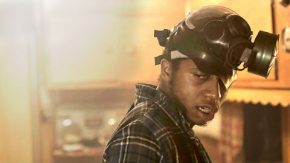
alchemistA man trying to survive in a shack in the woods plays with alchemy to discover an ancient secret to a better life.  Inadvertently, he summons a dangerous being who doesn’t take too kindly to his dealings. The Alchemist cookbook is written and directed by Joel Potrykus who is known for independent horror films shot in Michigan and who considers his style in the vein of Jim Jarmusch which is something each viewer can judge for themselves, but this reviewer did not really see that.

Here he crafts a fairly slow boil of a film.  It starts with an alchemy cooking sequence set to a great track, giving the impression that it might be an upbeat, fast moving film, but it soon becomes clear that the lead, Sean, is a paranoid man playing with forces he doesn’t fully understand.  Unfortunately, past that opening scene, the film feels slow and like it might need some extra oomph or perhaps to be edited differently.  It’s not boring but it’s not enthralling either.

The cast for this small budget is, well, small.  The lead of Sean is played by Ty Hickson who does great as the paranoid, perhaps desperate, man trying his hand at alchemy.  His performance here is good and worth seeing and he proves he can carry a complete movie on his own as the only other actor has only a few scenes and those scenes are always with him.  In the only other human role in the film is Amari Cheaton as Cortez a typical gangbanger who tries to help his friend Sean while also getting himself into trouble.  His performance feels more exaggerated and caricatured while less on point than Ty Hickson’s.  The last cast member listed is Fiji as Kaspar (the cat), as is usually the case with cats, he does a fabulous job while remaining rather nonchalant about the whole thing.

The film has some nice bits of science alchemy and some good effects.  The last third does amp up the horror factor and what can be seen is well done and executed.  These special effects are by Jeffery Husselman with visual effects by Scott Baisden and Daniel Falicki.

Also worth noting are the cinematography and the soundtrack.  The cinematography by Adam J. Minnick does a great job at making all outdoors images feel desolate in their settings while the indoors shots feel cramped to go with small shack the lead lives in.  This adds to the atmosphere here and is very well done.

The soundtrack for this film is mostly provided by way of an old tape deck that the lead character uses.  The song choices and what is fast forwarded tell a lot about the character, which makes him feel real, more like the crazy, paranoid version of someone every viewer knows.  His musical choices also reflect his internal turmoil, by letting him “choose” those songs, something so few films do.

The Alchemist cookbook is not a bad film but it has issues with pacing and with sections of the story feeling like filler.  The acting by the lead is good and he carries the film well.  The music is his best supporting character, but it’s not enough to make this reviewer want to see it again or be able to fully recommend it.

Fantasia International Film Festival runs from July 14th until August 3rd, 2016.

post

The Lure (2015) [Fantasia International Film Festival 2016]

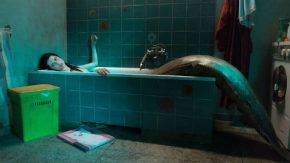
lureSirens attracted by a musician playing on the beach seduce him and his band into taking them in.  With them, they become part of the entertainment at a night club while openly being sirens.  When one of the girls falls for an earthly boy, she wants to trade her tail for legs, no matter the cost.

Written by Robert Bolestro, The Lure follows two siren sisters, Golden and Silver, as they navigate life on dry land.  The story he builds here is interesting and entertaining with lead characters that attract attention and keep it.  The story takes some unexpected turns and some less so, but all of them are fun to watch (even the ones less fun for the characters).  The ending (no worries, no spoilers) is touching without being schmaltzy.  Directing this modern fairytale is Agnieszka Smoczynska who takes the script and turns it into a kind of film version of a Bjork video.  She creates a colorfully loud film in some scenes and a subdued one (color-wise) in others.

The way she shoots a domestic fight or an operation is fantastic and something this reviewer has not seen many times before (and I have seen thousands of films).  Many scenes are shot in unexpected and original ways, making the film very unique.  Adding to these directorial choices is the cinematography by Jakub Kijowski complementing the story and framing every image perfectly.  The way this film is shot brings out its peculiar, exciting scenes and contrasts them excellently with the darker ones.

Playing the sirens are Marta Mazureka as Silver (Srebrna) and Michalina Olszanska as Gold (Zwota), both giving great performances.  Mazurek shows her soft side, playing the more innocent siren who falls for a human.  The way she develops her character is sweet and makes the viewers care about her like a little sister.  Olszanska plays the other sister, more bold and mean almost.  She brings out the killer side of sirens with gleeful abandon making her performance mesmerizing.  One of the support characters stands out form the rest due to the actress’ performance, Wokalistka Krysia, the mom-type character who takes the girls in.

This performance by Kinga Preis is fantastic and layered.  She shows the character’s vulnerability and her caring side, than switches to the performer side when her character hits the stage and commands attention, almost stealing scenes from the girls at times.  A few of her performance pieces were reminiscent of LuLu.

Also more than worth the price of the ticket is the special effects for the sirens’ tails.  They look as real as can be, with fishy scales and some glistening.  They are beautiful and grab the attention.  There is also some juicy, gooey gore in the aforementioned surgery scene that looks good.  Unfortunately, the IMDB page for The Lure has no special effects or visual effects credits.

The Lure is a comedy/drama/musical/horror and as the sirens are singers being taken in by a band the music is highly important.  The numbers and performances on screen with the band and then with the girls are fun, flamboyant at times, and highly entertaining.  The pop songs are catchy and do not overstay their welcome while the choreography by Kaya Kolodziejczyk and Jaroslaw Staniek adds some sexiness to the girls’ already alluring performances.

The Lure is a great film, like a long form music video that works, reminiscent of Bjork and Mylene Farmer with a true Polish spirit.  It offers a lot and is fun while remaining touching.  It must be noted that it is Polish cinema’s first musical.  The whole crowd at Fantasia ate it up and come out talking about what they had just seen.

Fantasia International Film Festival runs from July 14th to August 3rd, 2016.

post

I, Olga Hepranova (2016) [Fantasia International Film Festival 2016]

iolgaWhat pushes someone to once day decide they have had enough and that the only solution to be understood is to commit mass murder?

In 1973, in Prague (Czech Republic), 22 year old Olga Hepranova drove a truck into a waiting crowd, hitting 25 people and killing 8 of them.  The film is the story of how Hepranova got to this massacre. Taking on the hard task of writing this story for the screen without falling into sensationalism or exploitation, writers Roman Cilek, Tomas Weinreb, and Petr Kazda, they took a delicate subject and turned it into a touching and beautiful story of a girl who feels as though she is being bullied and who has a long period of bad luck.

After long enough of asking for help and not receiving it, she decides to take drastic measures.  They do not build Hepranova as a martyr or anti-hero but simply as a complex human being in need of help. Directors Petr Kasda and Tomas Weinreb took this script they co-wrote and turned it into a beautifully sad tale of a woman who possible could have been saved.  The way they shot the film, in tandem with cinematographer Adam Kozakl in black and white and with very somber tomes is sublime.  It takes this very heavy subject matter and make it bearable to watch.  They craft a film that mesmerizes its audience while making them just a bit uncomfortable.

As so much of the film rests on her shoulders, the part of Olga Hepranova had to be cast perfectly.  Actress Michalina Olszanska (mesmerizing in The Lure) was chosen and she is perfectly gloomy and fantastic.  She clearly understood the depth and seriousness of the part, never over acting, always giving her all and stepping in Hepranova’s shoes, no matter how uncomfortable the process looks.  She loses herself in the part and shows tremendous talent, proving that she is a start to keep watching.  The rest of the cast is also very good to great with one stand, Klara Meliskova, as Olga’s cold, unloving mother.

She shows how one woman can be there and take care of basic needs for her child while showing absolutely no love or affection toward that child.  Most characters are played as cruel or cold, except for the character of Miroslav, a man who tries to help Olga but has his own problems.  This part is played by Martin Pechlat who brings a bit of light to the film by not being as serious as the rest of the cast.  However, this is not in a funny or goofy way, but by showing just the right amount of light, even though highly flawed, to Olga’s life and the film.

The film is a must for fans of 70s Eastern Europe.  The costumes by Aneta Grnakova and the art direction by Alexandr Kozak are perfectly on point.  They give a great idea of what Prague and its people looked like in 1973.  They do a very detailed job, bringing the era to life. I, Olga Hepranova is a somber film with a dark subject that is a part of Czech history.  It was important that filmmakers behind the film pay attention to details and that they be careful to not over-dramatize the story.  They do this while creating a perfectly gloomy film that should make any audience feel something.

The very timely subject matter of a mass murderer running people over with a truck is unfortunate but it should not keep people from seeing this film when the genre, style, or subject matter is something they would like to watch.  This is not a film that is a feel good one; on the contrary, it’s depressing, sad, and beautiful.

post

Dongju: The Portrait of a Poet (2016) [New York Asian Film Festival 2016]

dongjuIn 1940s Korea, Japanese colonialists were banning Korea culture and the use of the Korean language in an effort to unify their territories and become a stronger world power.  In this struggle, a young man named Yun Dongju starts writing poems in Korean while attempting to survive the assimilation of his people, reluctantly becoming a fighter in a battle to preserve Korea’s identity.

This historical film was written by Yeon-Shick Shin and directed by a new master of the genre, Joon-ik Lee.  They create here a subtle and fairly easy to understand representation of what is considered a hard period in Korea through the eyes of a talented poet.  The film takes its time showing the young life of Dongju as well as the societal shift that the Japanese colonizing brought.  The poems read on black and white images of Korea are personal and real, they create a center for the story, an emotional anchor.  These were carefully chosen amongst Dongju’s work to best suit the film and they bring a solemnity to the proceedings.

The casting for this film is pivotal as so much rests on how the lead of Dongju is interpreted.  Kang Ha-Neul takes this character and develops him into a fully fleshed out human being, giving a voice for his soft yet emotional poems.  He shows a wide range of emotions with subtle variations, giving life to this man whose story is mainly untold, especially to Western audiences.  Supporting this performance are Jeong-min Park as Dongju’s cousin Song Monggyu who is someone who likes to stir the pot and possibly cause trouble for himself and those around him.

His performance is less subdued and a bit more in your face as time passes and the character requires the actor to be bolder.  Also supporting Kang Ha-Neul is Moon Choi as Kumi, the girl who believes in him and does all she can to get him published,  Her performance is also held back but stands out amongst the mostly male cast, showing a calm and strong female presence in a time when women were still encouraged to take a backseat to men’s dealings.

Shot in black and white, the look of the film is very serious which fits with the story and its developments.  The way the Korean countryside is shot is absolutely beautiful, the images convey the seriousness of the situation the Koran people faced during that period.  The pairing of filmed sequences with the reading of the poems is perfect.  Unfortunately, a credit for cinematography could not be found online (in English or French) at the time this was written.

The black and white images and style in which the film is shot make sense for this film and its subject but they do make it feel slower and made it harder for this reviewer to concentrate on the story and the poems.  The style is hypnotic but can also be sleep inducing if reading a lot of subtitles on a calm series of sequences is not one’s passion.  The slowness here is deliberate to give the viewers time to absorb the emotions and pay attention to the poems.

Poet Yun Dongju led a tragic life, like most artists about whom movies are made, in the time period that was anything but easy.  His story is worth watching for the quality of the film and the emotionality of his poems.  Viewers will (should) also learn about a tumultuous time in Korea’s history, which can be considered a bonus.  It’s a bit long and slow, but absolutely worth looking for and watching.

post

The Laundryman (2015) [New York Asian Film Festival 2016]

thelaundrymanA hit man who works for a laundry company as a cover up grows a conscience.  He’s highly trained and excels at his job, however, for a while now, he is plagued by ghosts and he must find out what they want from him in order to restore some sort of peace to his life.  To do this, he enlists the help of a cute but possible clueless clairvoyant.  Through all of it, he finds out more about his victims, his boss, and himself.

The Laundryman is a hybrid horror/comedy/action film by director Chung Lee and written by Yu-Hsyun Chen and Chung Lee.  The tale built here fills the complex task of mixing multiple genres without going into parody or satire or become a send-off/homage to its genres.  Here the mix of the genres works very well and has the story evolves its elements just work.  However, the comedy levels are more present in the first third or so of the film and then occasionally throughout the rest of the film.  The comedy works because the viewer is not hit over the head with it.

That being said, some of the scenes are completely ridiculous in the best way possible.  The horror, mainly from the ghosts and not much blood outside of a few short scenes works here as well.  The ghosts here are not meant to scare but they work so well with the story.  The first fight sequence is fantastic, the way its written and shot make it really fun.  The rest of the fighting is also entertaining.  Getting all of these elements together creates a really fun whole.

The casting here feels rather perfect for the story and the style.  Hsiao-chuan (Joseph) Chang is an entertaining lead.  He has a charisma that helps carry the whole film.  His acting is just about perfect for the material.  It may not be the top performance seen at New York Asian Film Festival, but it’s still a damn good one.  Supporting him is Regina Wan as the clairvoyant and Sonia Sui as the boss, both opposites until the end.  Their performances show excellent talent as they both do extremely well.  The cast for the ghosts is fantastic too and they manage to keep a straight face through some truly ridiculous situations.

For a partially horror movie, the effects are not super prominent but what we’re given is well done.  The CGI is good and blends well in the scenes where it is present.  It’s not overly used which avoids it becoming an annoyance.  Outside of the effects, the film looks really good, it grabs the attention from the get go with its colorful representation of Taiwan and the life of a man who, by all accounts, could be living a very grim life.  Most of the film, besides the flashbacks, feels all so chipper.  In general, the film looks very good.

The Laundryman is a really fun, funny, and entertaining film.  It may be hard to find for a while being a festival title, however it’s absolutely worth checking out.  The story is good, the acting is on point, the fighting “punchy”, and the ending, all the way after the credits, will make you giggle.