post

Fall Seven Times, Get Up Eight: The Japanese War Brides (2015)

The directors of this documentary short—Lucy Craft, Karen Kasmauski and Kathryn Tolbert—are journalists whose fathers were U.S. service members stationed in post-World War II Japan and whose mothers were among the tens of thousands of so-called “Japanese war brides.”

The three Japanese women profiled here—Hiroko Furukawa, Emiko Fukumoto and Atsuko Onda—frankly acknowledge to their daughters that they did not marry strictly for romantic reasons, but because they were eager to leave the economic chaos of Japan in favor of the chance of a better life across the Pacific. However, their only knowledge of the American way of life came from movies and the mostly positive impressions of the Americans involved in the occupation period.

Although the U.S. military was initially opposed to these marriages—in many states, interracial marriage was illegal—it quickly realized that it was unable to prevent fraternizing between U.S. military men and Japanese women. The military switched gears and worked to educate the Japanese women on what they should expect in their American lives—albeit with lessons on baking cakes and wearing make-up.

But once they arrived in the U.S., the challenges faced by the women in their new country were significant. Their spouses’ families were not entirely pleased with their presence, while the wider society was not eager to embrace the mixed raced marriages. The women also faced numerous problems in assimilating into the behavioral patterns of their adopted homes, especially when it came to raising children—strict Japanese parental expectations were dramatically out of step with the more leisurely American approach to raising children, which created additional stress in their households.

At 26 minutes, the film barely scratches the surface on the lives of the directors’ mothers or the wider social upheaval created by the war brides. (The thoughts of the men that married them are not recorded in this film.) But, nonetheless, it offers an intriguing glimpse into a long-forgotten chapter of post-World War II history.

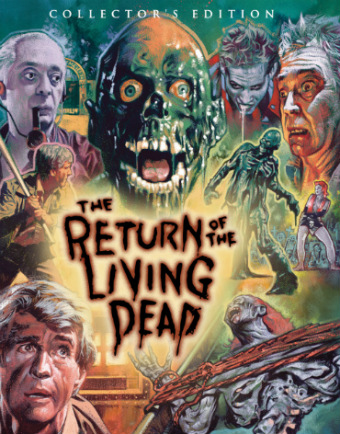
The Return of the Living Dead (1985): Collector’s Edition [Blu-Ray]

rotldIt’s not often that filmmakers strive to set themselves apart from what’s been widely embraced by the horror community and manage to properly redefine a subgenre. Before “Return of the Living Dead” fans accepted the walking dead shambled slowly toward you and ate flesh, but Dan O’Bannon transformed his zombies in to undead crack heads. Said undead crack heads bolted toward their prey like lightning, were devilishly clever, and craved human brains as a source of nourishment. Though “Return of the Living Dead” has a remarkable sense of humor and will inspire a lot of uneasy laughs from the audience, it’s through and through a creepy horror thriller about groups of people fending off undead monsters from every corner while trying to escape Kentucky as it’s ravaged by brain eating ghouls.

Continue reading

post

Devil Girl (2007)

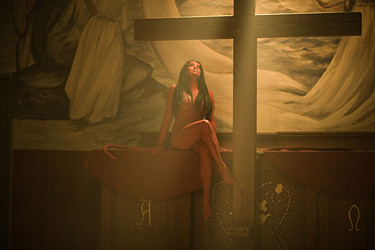
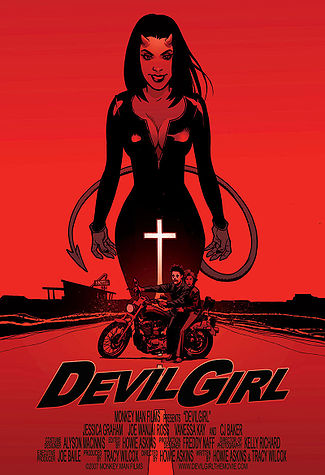
Devil_Girl-PosterIn an isolated desert town, a girl travelling cross country after the death of her father has car trouble after a drag race.  This forces her to stay in town for a while which means finding a place to stay, getting work, and mingling with the locals.  She ends up dealing with a weird motel owner, a preacher with odd leanings, a clown-faced man, and a stunning devil girl.

“Devil Girl” is directed by Howie Askins who co-wrote with Tracy Wilcox Gillie.  The story they put together here should be a great story considering its components, but instead of focusing on the titular Devil Girl, they relegate her to a few too short appearances, letting the film be about Fay, the girl on a road trip who ends up working as a stripper to survive.  The story also has a clown who seems to have been added for shock and weirdness factor which he does bring , but for all his screen time, he has very little impact on the story until the very end where he could easily have a been replaced.

The characters are decently written but not given much of interest to do.  The few twists and turns in the story are not quite enough to make it riveting or even all that interesting. Most of the cast gives ok performances with few stand-outs.  Lead actress Jessica Graham gets the most screen time and gives a good performance through most of it but she does look absolutely bored in a few scenes, most specifically the strip club scenes where once can guess she was trying to convey discomfort or shame as she did get the job reluctantly.  The one actress who really stands out the most and only gets a few scenes is Vanessa Kay who is the Devil Girl.

She has a very short time to make an impression but makes the most of it with a performance full of glee and charm, giving good reason for the movie to be named after her minor character. With a film called Devil Girl, one would expect more of a horror film but this is not it.  There is a little blood and some special effects; the design of the Devil Girl is pretty and sexy, her outfit being nearly nothing but red paint, which leads to a stunning attractive presence on screen for the curvy actress.  The main point of interest here, outside of the red hot girl, is the cars.  A bunch of old school muscle cars, racing each other and being eye candy.

For all of its muscle cars and the sexiness of the title character, the film is quite bland, boosting a group of basic, expected desert town settings and a lackluster story.  The film uses occasionally shaky camera and a lot of mild grindhouse looks to add to its story but it just doesn’t grab the viewer to make them care.  The last act twist basically kills the entire film and story built so far.

post

The Belle of Samoa (1929)

Unless you are a die-hard aficionado of the films of the late 1920s and early 1930s, there is a good chance that you never heard of the comedy team of Bobby Clark and Paul McCullough. This duo worked their way up from the rough-and-tumble worlds of circus entertainment and vaudeville before reaching Broadway stardom in the mid-1920s. When Hollywood jettisoned the silent movies in favor of “talking pictures,” Clark and McCullough were among the many Broadway headliners to find their way to Hollywood.

In 1928 and 1929, Clark and McCullough starred in14 shorts produced by the Fox studio. Sadly, all but two of these films are considered lost: “Waltzing Around” (1929), which exists in private collections and is available for exhibition at the moment, and “The Belle of Samoa” (1929), which can be found in an unauthorized YouTube posting. (The team later made short films at RKO, but most of their work for that studio is not easily accessible for contemporary review.)

0000The comedy of Clark and McCullough has been polarizing among many film scholars – some praise the duo for bringing a rough anarchy to the medium, while others bemoan the uneven distribution of comedy that favored Clark’s motor-mouthed antics while McCullough was often treated like a glorified onlooker to the mayhem. In some ways, the comics never truly found a comfortable transition from stage to screen, particularly Clark with his painted-on eyeglasses and his tendency to enunciate as if he was still playing to the last seat in the balcony. The theatricality of their act is clearly demonstrated in “The Belle of Samoa,” which is presented like a filmed record of a stage revue.

The film opens with the duo walking on stage wearing funny clothing – Clark has a fez and oversized coat while McCullough wears a porkpie hat and plaid pants – and immediately announce that they are in Samoa. They knock on a door and are greeted by a large, somber man wearing greasepaint make-up and a wild wig – this was the 1929 Hollywood idea of a Samoan native. The man is the guard at a sacred temple of the maidens of Samoa, and he tells the interlopers, “Speak softly.” Clark takes the instruction with flippancy, announcing, “Oh, it is a speakeasy!”

After tricking the guard with a gambling distraction, Clark and McCullough race inside and they find the temple consists of young women who are wearing exotic garb that seems closer to an Arabian Nights fantasy than a Samoan village. “All of these flappers are looking for a man!” Clark exclaims before a Samoan princess (played by Lois Moran, a popular film star of the era who was transitioning into talkies). Clark feels that McCullough is crimping his style and whacks him in the chest with a cane, to which McCullough moans, “Oooooh, my operation!” Clark then explains McCullough to the princess by stating, “That’s my valet – he look like a hill, but he’s really a valet.”

Just when it feels like Clark is wearing out his welcome, a curtain passes across the stage to signal a change of scene. For the next several minutes, the audience is treated to an extended musical sequence starring Filoi and her army of 60 Samoan singers and dancers. After this interlude, Clark and McCullough return to face death by beheading for defiling the maidens’ temple. The princess begs her father to spare the duo, and their salvation is rewarded by the princess performing a decidedly non-Samoan pop ditty while backed with her own small army of singers and dancers. At the end, everyone runs out on stage to take a bow.

Admittedly, “The Belle of Samoa” is no one’s idea of a classic. But it offers an idea of what Clark and McCullough’s Broadway offerings of that distant era may have looked like. Yes, the comedy is too corny and too politically incorrect for today’s tastes, but it moves with a rapid speed and a heavy sense of self-confidence that compensates for whatever it is missing in the aesthetics department. Clark muffs two lines, but recovers quickly and keeps firing away with his material. McCullough, however, is the real joy – he watches the proceedings with a slacker’s bemusement, and his cackle-voice delivery gives an odd charm to whatever he says. And while the Samoan musical segment requires a bit of patience, Lois Moran’s solo is fun and sexy – and it is a shame that she left films a few years after “The Belle of Samoa,” as she clearly possessed a star power that warranted a longer screen presence.

“The Belle of Samoa” is a hoary and somewhat creaky affair, but it is valuable as a reminder of where American comedy came from.

20 Past Films From Fantasia International Film Festival Worth Looking For

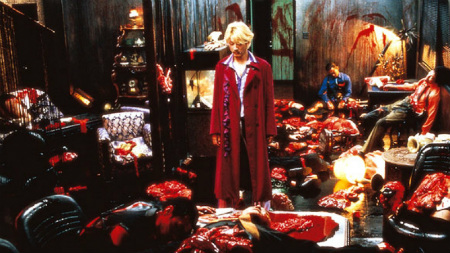
ichi-the-killerFantasia International Film Festival is having its 20th edition this July and I am proud to say I have only missed 4 of them, the first one, 2006, 2012, and 2014.  That being said, I’ve played catch up and seen some of the films from those years and can say without a doubt that Fantasia International Film Festival plays a fantastic selection of films from around the world, with a penchant for the odd, the weird,. And the often overlooked by mainstream movie goers.

Continue reading

post

Pig Pen (2015)

Pig Pen posterThirteen year old Rick lives in less than ideal conditions but social services don’t seem all that worried.  After things go from bad to worse, he runs away and becomes one of many street kids.  When he witnesses a brutal murder, Rick ends up going back home where a gruesome scene awaits him.

Pig Pen is directed by Jason M. Koch who co-wrote it with Mark Leake.  The film is unrelentingly dark and creates an oppressive atmosphere that should put viewers in an uncomfortable place.  The entire film is built on negativity and what little light or positivity there is gets snuffed very quickly every time.  The feeling and atmosphere created are oppressive and depressing.  The whole film is very very effective at this.  The characters that live in this environment are sad, desperate, or evil.  These people are almost all negative people, human beings anyone wouldn’t necessarily want to be around ever.  They are damaged souls who do damage onto others.

The dialogue is basic but fits the characters and advances the story without cluttering the film with long conversations or monologues.  The people involved are unhappy and living hard lives, so their language and conversations reflect that. The cast here is fairly small, most scenes involving Rick (Pig Pen), his mother Sandy, her boyfriend Wayne, or a combination of them.  Rick is played by much older than 13 years old actor Josh Davidson who plays the early teen part very well, especially considering his age (born in 1975 per IMDB), his interpretation is sad and desperate, and making the viewer feel for him.  Sandy is played by actress Nicolette le Faye who also gives a sad turn as her character, adding sheer fear which makes the viewer worry for her, her safety, and well-being.

As her boyfriend Wayne is Vito Trigo who brings menace and violence with all his being.  His character comes off as flat out nasty and scary as the abusive asshole who makes Rick lose it.  He brings out a visceral reaction to his character, enough to make the viewer hate him as he is just evil.  The characters all do come off as unhappy people with little to live for. Pig Pen being a very independent film made with the help of an Indie Go Go campaign, the few effects there are have to be expected to be on the inexpensive side but they also look great.  The central piece of effect, which will not be spoiled here to keep its surprise as big as can be, is very well done, looking real and painful, hitting a nerve as soon as it’s revealed.

Kaleigh Brown did fantastic work with that scene and the others where her special effects talents were needed.  She shows that she can work in little time, with a small budget to deliver big budget shock and horror.Pig Pen is not only an independent film made on a tight budget, it was also made with a small crew with a lot of that crew having worked with Jason M. Koch on his previous film 7th Day.  Having not seen that film, it cannot be compared here.  Solely based on Pig Pen however, let’s hope Koch keeps making films as he has a style that works and is a talented story teller.  Pig Pen is depressing and dark, a slice of desperation from one kid’s life, almost completely devoid of any light or hope.

It’s very violent in spots, with its violence not all being physical.  Thankfully it has some moments to breathe or it would have become too much or completely lost its impact.  This is not a feel good film and it should and probably will, make most viewers uncomfortable, a sign of a successful dark film.

post

The Pack (2015) [Blu-Ray]

pack-bluOnce again, “The Pack” is another in a long line of modern horror films that feel as if they were once written for the late seventies. Nick Robertson’s horror thriller is a very stripped down and simplistic survival thriller that packs in enough excitement and suspense to compensate for the lack of plot. “The Pack” is a combination of a home invasion thriller, and a nature run amok movie, where a seemingly normal family of four is attacked by a pack of large black wolves that arrive out of the wilderness of the Australian outback one night. The wolves are large and powerful as well as relentless, making the fight for survival absolutely intense.

The Wilson family are going through their troubles, as dad Adam finds out their farm is about to be foreclosed on. This creates familial tension, especially with daughter Sophie who wants to move to the city and be among actual people for once. Suddenly the pack of wild wolves burst from the woods and begin terrorizing the family, causing them to look for a way out of their farm and in to civilization. This proves to be more difficult than they could ever imagine, since they have no radio contact with the outside world, and any efforts from local authorities to rescue them results in the wolves literally tearing apart anyone that enters the threshold. A good amount of “The Pack” is built around the family spread apart and looking for a way to outwit and outmatch the wolves.

Their hunger is insatiable making them vicious and powerful in their pursuit. Robertson films some really tight and intense moments of evasion, as the characters hide in corners and small rooms trying to stay as quiet as possible while they devise a route out of the farm without being mauled. Though the budget obviously keeps us from seeing a full on attack by the wolves every minute, director Robertson works well with the limitations, making the wolves feel almost supernatural at times. Many of the best moments feature our characters making wise moves while the deck is stacked against them with these fierce clever monsters, and I was rooting for this family until the very end.

Though the final scene is a bit goofy for its blatant way of leaving the door open for a follow up, “The Pack” is a very good survival thriller and one I could definitely re-watch. The blu-ray from Scream Factory and IFC Midnight features an eight minute “Making Of” focusing on the dogs in the film, and how they worked with them, along with typical interviews about working with the director. There’s also the original theatrical trailer.