post

Joe’s Violin (2016)

Kahane Cooperman’s Academy Award-nominated documentary short offers a simultaneous pull on the heartstrings and a classical meditation on violin strings. The eponymous instrument is a violin donated by Joseph Feingold, a 91-year-old Holocaust survivor, to an instrument donation drive conducted by a radio station to help music students in cash-strapped schools in New York. The violin went to an all-girls academy in the Bronx, where it was presented to 12-year-old Brianna Perez, a gifted student from a broken home who aspires to become a music teacher.

Continue reading →

Working Class (2011) [San Diego Film Week 2017]

Using A Tale of Two Cities, this documentary tells the story of Mike Giant in San Francisco and Mike Maxwell in San Diego who are both artists and friends who connected through tattoos the first put on the second.  Throughout the film, their lives are paralleled and compared until it eventually brings them together.

Continue reading →

Country: Portraits of an American Sound (2015)

This documentary made in 2015 and released in early 2017 explores how the image of country singer is developed through photography and has been since the very start of the music genre.  Through interviews with photographers, artists, singers, and musicians, the history of country music is explored and the emphasis on how image can help make or break an artist’s popularity are explained as well as the process behind some memorable photographs done by various photographers, some specializing in country portraits and other specialized in portraits.

Continue reading →

Art as a Weapon (2012) [San Diego Film Week 2017]

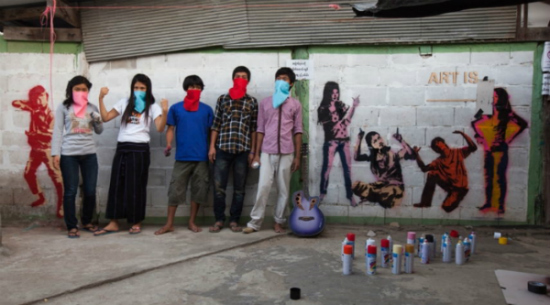
Made in 2012, Art as a Weapon is a documentary about using street art to publicly send a message, may it be of peace, hope, a political one, or any other messages sent to the mass public by way of graffiti, paintings, etc.  The film follows an art class in Burma learning to use art with the most effectiveness and contrasts this with American street artist Shepard Fairey.  Directed by San Diego documentarian Jeffrey Durkin, the film mixes the Burmese school students’ scenes with scenes shot in San Diego while artist Shepard Fairey was in town painting a Buddhist monk on the side of a building.

Continue reading →

post

The Illinois Parables (2016)

Deborah Stratman’s experimental film considers the wide scope of the American experience through a narrow prism of eleven chapters from Illinois history.

The production considers the eerie near-erasure of the land’s ancient inhabitants – the Cahokia Mounds are shown with scant explanation of their relevance, while Native American culture is viewed in the tacky stagnation of a museum diorama and the expulsion of the Cherokees is encapsulated in a street sign called “Trail of Tears Road.” The rise and fall of outsider communities is also considered in the relatively brief period of the Icarian utopian commune of French immigrants and the rise of Joseph Smith’s nascent Mormon movement (as well as Smith’s death and the burning of the Mormon temple in Nauvoo). Stratman brings in archival footage of the devastating 1925 Tri-State Tornado and stages a re-enactment of the televised re-enactment of the murder of Black Panther leader Fred Hampton by law enforcement.

Continue reading →

Frankenstein The Real Story/The Real Wolfman (DVD)

Halloween has come early this year! Lionsgate has graced horror fans with a ton of really interesting documentaries from the History Channel and A&E Network in America. For folks that always wanted to know the “Real” story behind “Frankenstein” and “The Wolfman,” well this is where you can turn. Truth be told, the entire double disc DVD set garners an array of forty five minute documentaries, with the Frankenstein topic taking center stage. With all three documentaries clocking in at 178 minutes in length, it’s a treasure trove for individuals that love Frankenstein and Mary Shelly. Featured in the first disc is “In Search of the Real Frankenstein,” “Frankenstein,” and “It’s Alive! The True Story of Frankenstein.” Oddly enough while all three documentaries can sometimes become repetitive, they offer up a unique look at Frankenstein with different angles and approaches.

Continue reading →

Eero Saarinen: The Architect Who Saw The Future (2016)

One of the most influential figures in post-World War II architecture was the Finnish-born Eero Saarinen, whose neo-futuristic vision created some of the most striking design accomplishments of the 20th century. Peter Rosen’s documentary, which aired on PBS’ American Masters, offers a satisfactory oversight of Saarinen’s career.

Continue reading →