Director Jim Wynorski offers up a sometimes clever, but inferior follow up to the original Robert Englund film, that doesn’t really advance the narrative so much as it treads water. Rather than explore the themes of the apocalypse, and the eventual war of good and evil dictated by the hotline, we’re once again subjected to a tale about the hotline wreaking havoc.
Tag Archives: Revenge
Freaks (1932)
For a very long time I avidly avoided Tod Browning’s “Freaks” simply because it was one of those films that I was intimidated by. While very few films leave me tainted, “Freaks” is a film I was afraid would be cheap, exploitative, and nauseating. “Freaks” is by all accounts one of the most downbeat horror classics ever made. Especially in the face of director Browning’s horror classic “Dracula.”
Fright Night Part 2 (1988)
Apparently Jerry Dandridge from “Fright Night” had a sister. And she’s pissed that Charlie Brewster killed him. She plans to get revenge on him by tracking him down, taking residence in the same building he resides in, and staging one of the most convoluted revenge plans ever written. She wants to turn Charlie in to a vampire, but then she also wants him to believe that he’s going crazy. She shows him that she’s a vampire quite often, but also wants him to think that she’s merely just a stage performer and Charlie is going nuts because–well–going crazy makes the blood sweeter?
Urban Legends: Final Cut (2000)
For the sequel to the creative but utterly underwhelming “Urban Legends,” director John Ottman and the writers basically ape “Scream” by taking the premise and much of the film’s general concept to the world of filmmaking. This time around “Final Cut” centralizes its story on a film school where a bunch of wannabe directors and actors are being knocked off by a serial killer with a fencing mask. Granted, I’m not a fan of the “Scream” films, but often times “Final Cut” feels like a poor man’s version of the Wes Craven series. A bunch of glamorous young folks in their thirties play aspiring Hollywood artists/college students, all of whom are being offed one by one by a masked killer in some of the most grotesque and anti-climactic ways possible.
Urban Legend (1998)
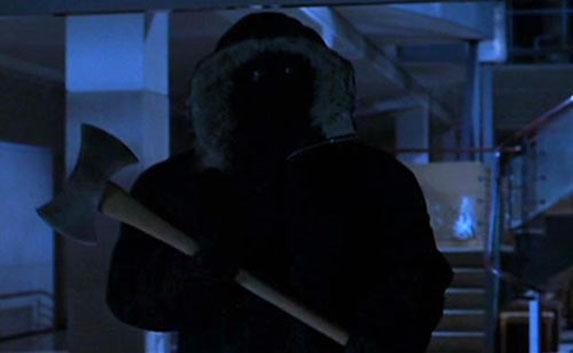
I never understood why, if “Urban Legend” is set in New England, does the killer wear a heavy winter coat that drapes over their face during what looks like the early Fall season. You figure the killer would opt for something sleeker and more compact, as well as something that doesn’t directly cut off peripheral vision. But that is one of the many irritating aspects of “Urban Legend” that demands a lot from its audience in the way of suspension of disbelief. This is a world where suddenly everyone owns a winter jacket with white fur lining once we’re aware of the killer’s garb. Even swimmers who happen to be wearing swimsuits decide to wear it while walking along an in-door pool. Only in this universe does that make even the slightest bit of sense.
Shocker (1989)
Wes Craven creates Freddy Krueger. Again. This time rather than invading the meta-reality of dreams, maniac Horace Pinker can travel through televisions. That said, “Shocker” is basically like “Nightmare.” There’s a maniac, a main character linked to him through dreams, a secret that the main character’s neglectful parent is hiding, a major supporting character that dies thanks to the maniac that allows the main character to face off against the maniac, and a final showdown where the main character turns the tables on the maniac.
Phantom of the Megaplex (2000)
I think one of the reasons why the DCOM “Phantom of the Megaplex” has now gone on to basic obscurity is that it’s one of the weirder movies the Disney Channel ever produced. It’s not just an ode to the love of movies, but it’s a call back to “The Phantom of the Opera.” Not only does the film draw heavily from the original story, sans the violence and murder, but it actually influences its audience to check out the Lon Chaney masterpiece. “Phantom of the Megaplex” is a busy and often messy horror fantasy, but one that works, mainly because the writers of the film clearly love movies as much as we do.