
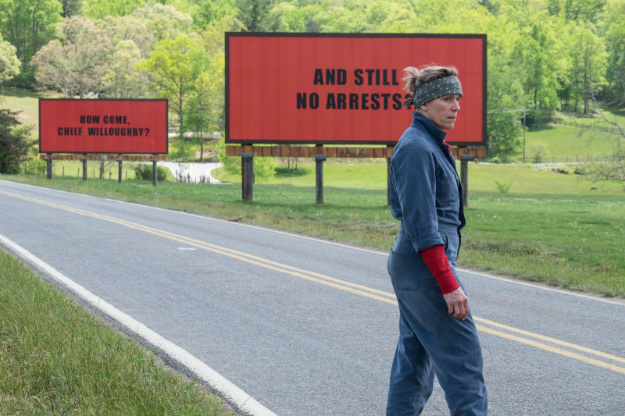
 If there’s only one person who could have played Mildred Hayes, it’s Frances McDormand. McDormand is enormous in the role of Mildred Hayes, a flawed but fierce protagonist who is so rock solid, but shattered underneath what she eventually reveals to be a pure façade. One of the greatest moments in McDormand’s turn is the moment when she battles to save her trio of billboards as they inexplicably go up in flames. The battle is futile, but to her it’s everything. “Three Billboards Outside Ebbing, Missouri” is a poetic, and occasionally darkly funny film about revenge, as well as the fallout and the ripple effect that reactionary anger to tragedy can have. Much of Mildred Hayes’ life since we met her has been spent with a lot of anger and fury, and she’s been kept awake by the nagging notion that she may never get resolution on one horrendous period of her life.
Category Archives: Movie Reviews

The Post (2017)
Steven Spielberg’s latest bad movie attempts to recapture the emotional drama surrounding the 1971 publication of the Pentagon Papers. One might imagine that the film would highlight the challenges and consequences faced by Daniel Ellsberg in ferrying the documents out of the realm of government classified restrictions, or the efforts of the New York Times in bringing these astonishing documents to the public. Instead, the crux of the film is curiously focused on the Washington Post, which was late to reporting the story but wound up picking up the publication of the Pentagon Papers’ contents after the Nixon White House threw temporary legal obstacles in the Times’ path.
Fast Convoy (Le Convoi) (2016)
 A convoy carrying drug to Spain hits a few issues on the road and must make due with what they can.
Written by Yann Brion and Frédéric Schoendoerffer and directed by the latter, Fast Convoy is a road movie and a drug movie while it also kinda feels like a heist movie in that these guys, in multiple cars, are basically trying to make it to a destination with illicit merchandize. The film is rather character-based with each character traveling with a co-pilot and taking orders from an unseen man. The story builds around them as they drive. While the title is a bit misleading, the film does have a few car-chase-ish scenes which have occasional nods to different car films and may or may not be influenced by the Luc Besson way of shooting cars on the road (low to the ground, front car pov). The car stuff is really one of the main appeals to this film and the scenes are well done and shot.
The Belko Experiment (2017)
 Like most of Greg McLean’s films, “The Belko Experiment” is just a big excuse to be as sadistic and inexplicably cruel as humanly possible, while taking pages from Koushun Takami’s “Battle Royale.” Coincidentally, another film in the same vein as “The Belko Experiment” came to theaters in 2017, in the form of Joe Lynch’s “Mayhem,” and while both films are insanely violent, at least the latter film had something to say about office culture and corporate politics. There’s a certain point in “The Belko Experiment” where it’s clear that McLean and writer James Gunn have no commentary on office culture and are by no means exploring the idea of fighting for a job through over the top violence, clearly just going for cruel unnecessary violence.
Eve of Destruction (1991) [Blu-Ray]
 Now Available from Shout! Factory
I’m all for the idea that every movie no matter how bad they may be, has some kind of value to them. I’m not saying that “Eve of Destruction” is a bad movie, I’m just wondering why it received a Blu-Ray release from Shout! when it’s a fairly unremarkable movie. It’s about as routine and stale as you’d imagine a movie made in the post-“Terminator” era could be, where every studio dealt us their own movie about a killing machine run amok with a big gun or massive weapon. Here we’re given a weird central plot about clones Gregory Hines who is about the least convincing military mercenary ever put to film.
The Shape of Water (2017)
 What “The Shape of Water” ultimately amounts to is Guillermo Del Toro’s own adoration for monster and romance cinema. Del Toro constantly evokes shades of “The Creature Walks Among Us,” and “Beauty and the Beast,” while also channeling Woody Allen’s “Purple Rose of Cairo.” Much like the latter, “The Shape of Water” depicts a somewhat whimsical romance in a world filled with misery and darkness at every corner. Del Toro has a lot to say about the ugliness of humanity and the ideas of what monsters truly are in this world and others.
Inoperable (2017)
 As a hurricane approaches, a woman wakes up in an evacuated hospital. As she tries to figure out what is going on, she discovers that she must escape to survive.