
 Jean-François Richet’s “Blood Father” is supposed to be considered Mel Gibson’s cinematic comeback as the action hero we all knew and love before… you know. “Blood Father” is one in the many growing titles of fifty something men displaying vigilante justice, and Gibson plays well to type. He’s that crusty fifty something man who often resembles Martin Riggs if Riggs became a convict, and attempted to spend his life redeeming himself or something. Gibson plays Link, an ex-convict working hard to live out the rest of his life as quietly as possible. But things don’t go as planned when his estranged daughter, who is involved with a vicious gangster, shows up at his door begging for shelter. But when her boyfriend is convinced she knows too much, he goes looking for her.
Tag Archives: Action
Con Air (1997)
 I would have loved to be there at the pitch meeting for “Con Air.” Take “Die Hard,” make the villain John Malkovich and make its two heroes once popular eighties stars, and you have yourself what is a tonally uneven but pretty solid action movie all around. Star Nicolas Cage does double duty camp as hero Cameron Poe, an army ranger who accidentally murders a man while attempting to defend his wife one night at a bar. For some reason this qualifies him to travel on a transport flight to a new prison alongside some of the worst criminals in the world (?). This includes rapists, cannibals, child molesters, and vicious serial killer Cyrus “The Virus” Grissom, as played by John Malkovich.
Face/Off (1997)
 America never did John Woo any favors, did it? The man who gave us “The Killer” and “Hard Boiled” now offers us a movie where American stars John Travolta and Nicolas Cage seem to be competing to see who is a worse actor. I guess when you’re working alongside Cage, though, you either have to be as awful as he is, or else risk causing some kind of black hole. Either way, for a man who has such a skill for delivering breakneck action films, “Face/Off” is that movie so moronic, you can’t even excuse it as science fiction. It’s kind of that movie you just accepted in 1997 mainly because Cage and Travolta joining forces was a little better than when Travolta met Christian Slater in “Broken Arrow.”
Rocky V (1990)
 You have to give it to Sylvester Stallone. The reason why Rocky is such a pop culture icon is because Stallone has always managed to keep him relevant. Rocky could have gone down with eighties icons like Max Headroom or Alf, but Stallone has kept his character socially relevant time and time again. The first film was about the underdog, the second about fame, the third about repeating history, the fourth about the cold war, and part five is where the series trips and falls on its face. “Rocky V” doesn’t have much of a point to make and doesn’t do much of anything with Rock Balboa at all. It seems to be like one of Stallone’s efforts to break Rocky out of the eighties cold war pigeon hole and make him blue collar and the underdog again. Instead rather than building a hopeful and raucously engaging sports drama, “Rocky V” is depressing right until the very end.
Rocky IV (1985)
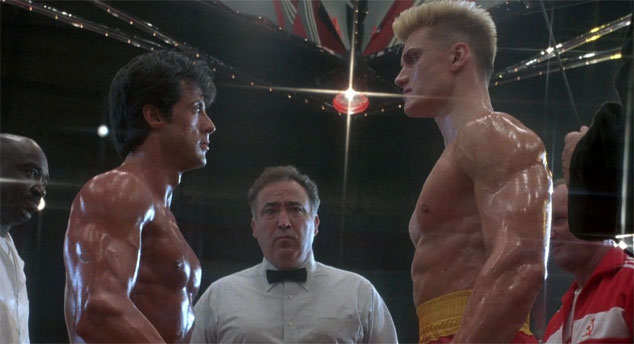
With Superman, Hulk Hogan, and Rocky Balboa, America pretty much beat the hell out of Communist Russia in the eighties, and we were proud of it. While “Rocky III” is the superior sequel in the original “Rocky” series, “Rocky IV” is perhaps the most talked about of the Rocky mythology and is also the most action packed. “Rocky IV” has a brisk pacing with almost no slow down in its storytelling and that brevity is probably why the sequel is still so beloved, despite its camp and homoerotic overtones. There really isn’t much to “Rocky IV” that’s tough to figure out. It has a robot that talks like a woman, features scenes of Rocky’s son trading one-liners with his friends while watching his dad’s fight, and a stern jingoistic attitude that it unapologetically waves around.
Rocky III (1982)
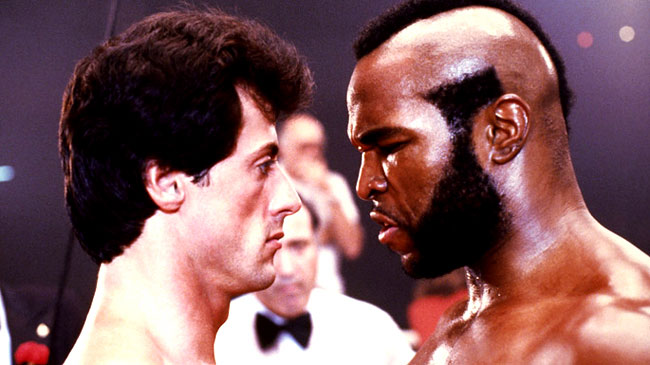
If there is any real successor to “Rocky” in the original series, it has to be “Rocky III.” While “Rocky II” was an interesting enough look at Rocky dealing with fame, “Rocky III” puts us right in to where we were in the original film that started it all. Now “Rocky” is a champion in his prime who has settled in to his wealth and luxury, and there’s a hungry new fighter named Clubber Lang out there who wants what he has, and is willing to whatever it takes to get it. For the first time ever, Rocky Balboa has a lot to lose, and he meets his match in Clubber Lang, a humongous and deadly boxer who wants to take on Rocky Balboa.
Rocky II (1979)
 At the end of the day, when Rocky Balboa learned to test his limit and prove to the world he is a contender, he is still Rocky Balboa, warts and all. What I enjoy most about “Rocky II” is that even though we didn’t need it, Director Stallone allows us a look in to how the fight with Apollo Creeds affects the man Rocky Balboa in the long run. In the end when he’s gone through the wringer and fought hard, where does Rocky go from there? Apollo is still the champion and is still wealthy, and Rocky is still living in his neighborhood, and is arguably a celebrity. What’s more is that Rocky is thrust in to worldwide fame, and he has to face that perhaps his fame will likely be short lived with an only fifteen minute window for him.