post

Sonic the Hedgehog: The Movie (OAV) (1999)

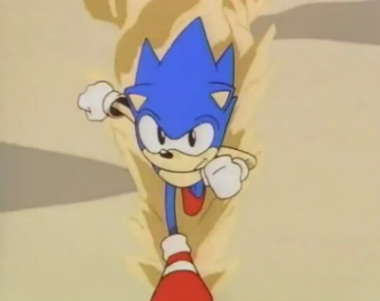
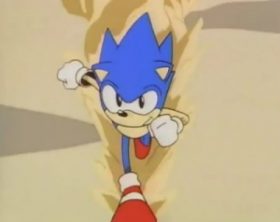
sonic-movie1999Shut up, Tails! Granted, I have always liked the “Sonic” movie from 1999 that finds him battling Metal Sonic, but Tails has to be the most grating animated sidekick of all time. True, he’s still a useful superhero, but in the end I hated this character. “Sonic The Hedgehog: The Movie” from 1999, originally made in 1996, is the anime continuation of the original animated series from the mid nineties. I speak of the very good animated adventure, not the crappy Looney Tunes knock off that aired almost at the same time. This time around Sonic is relaxing in his world alongside Tails, and finds out that Robotnik aka Eggman is back.

He’s kidnapped the president and his daughter, insisting Sonic and Tails must go to Eggmanland to stop his evil clone. Dark Robotnik is a robotic beast with massive wings who thinks like Robotnik, and Sonic has to travel to the city to stop the generator before it explodes. But things get tough as Sonic and Tails realize the city has a ton of hazards, and they’re hopelessly outnumbered. Plus, they don’t know that Robotnik has Hyper Metal Sonic, a robotic version of Sonic, waiting for him ready to be activated. Thankfully though, Sonic and Tails aren’t completely alone, as they gain the help of their rogue friend Knuckles.

Knuckles, once an anti-hero, is now an adventurous hero who takes it upon himself to make sure Sonic and Tails pull off their mission safely. “Sonic” is a short and sweet animated adventure with some darn good animation, and an excellent cyberpunk aesthetic that anime buffs and followers of the cyberpunk sub-genre will appreciate. Though, admittedly, the movie is slim on narrative, the director makes up for it with some killer action, and picturing Sonic, Tails, and Knuckles doing what they do best, and looking darn cool performing their signature moves we’ve seen in the classic games. This is a movie that still holds up; it was a lot of fun back in 1999, and it’s a good time today.

post

The Last Heist (2016)

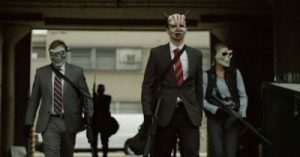
heist1As a bank is closing and its clients are emptying their security boxes, a few stragglers are left in the bank when a group of robbers attacks the bank looking for a very particular security box.  Meanwhile, unbeknownst to them all, one of the clients starts picking the group off one by one.

The Last Heist was written by Guy Stevenson whose previous credits are mostly comedies and cartoons making this thriller a departure from his usual work.  The writing here is decent and fairly by the book for this type of movie, however, it feels like two different stories (bank robbery and serial killer) put together which makes it harder to keep everything going on working well.  That being said, the proceedings are fairly entertaining even though the killer’s presence is given away quickly, soon followed up by their identity.  It must be noted that the dialogue is good and feels realistic for most of the characters.

This script was directed by Mike Mendez whose style gets a bit lost here as he excels at bloody, crazy goodness which this movie has plenty of but yet still does not feel like a Mendez movie.  Here he gathers all the elements in one mostly cohesive story with plenty blood (practical effects and unfortunately CGI) and a big group of actors of variable talent levels.  The pace of the film is good, giving each group of characters their time of screen, helping bring all the elements that could have become two films together while giving them the time they need to develop.

The cast is big and varied, with only a few ladies but they do get some screen time and are not just there to be cute or to be rescued.  Of course, with a cast this big, standouts will happen for good and bad reasons.  The main standout here is Henry Rollins who always has a strong presence on screen.  Here is a good but not the best he’s been.  He seems to give a variation of his character in He Never Died with extra touches of crazy added for good measure.

The other two stand-outs are so for much different reasons.  Torrance Coombs as Paul, the lead robber, shows talent and leadership while also showing some restraint when needed.  On the opposite side of this is Kristina Klebe who usually gives strong performances but here, her character comes off as grating as she tries to look extra tough, like a badass bitch but just ends up coming off like she is trying too hard.  Sadly, a lot of the rest of the cast feels under used, such as Nick Principe who would have been more interesting in a part with a bit more meat on its bones and not just as the hired muscle when those who have seen his work know he can do more than this.

Supporting these are the effects which are uneven in quality.  CGI blood is almost never good and visibly fake, unless a scene is very darkly lit or the blood is very scarce.  The blood here is no different, which can be an annoyance.  The practical effects on the other hand look very good and properly gooey.  Also, the eyes in jars do look a bit funny, but disembodied eyes usually do.

The film has its issues but is an easy watch and fairly entertaining.  It creates a cat and mouse story within a heist story with hostages that are not so helpless.  Some of it, like the ending, becomes a bit much, but Rollins and Coombs presences along with an interesting story with plenty twists and a good pace make it worth checking out.

post

Steel (1997)

Steel1997

If you ever sat down and wondered “Why did it take so long for an Iron Man movie to hit theaters?” then you’d be wise to sit down and watch “Steel.” Not only did studios not invest in loyal adaptations of superheroes in the nineties, but the concept of a man in a metal suit fighting crime was impossible to put on screen. Especially if you have a studio unwilling to invest in committing to the concept and making it feel somewhat realistic with CGI. Steel was originally birthed as a Superman clone with a concept very similar to Iron Man. John Henry Irons was a weapons developer betrayed by his organization.

When Superman died, he took his weapons of mass destruction and used them to build a steel suit to help keep law and order in Metropolis. When Superman came back from the dead to take back his mantle, Steel became his own superhero with dignity and some sense of stature, but was always something of a fourth rate Iron Man clone. Obviously Warner took the concept and premise for this somewhat notable superhero and turned it in to a clunky and campy superhero adventure with zero stakes. Suddenly everything Jon Bogdanove, and Louise Simonson worked toward in making “Steel” somewhat of a hero in his own right was undone by this ridiculous movie. Here, there are only three vague references to Superman, while Shaquille plays an unconvincing military officer who is also developing weapons for combat. Judd

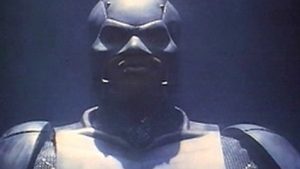
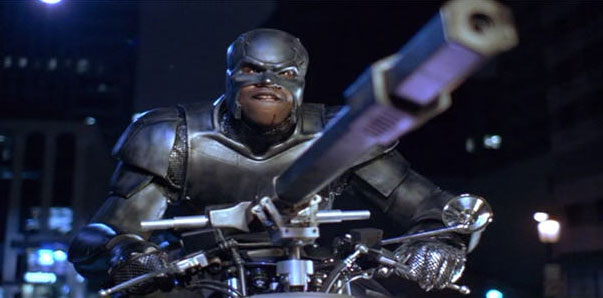
Nelson plays villain Nathaniel Burke whose lust for violence destroys their experiment causing John Henry Irons to be discharged from the military while Annabeth Gish as friend Sparky, is rendered a paraplegic. When John returns home, he learns his weapons are being streamlined for gang combat, and Nathaniel is behind it, making a deal with an arcade game exec to distribute and sell his high tech weapons. And he’s really evil, because they’re recruiting teenagers to test their weapons, booga, booga! “Steel” is a marvel of superhero cinema, mainly because it’s so painful watching Shaquille O’Neal stomping around in a heavy steel suit that looks so ill fitted to his form it gets gradually more embarrassing as the film unfolds. Why even bothering to adapt Steel is mind boggling, but adapting him in to this kids film makes the investment so much more horrendous.

The initial revelation of Shaq’s character John as Steel is supposed to be awe inspiring and cool, but Shaq looks so goofy in costume. It’s bad enough the suit looks heavy and clunky, Shaq can barely run around in it, but the helmet he wears makes him look awfully cross eyed. I’m willing to suspend my disbelief at a man running around in a clunky metal costume, but the police in the movie are so inept, they can barely keep up with the man moving as slow as molasses. Plus, it wouldn’t be too hard to find Steel’s alter ego. Just look for the only man in the city who is seven feet tall. From there, “Steel” is reliant on a heavy formula of repetition and camp that’s more obnoxious than cute.

To make the cruel experience more endurable here’s a good drinking game for you: Take two shots every time Shaq makes a basketball reference. Take a shot every time Shaq mumbles through a line. Take a shot every time Shaq rips something apart or breaks someone’s property. Take two shots every time Judd Nelson flares his nostrils. Your liver will be shot by the time the movie comes to a merciful close. Thankfully, “Steel” didn’t complete destroy the comic book movie, as it took “Blade” only a year later to prove comic book movies could be a bankable property worthy of an audience and franchise. The media usually credits “X-Men” but really, it started with “Blade.”

post

Finding Dory (2016)

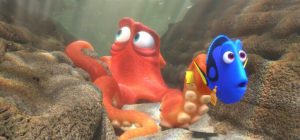
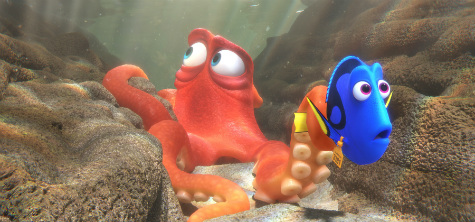
findingdoryI, like many other people, were wondering why there even needed to be a sequel to “Finding Nemo” that focused on Dory. Granted, Dory was a charming supporting character, and Ellen DeGeneres was great, but Dory always seemed like a character you could quickly get bored with. Surprisingly, director Andrew Stanton not only proves that Dory is worth focusing an entire film on, but that her story deserved to be told just as much as Marlin and Nemo’s did. Stanton and co. follow a very non–linear storyline for the sequel; “Finding Dory” goes back in time to follow the blue Tang we know as Dory, then cuts off as she meets Marlin, and begins a year later where she’s now living with Marlin and Nemo and acting as Nemo’s surrogate guardian alongside Marlin.

Dory, much like Nemo, was born with just as much of a disadvantage. While “Finding Nemo” conveyed the trials, tribulations, and worries of raising a child with a physical disability, “Finding Dory” uses Dory’s short term memory loss as a metaphor for the trials, tribulations, and worries that come with raising a child with a mental illness or mental disability. Raising Dory isn’t so much a burden for her parents Jenny and Charlie, as they approach her lack of memory with as much patience and consideration as possible. They’re well meaning and lovely parents that do everything in their power to help Dory channel her disability in to an advantage all while turning it in to a fun game.

But they can only do so much, since they don’t really seem to accept that Dory’s condition is permanent and may be a part of who she is for the rest of her life. Plus, as she ages, the world is looking more and more appealing to her, so it soon becomes a race for her parents to make her handicapable before their worst fears of the ocean swallowing her up come to fruition. Sadly, Dory does get lost, and her short term memory becomes a constant pitfall in her efforts to reunite with her parents. Before long, she’s forgotten that she’s even lost, and years have passed on. Thus she meets her fate with Marlin and Nemo, which gives her a newfound perspective and the confidence that she can find her parents once again. “Finding Dory” opens up the world we saw in “Finding Nemo” by adding a new slew of fun and lovable characters.

I especially loved Hank the Septopus, Destiny a near sighted Whale Shark, and a pair of Walrus’ comically protective of their perching rock. “Finding Dory” isn’t just a callback to the original film, but the narrative literally centers on Dory trying to find her memories and her family which ultimately represents herself. DeGeneres is even better here than in the first film as Dory, as she injects a lot of complexity and true emotions in the character and her journey to find her family which she is convinced will help improve her memory in the long run. “Finding Dory” is fantastic as director Andrew Stanton and co. give Dory brand new obstacles and dimensions, and comprise a funny, exciting, and incredibly heartbreaking tale of overcoming a handicap and leaning on family when the world is at its darkest.

post

Zootopia (2016) [Blu-Ray/DVD/Digital]

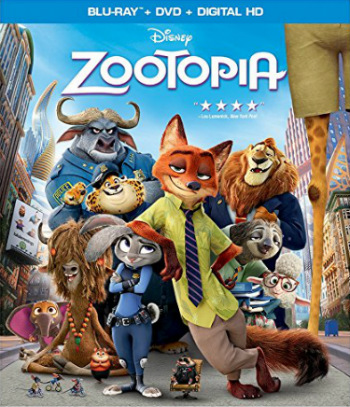
zootopia-dvdDisney’s newest “Zootopia” is a very heavy and complex movie that can be appreciated by a broader audience. Sure, it has a lot of ideas about heroism, courage, and features a slew of really charming cute animals, but it’s also a tale about prejudice and stereotypes. It’s an inverted exploration of biases and conclusions we draw with others that can be dissected and analyzed by virtually anyone. I don’t think “Zootopia” is about a specific issue in the modern social and political climate, but it does hold an interesting function in helping us to take a second look at racism and the ideas of stereotyping a specific sub-set of individuals and how damaging it can be to us as a society and personally.

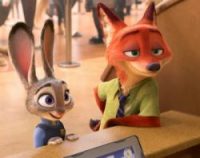
Ginnifer Goodwin is fantastic as Judy Hopps, a rabbit who has been told all of her life that she’s incapable of being anything but a farmer. When she beats all the odds and tries for her role as a police officer, she eventually proves everyone wrong and ends up earning a job as an officer in Zootopia. Zootopia is a series of small communities and cities made up animals, most of which are prey. The predators are reserved for more side roles in the society that are influential but not totally intimidating. Judy is underestimated mainly for her size and gender, and is sadly relegated to being a Meter Maid.

After stopping a theft from a local flower shop, she begs her commander Chief Bogo (Idris Elba) for a chance, and volunteers to find a missing Otter. With only forty eight hours given by Bogo, Judy begins cracking the case and blackmails local con artist, Nick Wilde, a sly Fox who may be able to help her. With their uneasy pact, Hopps learns about a grander scheme involving other missing animals, and the unnerving idea that local predators may begin hunting prey and ruining the harmony of Zootopia. Goodwin is charming and fun as heroine Hopps, who manages to disprove a lot of assumptions about her from her department and fox Nick Wilde, who sees her as literally nothing more than a dumb bunny who’s bitten off more than she can chew.

With courage and old fashioned determination, Hoops paves her way in to the annals of Disney heroines with ease. The voice work is fantastic with folks like Idris Elba and JK Simmons lending their voice talents, while Jason Bateman is a wonderful foil to Hopps. With his calm and smug deliver, Bateman turns Wilde in to a complex anti-hero, who garners his own ideas about stereotypes and the often inescapable pigeonholes society can put us in to. Wile just accepts his fate as a lower class predator, while Hopps is eager to prove she’s so much more than prey destined to reproduce and farm. Like the former Disney smash “Frozen,” the writers take its audience seriously and offer complex and very adult overtones that will allow them to give second and third thoughts about what “Zootopia” is trying to convey.

Along the way there are some genuinely funny moments, including the visit to the DMV run by Sloths, the fun jabs at previous Disney films, and shockingly compelling dynamic between Nick and Judy. “Zootopia” is another stellar Disney film that begs for a second look thanks to its evocative overtones and commentary.

The Disney release of “Zootopia” comes with a DVD and Digital Copy alongside the Blu-Ray. Among the features, there’s “Research: A True-Life Adventure,” a ten minute look at how the filmmakers dropped themselves in to the animal kingdom to research wildlife and bring them to life for the film. “The Origin of an Animal Tale” is a nine minute look at filmmakers discussing ideas for the movie during development, along with inspirations, themes, and whatnot.

“Zoology: The Roundtable” is a three part feature clocking in at almost a half hour, covering various facets of the film. There’s “Characters” about the film’s primary characters, “Environments” about the bigger and more minute details that comprise the film, and “Animation” revolving around the film’s fantastic animated sequences. “Scoretopia” is a look at the film’s fun score, “Z.P.D. Forensic Files” is a three minute look a the Disney East Eggs throughout the movie. There’s a music video by Shakira, a look at the characters removed from the final film, and a slew of deleted scenes and an alternate opening with an optional commentary by Byron Howard and Rich Moore.

Teenage Mutant Ninja Turtles II: The Secret of the Ooze (1991)

TMNT-III know that this is grounds for getting my “90’s Kid” membership card stripped from my hands, but the more I see “TMNT II,” the more I dislike it. Yes, it has camp value thanks to Vanilla Ice, but nostalgia lens aside, it’s a pretty crummy follow up to the 1990 movie. It’s basically the “Batman Forever” of the original TMNT movie series, a movie that waters down the formula of the Ninja Turtles. Hell, even like “Batman Forever,” the turtles are no longer urban legends working in the shadows, and become virtual celebrities by the climax. Much to the shock of everyone involved, 1990’s “TMNT” movie was a film for all ages that took violence seriously, and depicted actual consequences to actions and decisions.

Continue reading

post

Teenage Mutant Ninja Turtles: Out of the Shadows (2016)

TMNToutoftheshadowsWhile 2014’s “Teenage Mutant Ninja Turtles” was a watered down remake of the 1990 Jim Henson production, “Out of the Shadows” is a larger and sillier remake of “Secret of the Ooze” taking a lot of the ideas from the aforementioned film and realizing them to a more “TMNT” accurate vision. “Secret of the Ooze” had all the implications of the Krang, Baxter Stockman and the like, but “Out of the Shadows” takes that and re-introduces it to make about as much sense as it can. Rather than Tokka and Rahzar, we finally have Bebop and Rocksteady in their full disgusting glory, battling the Ninja Turtles, and playing stooges to the Shredder. “Out of the Shadows” isn’t a masterpiece by any means, but it’s ten times better than its 2014 predecessor.

That might be because it comes up with a radical new idea and focuses the majority of the sequel on the titular Ninja Turtles. April O’Neil is still a major character but is pushed to the sidelines more and more, allowing the characters we came to see a bigger spotlight and more of a chance to grow and blossom. The Platinum Dumbs version of the turtles is still wildly imperfect and stupid, but “Out of the Shadows” is at least fun, and tries to give us as many elements from the canon as possible. After Shredder’s plans from the first film are thwarted, he’s taken to jail and sent to a maximum security prison, supervised by Officer Casey Jones. When Shredder is broken free by his foot clan, he brings along thugs Bebop and Rocksteady to set off a plan to take over the world alongside a new alien ally.

Armed with mad scientist Baxter Stockman, Shredder plans to build a mutant army, and use his alien allies to help him rule. When the Turtles, with the help of April, learn of the mutagen, they learn the ooze has potential to turn them in to humans. With the turtles still pariahs of the city, Raphael is tempted to become human, while Leonardo tries to convince them to stay true to themselves. This time around there’s a larger focus on the dynamics of the brothers, as Leo and Raph bicker and fight for command over this current development, while Michelangelo is no longer making erection jokes, and is now the party dude we know and love, making cracks, fawning over pizza, and approaching every challenge with a chuckle worthy of Spiccoli. Stephen Amell is also a fun addition to the cast, providing a charismatic take on Casey Jones.

“Out of the Shadows” is a really good time and about as close to great as can be expected from something starring Megan Fox. I wish she’d drop out and allow an actress with actual ability and chemistry with her co-stars to take the reins as April. “Out of the Shadows” also has no idea how to handle so many elements of the narrative as there’s so much going on for a hundred minute movie. A lot of conflicts are tacked on, sub-plots go nowhere, and Splinter being retconned to have no connection to Shredder makes him a virtually pointless addition to the team. He literally does nothing but meditates in the background and offer convenient pearls of wisdom to his sons, with no actual emotional investment in their battle. You could have cut Splinter out of this movie, and it would have had no effect on the overall production.

Meanwhile there is the gaping wide hole of the new mutagen presented from Dimension X and the Krang. If the mutagen turns Bebop and Rocksteady from humans to animals, why can the mutagen possibly turn the turtles in to humans? They weren’t humans before they became teenage turtles. The implication of being mutants is that they’re anthropomorphic and human like, so wouldn’t they revert back to normal everyday turtles if given the mutagen? Also, I’m not a science wiz, but since when do the turtles have human DNA in them? Wouldn’t becoming human being a mutation be very redundant to the narrative? That said, if you can forgive the canyon wide plot hole, “Out of the Shadows” is an entertaining diversion that improves on a lot of the glaring flaws from the 2014 reboot.